
Navigating the Legality of Urban Foraging in the Sooner State
Dumpster diving, often referred to as urban foraging or salvaging, is a practice that sparks considerable debate. For many, it represents a sustainable way to acquire goods, reduce waste, and even supplement income. For others, it conjures images of trespassing and unsanitary conditions. In Oklahoma, like many other states, the legality of dumpster diving is not a simple yes or no answer. It’s a nuanced issue influenced by federal, state, and local regulations, as well as the specific circumstances surrounding each instance of salvaging. Understanding these complexities is crucial for anyone considering engaging in this activity within the Sooner State.
Federal Preemption and the Supreme Court’s Influence
The cornerstone of understanding dumpster diving legality in the United States lies in a pivotal Supreme Court case: California v. Greenwood (1988). In this landmark decision, the Supreme Court ruled that the Fourth Amendment, which protects against unreasonable searches and seizures, does not apply to garbage left for collection in a publicly accessible area. The reasoning was that individuals have no reasonable expectation of privacy in the contents of their trash once it has been placed on the curb or in a common area designated for pickup.
This ruling effectively means that law enforcement cannot conduct warrantless searches of your trash if it’s accessible to the public. However, it’s vital to recognize that this decision pertains to the search of discarded items, not necessarily the act of retrieving them. The implications for dumpster diving are that if trash is left in a place where anyone can access it, federal law doesn’t prohibit its examination. This forms the bedrock upon which state and local laws are built. In Oklahoma, this federal precedent is generally respected, but its interpretation and the subsequent overlay of state and local ordinances create the practical landscape for dumpster divers.
State Laws and Property Rights in Oklahoma
While the Greenwood decision established a federal standard for privacy concerning discarded items, Oklahoma retains the authority to enact its own laws regarding property rights and trespassing. The core legal concern for dumpster divers in Oklahoma often boils down to whether they are trespassing on private property to access the dumpsters.
Most dumpsters are located on private property, such as behind businesses, apartment complexes, or private residences. Accessing these dumpsters without permission can be considered trespassing, which is a criminal offense in Oklahoma. State statutes define trespassing as entering or remaining unlawfully on the premises of another. The key word here is “unlawfully.” Even if the dumpster’s contents are legally considered abandoned by federal standards, the act of reaching them might involve an unlawful entry onto private land.

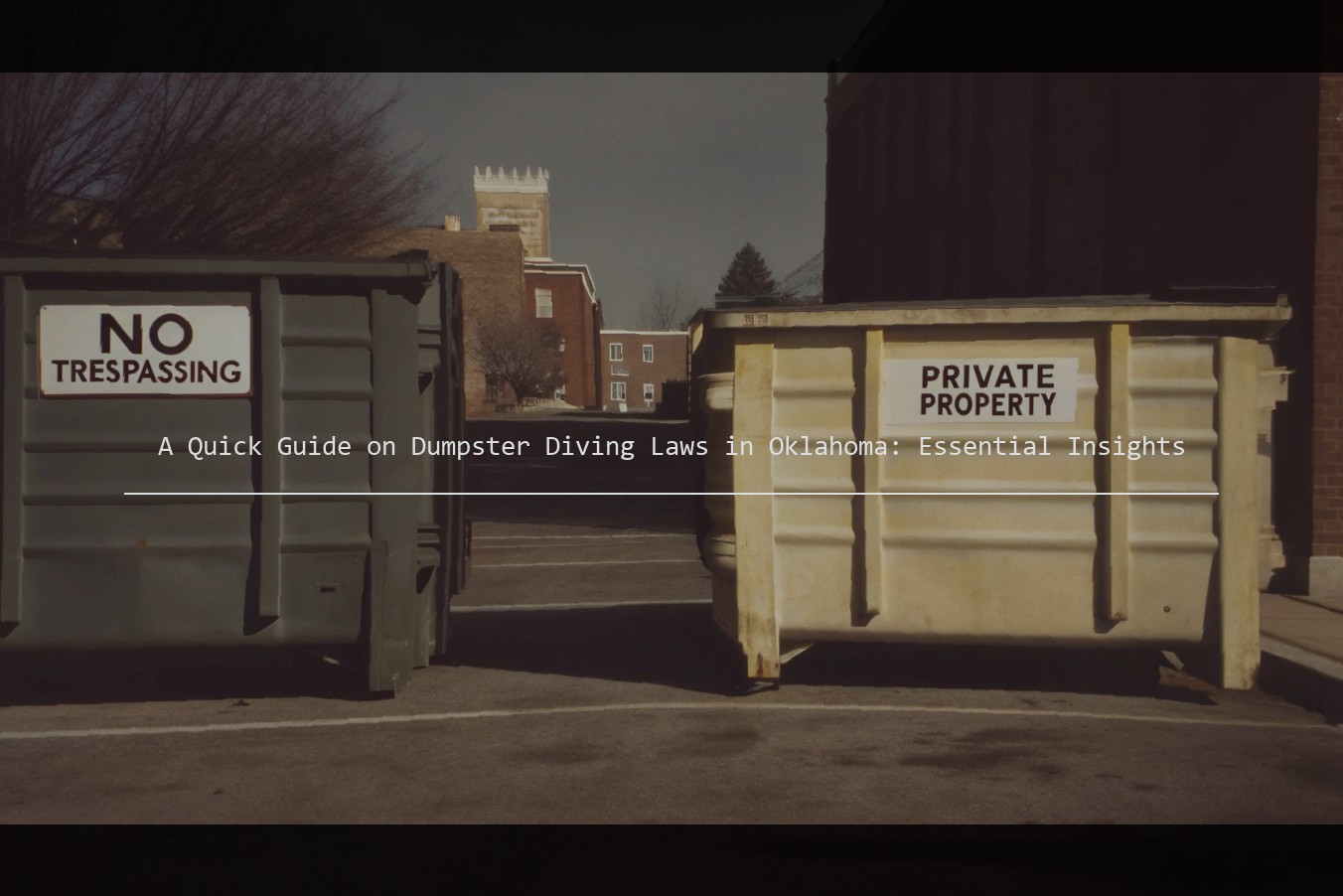
Many businesses in Oklahoma clearly post “No Trespassing” signs or have fences and gates to restrict access to their property, including the areas where dumpsters are located. Ignoring these signs or circumventing barriers can lead to citations for trespassing. The severity of the charge can vary depending on the specific circumstances, intent, and whether damage to property occurred. For dumpster divers, this means that even if the trash itself is fair game according to federal law, the path to that trash might be legally prohibited.
Local Ordinances and Business Policies
Beyond state laws, individual municipalities in Oklahoma may have their own ordinances that further regulate or prohibit dumpster diving. City councils can enact laws related to public health, sanitation, and the prevention of nuismeny. These local rules can sometimes be more restrictive than state laws.
For instance, a city might pass an ordinance that prohibits individuals from disturbing or rummaging through any refuse container on public or private property, citing concerns about public health, safety, or the aesthetic appearance of the city. Such ordinances would directly impact the practice of dumpster diving, regardless of the federal privacy ruling.
Furthermore, many businesses in Oklahoma, and indeed across the nation, have policies that explicitly forbid scavenging from their dumpsters. These policies are often communicated through signage or through their contracts with waste disposal companies. While a business policy is not a criminal law, violating it can lead to being banned from the premises, or in some cases, the business may choose to involve law enforcement by reporting trespassing.
It is crucial for individuals interested in dumpster diving in Oklahoma to research the specific ordinances of the city or town they are in. This can often be done by contacting the local city clerk’s office or by reviewing municipal code online. Understanding these local regulations is as important as understanding state trespassing laws and federal privacy rulings.
Best Practices and Avoiding Legal Pitfalls
For those who choose to engage in dumpster diving in Oklahoma, adopting a set of best practices is essential to minimize legal risks and ensure responsible conduct.
- Respect Private Property: Always be mindful of where dumpsters are located. Avoid dumpsters that are clearly on private property with restricted access, such as behind locked gates, in fenced areas, or with prominent “No Trespassing” signs. Prioritize dumpsters in easily accessible, public-facing areas if available.
- Check Local Ordinances: Before diving in any particular Oklahoma city or town, research its specific municipal codes regarding waste disposal and scavenging. What might be tolerated in one town could be strictly prohibited in another.
- Observe Signage: Pay close attention to any signs posted by businesses or property owners. These signs often indicate their stance on scavenging.
- Avoid Disturbing the Peace: Be discreet and avoid making excessive noise or creating a mess. Causing a disturbance can attract unwanted attention from law enforcement or property owners, even if the act of salvaging itself isn’t explicitly illegal under all circumstances.
- Be Mindful of Health and Safety: While not strictly a legal issue, maintaining personal safety and hygiene is paramount. Wear protective gear, handle items with care, and be aware of potential hazards within dumpsters.
- Understand Business Policies: Even if not explicitly illegal, a business can ask you to leave their property. Repeatedly ignoring such requests can lead to being banned or facing trespassing charges.
- Consider “Permission”: In some cases, if you develop a relationship with a business owner or manager, you might be able to obtain explicit permission to salvage from their dumpsters. This can significantly reduce legal risks.
- Know What You’re Taking: While the Greenwood decision deals with privacy, laws against theft still apply. If you are taking items that are clearly marked as for sale, or if there’s any ambiguity about whether they are truly abandoned, you could face charges of theft.
By adhering to these guidelines, dumpster divers in Oklahoma can significantly reduce their chances of encountering legal trouble. The practice exists in a grey area, heavily influenced by property rights and local regulations, making awareness and caution the most valuable tools for any urban forager.
LifeOutOfTheBox is a participant in the Amazon Services LLC Associates Program, an affiliate advertising program designed to provide a means for sites to earn advertising fees by advertising and linking to Amazon.com. Amazon, the Amazon logo, AmazonSupply, and the AmazonSupply logo are trademarks of Amazon.com, Inc. or its affiliates. As an Amazon Associate we earn affiliate commissions from qualifying purchases.