
The question of distance between two prominent Californian cities, Fresno and San Francisco, is a common one for travelers, residents, and anyone planning a journey through the Golden State. While both are significant hubs in California, they are separated by a considerable stretch of land, offering distinct experiences and requiring careful consideration for travel planning. Understanding this distance is the first step in crafting a memorable trip, whether you’re heading to the bustling metropolis of the Bay Area or the agricultural heartland of the Central Valley.
Understanding the Geographical Divide
The distance between Fresno and San Francisco is not a simple, fixed number but rather a measure that varies depending on the mode of transport and the specific route taken. Primarily, the distance is discussed in terms of road mileage, which is the most common way individuals traverse between the two cities. This drive offers a glimpse into the diverse landscapes of California, transitioning from the flat, fertile plains of the Central Valley to the rolling hills and eventual urban sprawl as one approaches the San Francisco Bay Area.
Driving Distance and Time
The typical driving distance between Fresno and San Francisco is approximately 170 to 180 miles, depending on the exact starting and ending points within each city and the chosen highway. The most direct and commonly used route is via California State Route 99 (SR 99) northbound, merging onto Interstate 5 (I-5) and then transitioning to highways that lead into San Francisco, such as U.S. Route 101 (US 101) or Interstate 80 (I-80) across the San Francisco-Oakland Bay Bridge.
The driving time can fluctuate significantly due to traffic conditions, especially as one approaches San Francisco and traverses its notoriously congested roadways. Under ideal conditions, with minimal traffic and adhering to speed limits, the journey can take between 3 to 3.5 hours. However, it is not uncommon for this trip to extend to 4, 5, or even more hours during peak commute times, holidays, or days with significant events in the Bay Area. Travelers are advised to consult real-time traffic applications before and during their journey to estimate accurate travel times.
Route Variations
While the SR 99 to I-5 route is standard, alternative routes exist, though they often add to the travel time. One might consider taking State Route 152 (SR 152) west from Fresno towards Gilroy, and then heading north on US 101. This route can be more scenic, passing through agricultural lands and smaller towns, but it is generally longer and can also experience congestion. The choice of route often depends on individual preferences for scenery, traffic tolerance, and the desired arrival time.
Distance by Air
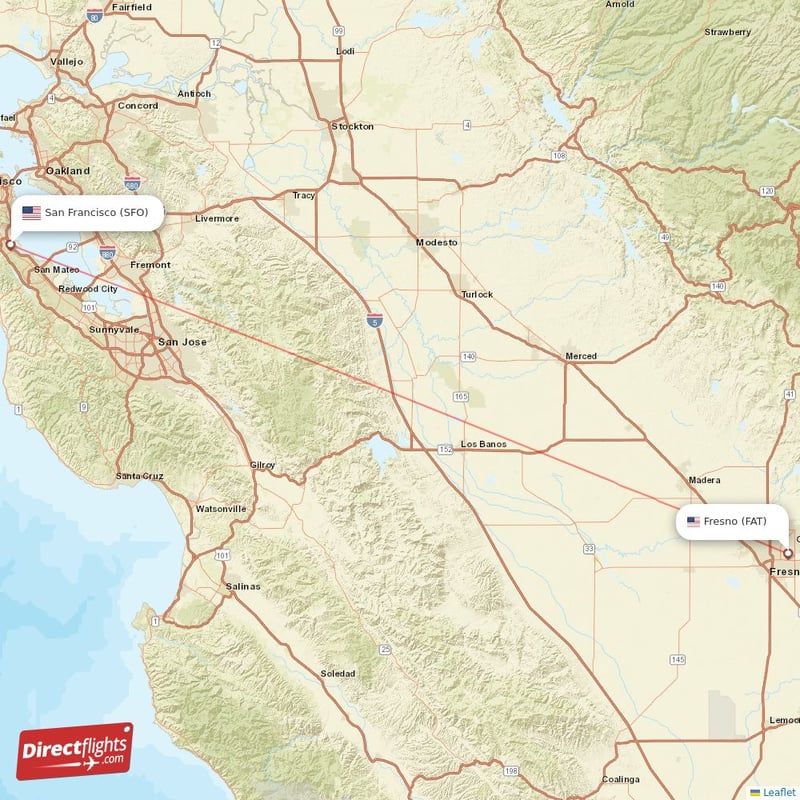
For those seeking to minimize travel time, air travel offers a significantly faster alternative. Fresno Yosemite International Airport (FAT) serves Fresno, and San Francisco International Airport (SFO), Oakland International Airport (OAK), and San Jose International Airport (SJC) serve the Bay Area. Direct flights between FAT and SFO or OAK are available, with flight durations typically around 1 hour.
However, it is crucial to factor in the total travel time associated with air travel. This includes travel to and from airports, check-in procedures, security screenings, boarding, and baggage claim. When these elements are considered, the total door-to-door travel time for flying might not be drastically shorter than driving, especially for those residing or traveling to areas close to Fresno and the Bay Area terminals. Nevertheless, for longer journeys or when time is of the essence, flying remains a practical option.
Alternative Travel: Bus and Train
Public transportation options also connect Fresno and San Francisco, providing alternatives for travelers who prefer not to drive or fly. Bus services, such as those offered by Greyhound or FlixBus, operate regular routes between the two cities. These journeys typically take longer than driving, often ranging from 4 to 6 hours, depending on the number of stops and layovers. They can be a cost-effective option for budget-conscious travelers.
The Amtrak train service also connects the two regions, though it typically involves a transfer. Passengers might take an Amtrak San Joaquins train from Fresno to a station in the Bay Area, such as Emeryville, and then utilize connecting bus services or other transit options into San Francisco. Train travel can offer a more relaxed journey with the opportunity to enjoy the passing scenery, although the total travel time often exceeds that of driving.
Planning Your Journey: Considerations and Tips
The decision of how to travel from Fresno to San Francisco hinges on a variety of factors, including budget, time constraints, personal preferences, and the purpose of the trip. Each mode of transportation presents its own set of advantages and disadvantages, and understanding these will help in making an informed choice.
Choosing the Right Mode of Transport
For travelers who value flexibility and the ability to make spontaneous stops, driving is often the preferred method. It allows for exploration of towns and attractions along the way, such as the charming city of Visalia or the agricultural landscapes of the San Joaquin Valley. Renting a car is also an option for those who do not own a vehicle. However, the cost of fuel, potential wear and tear on a personal vehicle, and the stress of navigating San Francisco traffic and parking should be factored into the decision.
Air travel is ideal for those whose primary concern is speed. If the cost of flights and associated airport transfers is within budget, it offers the most efficient way to cover the distance. Booking flights in advance, especially during peak travel seasons, can often lead to better fares.
Public transportation, whether by bus or train, appeals to those seeking economical travel or an opportunity to relax during the journey. It removes the burden of driving and parking in San Francisco, a significant consideration given the city’s notoriously challenging parking situation and high fees.
Navigating San Francisco Upon Arrival
Once you arrive in the San Francisco Bay Area, whether by car, plane, bus, or train, further navigation within the city will be necessary. San Francisco boasts an extensive public transportation system, including buses, streetcars, and the iconic cable cars. Utilizing these services can be a convenient and environmentally friendly way to explore the city’s many attractions, from Fisherman’s Wharf to Golden Gate Park.
For those who drove, it is advisable to research parking options in advance, as many hotels and popular destinations have limited and expensive parking. Ride-sharing services like Uber and Lyft are widely available and can be a practical alternative to driving and parking within the city.

The Experience of the Journey
The journey between Fresno and San Francisco is more than just a measure of miles; it’s an experience that encapsulates the diverse geography and lifestyle of California. Driving north from Fresno, one witnesses the vast agricultural fields that define the Central Valley, a testament to the region’s agricultural prowess. As the landscape begins to change, with rolling hills and oak trees appearing, you are entering the transitional zone towards the more Mediterranean climate and topography of the coast.
The arrival in the San Francisco Bay Area marks a shift from wide-open spaces to a densely populated and dynamic urban environment. The iconic sights and sounds of San Francisco – the fog rolling in over the Golden Gate Bridge, the bustling piers, the Victorian architecture – all contribute to the allure of this world-renowned city. Understanding the distance is simply the starting point; the true essence of the trip lies in the experiences that unfold along the way and at the destination.
LifeOutOfTheBox is a participant in the Amazon Services LLC Associates Program, an affiliate advertising program designed to provide a means for sites to earn advertising fees by advertising and linking to Amazon.com. Amazon, the Amazon logo, AmazonSupply, and the AmazonSupply logo are trademarks of Amazon.com, Inc. or its affiliates. As an Amazon Associate we earn affiliate commissions from qualifying purchases.