
The allure of the aurora borealis, the celestial dance of the Northern Lights, typically conjures images of icy tundras and frigid northern skies. Destinations like Iceland, Norway, or Canada are often the first to spring to mind for aurora chasers. However, the possibility of witnessing this breathtaking phenomenon much closer to home, even in the warmth of a Texas night, sparks an intriguing question. While not a common occurrence, the answer is a nuanced “yes,” dependent on a confluence of rare celestial events and optimal viewing conditions. Understanding the science behind the aurora and the specific factors that might allow it to grace the Texas sky is key to appreciating the potential, however slim, for this unforgettable experience.

Understanding the Aurora Borealis
The aurora borealis, and its southern counterpart, the aurora australis, are natural light displays in the sky, predominantly seen in high-latitude regions. They are caused by charged particles from the sun, known as the solar wind, colliding with atoms in the Earth’s upper atmosphere.
The Sun’s Role
The sun is a constantly active star, releasing a stream of charged particles into space. This stream is called the solar wind. The intensity of the solar wind varies. When the sun is particularly active, for example, during a solar flare or a coronal mass ejection (CME), it releases a much larger and more energetic burst of these charged particles. These events can significantly increase the likelihood of aurora sightings at lower latitudes.
Earth’s Magnetic Field
Earth possesses a magnetic field that acts as a shield, deflecting most of the solar wind. However, this magnetic field is weaker at the poles. When charged particles from the solar wind reach Earth, they are guided by the magnetic field lines towards the polar regions. It is here, in the ionosphere, that these particles collide with atmospheric gases such as oxygen and nitrogen, exciting them and causing them to emit light in vibrant colors – predominantly green, but also red, pink, blue, and violet.
Geomagnetic Storms and Aurora Visibility
The key factor in seeing the aurora at lower latitudes like Texas is a strong geomagnetic storm. These storms occur when the solar wind is particularly dense and energetic, overwhelming Earth’s magnetic field and causing it to become distorted. During a severe geomagnetic storm, the aurora can extend much further south than its usual auroral oval. This means that even a state as far south as Texas could, under the right circumstances, experience a visible aurora.
Factors Favoring Aurora Visibility in Texas
While the general principles of aurora formation apply globally, specific conditions must align for the Northern Lights to be observable in Texas. These include the strength of the solar activity, the direction of the solar wind, and the absence of light pollution.
Solar Activity Levels
The most crucial determinant is the intensity of solar activity. The aurora is categorized by the Kp-index, a measure of geomagnetic activity. A Kp-index of 5 or higher is considered a geomagnetic storm, and the higher the Kp-index, the further south the aurora can be seen. For Texas to witness the aurora, a Kp-index of 7 or even 8 might be necessary. Such high levels of geomagnetic activity are relatively rare, typically occurring during periods of heightened solar activity, such as around solar maximum in the 11-year solar cycle.
Timing and Direction of Solar Events
Not all solar events are equal. A CME that is directed towards Earth is far more likely to cause a significant geomagnetic storm than one that is moving away from our planet. Even if there is a powerful solar flare, if the associated plasma cloud is not aimed directly at Earth, its impact will be minimal. Therefore, aurora watchers in Texas must not only monitor solar activity but also the trajectory of these solar events.
Observing Conditions
Even with a powerful aurora overhead, visibility in Texas can be hampered by local factors.
Light Pollution
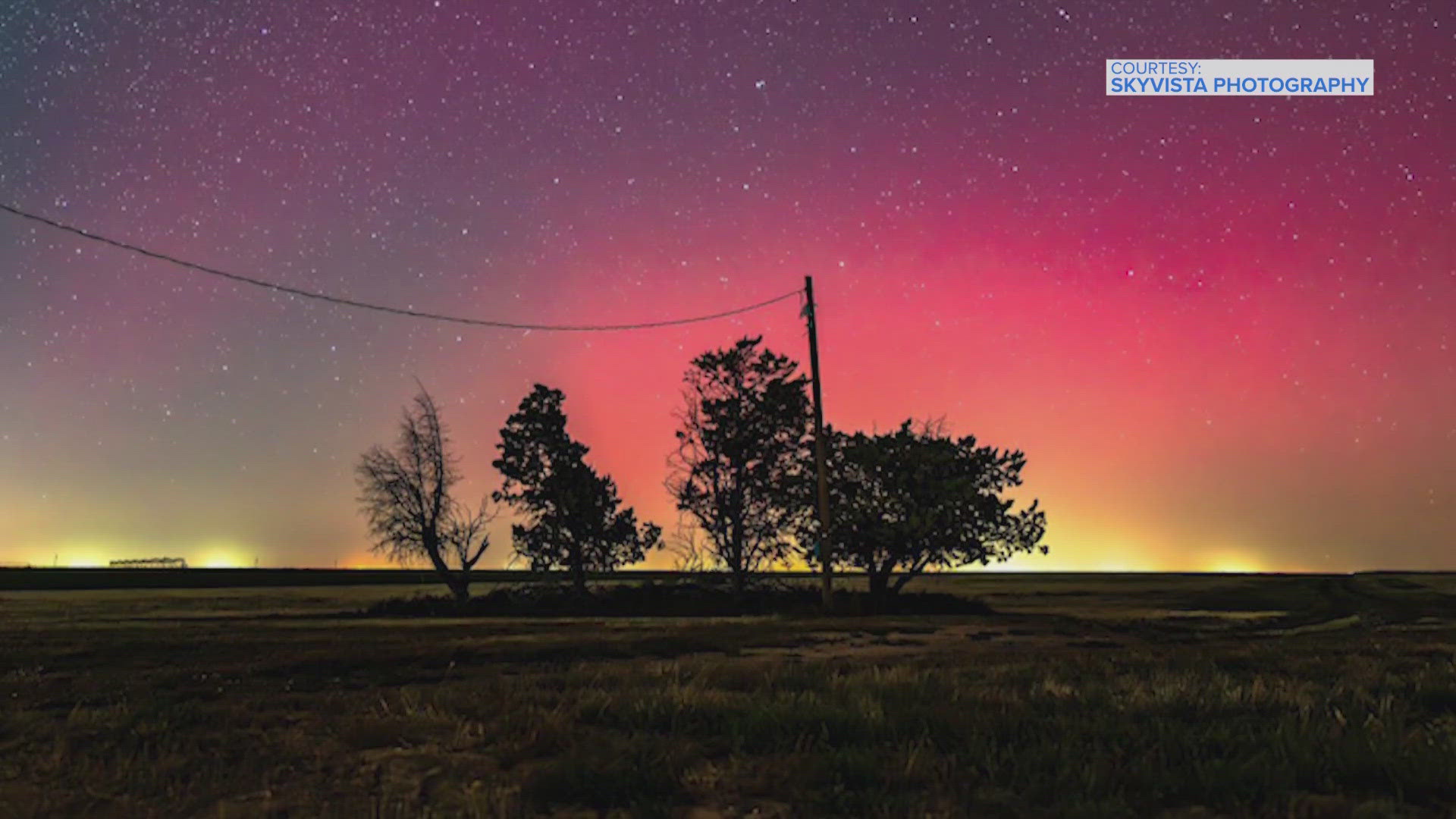
Urban areas and even smaller towns in Texas can suffer from significant light pollution, which can easily wash out the fainter glow of the aurora. To have the best chance of seeing the aurora, one would need to travel to areas with minimal artificial light. Dark sky preserves or remote rural locations would be ideal.
Cloud Cover and Weather
As with any astronomical observation, clear skies are paramount. Texas experiences a variety of weather patterns, and persistent cloud cover can completely obscure any celestial display, including the aurora. Therefore, a favorable weather forecast is as important as a strong geomagnetic storm.
Moonlight
A bright moon can also diminish the visibility of the aurora, much like light pollution. The best viewing conditions would be during a new moon or when the moon is below the horizon.
Potential Viewing Locations and Strategies
Given the rarity and specific requirements for viewing the aurora in Texas, identifying optimal locations and employing smart strategies significantly increases one’s chances. The goal is to minimize light pollution and maximize unobstructed views of the northern horizon.
Northern Texas and Panhandle
The northernmost regions of Texas, including the Texas Panhandle, offer the best potential viewing spots. Areas away from the major metropolitan centers like Dallas-Fort Worth or Houston are preferable. Towns like Amarillo or more remote areas within counties such as Briscoe or Childress could offer darker skies. The higher elevation and more open landscapes in the Panhandle can also provide a wider horizon for viewing.
West Texas and Big Bend Region
While often associated with stargazing due to its extreme darkness, the Big Bend National Park region and other parts of West Texas are also exceptionally far south for aurora viewing. However, the sheer lack of light pollution in these vast, sparsely populated areas means that if an aurora were strong enough to reach these latitudes, it would be seen with incredible clarity. The challenge here is the distance from the magnetic pole, meaning the aurora would need to be exceptionally powerful to be visible.
Strategies for Aurora Hunting in Texas
- Monitor Space Weather Forecasts: Several websites and apps provide real-time and forecast data for aurora activity. These include the NOAA Space Weather Prediction Center, Spaceweather.com, and various aurora forecast apps. These resources will indicate the Kp-index and potential for visible auroras.
- Follow Local Astronomy Groups: Local astronomy clubs or social media groups in Texas might share alerts for potential aurora sightings and good viewing spots.
- Seek Out Dark Sky Locations: Prioritize visiting state parks, national forests, or designated dark sky areas that are known for their low light pollution. Researching these locations beforehand is essential.
- Plan for the Unexpected: Aurora sightings in Texas are rare events. If a significant geomagnetic storm is predicted, be prepared to travel to a darker location, even if it requires a last-minute decision.
- Face North: When looking for the aurora, always face the northern horizon. The most intense displays are usually seen in this direction.
- Allow Your Eyes to Adjust: Give your eyes at least 20-30 minutes to adjust to the darkness before attempting to spot the aurora. Avoid looking at bright lights, including your phone screen, during this time.
- Be Patient: Aurora displays can be fleeting. Even when conditions are favorable, there might be periods of inactivity. Patience is a virtue for any aurora hunter.
A Rare Spectacle: The Potential and the Reality
The question of seeing the Northern Lights in Texas is one that sparks hope and curiosity. Scientifically, it is possible, but practically, it requires a perfect alignment of extraordinary celestial events and ideal terrestrial conditions. The chances of this alignment are slim, making it a rare and treasured spectacle for those fortunate enough to witness it.
Historical Sightings
There have been documented instances of auroras being visible in Texas, though they are infrequent. The most notable event was during the Great Geomagnetic Storm of 1859 (the Carrington Event), where auroras were reported as far south as the Caribbean. More recent, though less intense, sightings have been reported during strong solar storms in the 21st century, primarily in the northernmost parts of the state and often described as faint glows or subtle colorations on the northern horizon rather than the vibrant, dancing curtains seen at higher latitudes.

Managing Expectations
It is crucial to manage expectations when considering aurora viewing in Texas. While the dream of seeing the aurora borealis is captivating, the reality is that for most Texans, this experience will likely necessitate travel to more northerly latitudes. However, the very rarity of the event, should it occur, would make it all the more magical. The scientific curiosity and the pursuit of such an elusive natural phenomenon add a unique layer to the adventure of exploring Texas under its vast, star-studded skies. Even without a full aurora display, the dark skies of West Texas offer incredible stargazing opportunities, a different but equally awe-inspiring celestial experience.
In conclusion, while Texas is not a prime aurora destination, the universe occasionally offers surprises. With an understanding of space weather and a bit of luck, one might just catch a glimpse of the aurora borealis painting the Texas night sky, a truly unforgettable testament to the dynamic nature of our solar system and our planet’s place within it.
LifeOutOfTheBox is a participant in the Amazon Services LLC Associates Program, an affiliate advertising program designed to provide a means for sites to earn advertising fees by advertising and linking to Amazon.com. Amazon, the Amazon logo, AmazonSupply, and the AmazonSupply logo are trademarks of Amazon.com, Inc. or its affiliates. As an Amazon Associate we earn affiliate commissions from qualifying purchases.