
Navigating the open roads of Texas on a motorcycle is a quintessential American experience. From the vast plains of the Panhandle to the scenic routes of the Hill Country, the Lone Star State offers a diverse tapestry of landscapes for riders to explore. However, before you embark on your two-wheeled adventure, understanding the legal requirements is paramount. Specifically, the question arises: “Do you have to have a motorcycle license in Texas?” The answer, in short, is a resounding yes, but the specifics of obtaining that license and understanding its implications are crucial for any aspiring or current motorcycle rider in the state.
This guide delves into the intricacies of motorcycle licensing in Texas, aiming to equip you with the knowledge needed to ride legally and safely. We will explore the different types of licenses, the requirements for obtaining them, and the specific provisions that might apply to your situation, whether you’re a seasoned rider or a complete novice looking to experience the thrill of motorcycling for the first time.
Understanding Motorcycle Endorsements in Texas
In Texas, you don’t typically obtain a separate “motorcycle license” in the same way you might a CDL for commercial trucks. Instead, the state utilizes an endorsement system. This means that your existing driver’s license will need to be officially updated to reflect your qualification to operate a motorcycle. This endorsement is officially known as the Class M endorsement.
The Class M Endorsement: What It Is and Why You Need It
The Class M endorsement is a designation added to your standard Texas driver’s license. It signifies that you have met the state’s requirements to operate a motorcycle, motor-driven cycle, or moped. Operating a motorcycle without this endorsement is illegal and can result in fines, points on your driving record, and potentially the impoundment of your vehicle.
The requirements for obtaining this endorsement are designed to ensure that riders possess the necessary skills and knowledge to operate a motorcycle safely. This involves a combination of written testing and a practical skills test.
Who Needs a Class M Endorsement?
Generally, anyone operating a motorcycle, motor-driven cycle (which includes scooters with engines larger than 50cc or capable of speeds over 30 mph on level ground), or moped on public roads in Texas must have a Class M endorsement on their driver’s license. This applies to both residents and non-residents operating vehicles within the state.
There are, however, a few limited exceptions, which we will explore further. These exceptions are typically for individuals who are not operating on public roadways or are using vehicles with very small engine displacements.
Requirements for Obtaining a Class M Endorsement
The path to obtaining your Class M endorsement involves meeting specific age requirements and successfully completing both a knowledge test and a skills test. The process is overseen by the Texas Department of Public Safety (DPS).
Age Requirements and Restrictions
In Texas, the age at which you can begin the process of obtaining a motorcycle license or endorsement is 16 years old. However, there are crucial differences in the requirements for individuals under 18 compared to those 18 and older.
-
Under 18 Years Old:
- Applicants must hold a learner’s permit (issued after passing the knowledge test and holding a provisional driver’s license) for at least six months before they can apply for the full Class M license.
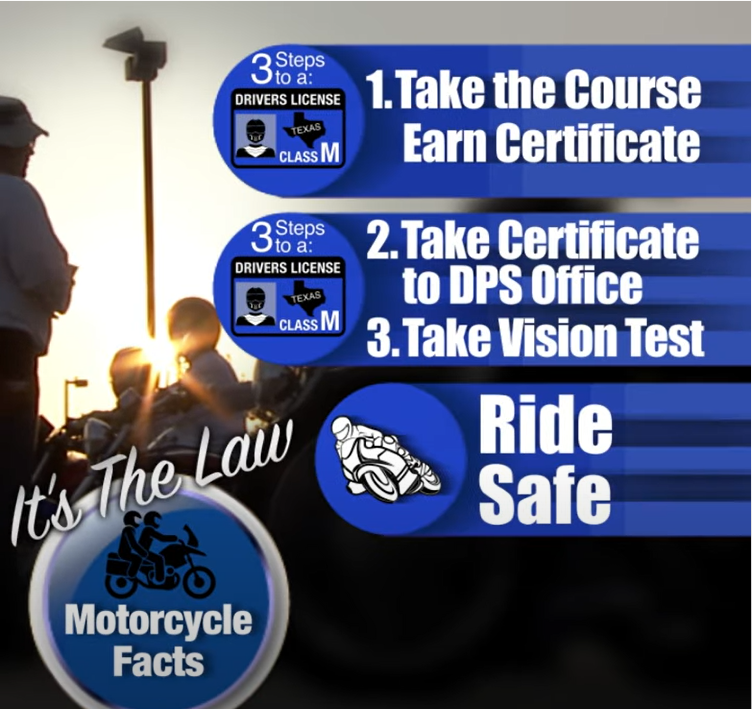
- They must complete a state-approved motorcycle safety course. This course provides valuable training on riding techniques, safety precautions, and accident avoidance.
- Upon completion of the course, they will receive a Motorcycle Safety Course Completion Certificate, which exempts them from the practical skills test at the DPS.
-
18 Years Old and Older:
- Applicants can choose to take a state-approved motorcycle safety course, which will exempt them from the practical skills test. This is highly recommended for all riders, regardless of age, as it provides comprehensive training.
- Alternatively, if they choose not to take a safety course, they must pass both a written knowledge test and a practical motorcycle skills test administered by the Texas DPS.
The Written Knowledge Test
The written knowledge test assesses your understanding of motorcycle laws, safe riding practices, and traffic regulations specific to operating a motorcycle. It covers topics such as:
- Road signs and signals
- Lane positioning and visibility
- Braking and cornering techniques
- Hazard perception and avoidance
- Riding in various weather conditions
- Alcohol and drug impairment
You can prepare for this test by studying the official Texas Motorcycle Operator Manual, which is available on the Texas DPS website. Many motorcycle safety courses also cover the material necessary to pass this test.
The Practical Skills Test

The practical skills test evaluates your ability to safely maneuver a motorcycle. This test is typically conducted in a controlled environment, such as a designated skills course. You will be required to demonstrate proficiency in a series of maneuvers, which may include:
- Starting and stopping: Smoothly accelerating and decelerating, controlled stops.
- Cone weave: Navigating a series of cones in a serpentine pattern without touching them.
- Turning: Executing smooth, controlled turns at various speeds.
- Stopping: Performing an emergency stop.
- Obstacle avoidance: Safely maneuvering around a simulated obstacle.
- U-turns: Executing a controlled U-turn.
The specific maneuvers and their requirements may vary slightly depending on the testing location. If you opt not to take a motorcycle safety course, passing this skills test is mandatory. If you successfully complete an approved course, you are typically exempted from this test.
Exceptions and Special Circumstances
While the Class M endorsement is generally required, Texas law does provide a few limited exceptions that may allow individuals to operate certain types of two-wheeled vehicles without the endorsement. It is crucial to understand these exceptions precisely, as misinterpreting them can lead to legal issues.
Operating Off-Road
The requirement for a motorcycle license or endorsement primarily applies to operating vehicles on public roadways. If you are exclusively riding on private property or designated off-road areas where public access is prohibited, and the vehicle is not registered for street use, the Class M endorsement may not be legally required for that specific activity. However, this is a complex area, and local ordinances or park rules may still apply. It is always advisable to confirm with local authorities if you are unsure.
Mopeds and Motor-Driven Cycles
Texas law differentiates between motorcycles, motor-driven cycles, and mopeds based on engine size, top speed, and other characteristics.
-
Mopeds: Generally, vehicles classified as mopeds in Texas have an engine displacement of 50cc or less and cannot exceed 30 miles per hour on level ground. Riders of vehicles solely meeting the definition of a moped and who are 15 years of age or older may not need a Class M endorsement. However, they must still possess a valid driver’s license. It is vital to check the specific classification of your vehicle to determine if it falls under the moped definition.
-
Motor-Driven Cycles: This is a broader category that can overlap with motorcycles. If a vehicle has an engine larger than 50cc or is capable of exceeding 30 mph, it is generally considered a motor-driven cycle and requires a Class M endorsement, even if it is sometimes referred to as a scooter.
Temporary Operation by Non-Residents
Non-residents visiting Texas with a valid driver’s license from their home state that includes a motorcycle endorsement are generally permitted to operate motorcycles in Texas for a limited period. However, if a non-resident’s home state license does not have a motorcycle endorsement, they would need to obtain a Texas Class M endorsement to legally ride in the state. It is always best to be familiar with Texas traffic laws and ensure your documentation is in order before riding.
The Benefits of Motorcycle Safety Training
While motorcycle safety courses are mandatory for riders under 18 who wish to waive the skills test, they are highly recommended for riders of all ages. The training provided goes far beyond what can be assessed in a basic skills test and offers invaluable benefits that can significantly enhance safety on the road.
Enhanced Riding Skills and Confidence
Approved motorcycle safety courses, such as those offered by the Motorcycle Safety Foundation (MSF) or equivalent state-approved programs, are designed to teach fundamental and advanced riding techniques. These courses cover:
- Cornering techniques: Learning to lean and navigate curves effectively.
- Braking techniques: Mastering both front and rear brake application, including emergency braking.
- Collision avoidance: Developing the skills to anticipate and react to potential hazards.
- Riding in different conditions: Adapting to rain, gravel, and other challenging surfaces.
- Vehicle inspection: Learning to perform pre-ride checks to ensure the motorcycle is in safe working order.
By honing these skills in a controlled environment, riders gain confidence in their abilities, which can translate to safer decision-making on the road.
Potential Insurance Discounts
Many motorcycle insurance providers offer discounts to riders who have completed an approved motorcycle safety course. This is because these courses are proven to reduce the risk of accidents, making riders a more attractive prospect for insurers. The savings on insurance premiums can often offset the cost of the course itself, making it a financially prudent decision in addition to a safety-focused one.

A Foundation for Lifelong Safe Riding
The knowledge and skills acquired in a motorcycle safety course form a solid foundation for a lifetime of safe riding. The courses emphasize a proactive approach to safety, encouraging riders to constantly assess risks, maintain their motorcycles, and ride within their capabilities. This commitment to continuous learning and responsible riding is essential for enjoying the freedom of the open road without compromising personal safety. For anyone considering a motorcycle in Texas, investing in a safety course is one of the most important first steps they can take.
LifeOutOfTheBox is a participant in the Amazon Services LLC Associates Program, an affiliate advertising program designed to provide a means for sites to earn advertising fees by advertising and linking to Amazon.com. Amazon, the Amazon logo, AmazonSupply, and the AmazonSupply logo are trademarks of Amazon.com, Inc. or its affiliates. As an Amazon Associate we earn affiliate commissions from qualifying purchases.