
The history of how the United States gained control of Texas is a complex tapestry woven with threads of exploration, settlement, revolution, and ultimately, annexation. What is now a vast and vibrant state, crucial to the American narrative, was once a contested territory, shaped by the ambitions of several nations. Understanding this acquisition requires delving into the early colonial period, the rise of Mexican influence, the struggle for independence, and the final, pivotal moments that brought the Lone Star State into the Union.
Early Explorations and Spanish Claims
Long before either the United States or Mexico held significant sway, the land that would become Texas was explored by Europeans. Spanish explorers, driven by the quest for gold and glory, were among the first to chart its coastlines and interior. In 1519, Alonso Álvarez de Pineda created the first map of the Texas coastline, claiming the territory for Spain. Over the next centuries, Spanish ambitions led to the establishment of missions and presidios, particularly in East Texas, though their presence remained relatively sparse. These early settlements, like the mission of San Antonio de Valero (later to become the Alamo), laid the groundwork for future cultural and political developments.
The Spanish Crown viewed Texas as a buffer zone against French encroachment from the north and east, particularly after the French established Fort Saint Louis near Matagorda Bay in 1685. While these Spanish claims were legally established through exploration and early settlement, the vastness of the territory and the limited number of Spanish colonists meant that effective control was often tenuous. The indigenous populations, such as the Caddo, Comanche, and Apache, remained the dominant forces across much of the region.
The Impact of Spanish Colonization
- Missions and Presidios: The Spanish established a network of missions intended to convert indigenous peoples to Christianity and Spanish customs, and presidios (forts) to protect their claims and facilitate trade. These institutions, though often short-lived, left a lasting cultural and architectural legacy in places like San Antonio.
- Limited Population Growth: Despite claims, Spanish settlement in Texas remained limited. The harsh environment, persistent conflicts with indigenous tribes, and the distance from the administrative centers of New Spain contributed to a sparse European population.
- French Interference: The brief but significant French presence under Robert de La Salle highlighted the strategic importance of the region and spurred further Spanish efforts to solidify their control.
Mexican Independence and Anglo-American Settlement
The early 19th century marked a seismic shift in the political landscape of North America. In 1821, Mexico achieved independence from Spain, and Texas became a part of the newly formed nation. Recognizing the need to populate and develop its northern frontier, the Mexican government began to encourage immigration, particularly from the United States.
Stephen F. Austin, often hailed as the “Father of Texas,” played a pivotal role in this era. He secured permission from the Mexican government to bring hundreds of Anglo-American families to settle in the region. These immigrants, attracted by cheap land and opportunities, brought their culture, customs, and legal traditions with them. The agreement stipulated that settlers would become Mexican citizens, adopt the Catholic faith, and adhere to Mexican laws.
However, the influx of American settlers, with their distinct cultural norms and growing desire for greater autonomy, soon led to friction with the Mexican government. Differences in language, religion, and political aspirations created a growing divide. The Mexican government, wary of the increasing American presence and influence, began to implement policies aimed at curbing immigration and asserting more direct control.
The Empresario System and Growing Tensions

- Stephen F. Austin’s Colony: Austin’s successful colonization efforts attracted thousands of Americans, establishing the foundation for the future state.
- Cultural Differences: The clash between Anglo-American and Mexican cultures, legal systems, and political ideologies became a significant source of conflict.
- Mexican Government’s Concerns: The Mexican government’s increasing anxiety over American dominance in Texas led to policies like the Law of April 6, 1830, which aimed to halt further American immigration and strengthen Mexican military presence.
The Texas Revolution and Independence
The mounting tensions between the American settlers and the Mexican government eventually erupted into open conflict. The spark that ignited the revolution is often attributed to the Battle of Gonzales in October 1835, where Texian militia resisted an attempt by Mexican troops to reclaim a cannon. This skirmish quickly escalated into a full-blown war for independence.
Key events in the revolution included the siege and fall of the Alamo in March 1836, a pivotal moment of heroic but ultimately tragic resistance. The defenders of the Alamo, led by figures like William Travis, Jim Bowie, and Davy Crockett, fought valiantly against a much larger Mexican army. Though the defenders were defeated, their sacrifice became a rallying cry for the Texian cause, embodying the spirit of defiance.
Just weeks later, on March 2, 1836, Texian delegates at Washington-on-the-Brazos signed the Texas Declaration of Independence. The decisive victory for the Texian army came at the Battle of San Jacinto on April 21, 1836, where General Sam Houston’s forces routed the Mexican army under General Antonio López de Santa Anna. The capture of Santa Anna effectively ended the major fighting, paving the way for the establishment of the Republic of Texas.
Defining Moments of the Revolution
- Battle of Gonzales (1835): The “Come and Take It” flag became a symbol of Texian defiance.
- Fall of the Alamo (1836): A devastating loss that galvanized the Texian independence movement.
- Texas Declaration of Independence (1836): The formal assertion of self-governance.
- Battle of San Jacinto (1836): The decisive victory that secured Texian independence.
The Republic of Texas and the Path to Annexation
For nearly a decade, Texas existed as an independent republic. The Republic of Texas faced numerous challenges during its existence, including economic instability, ongoing border disputes with Mexico, and the complex issue of slavery, which was deeply entrenched in its economy and society.
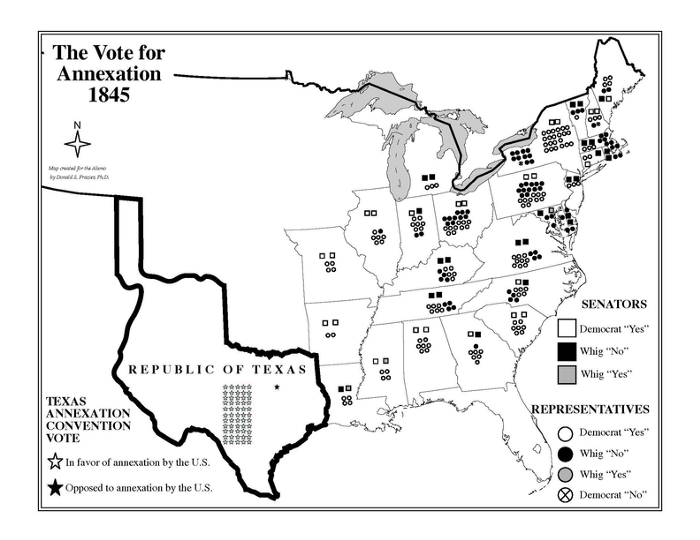
Many Texans, particularly those with ties to the United States, harbored a strong desire for annexation. They believed that joining the Union would provide greater economic security, political stability, and military protection. However, the prospect of annexation was not without controversy in the United States. The main obstacle was the issue of slavery. Admitting Texas, a slaveholding republic, into the Union threatened to upset the delicate balance of power between free and slave states in Congress, a contentious issue that would eventually lead to the Civil War.
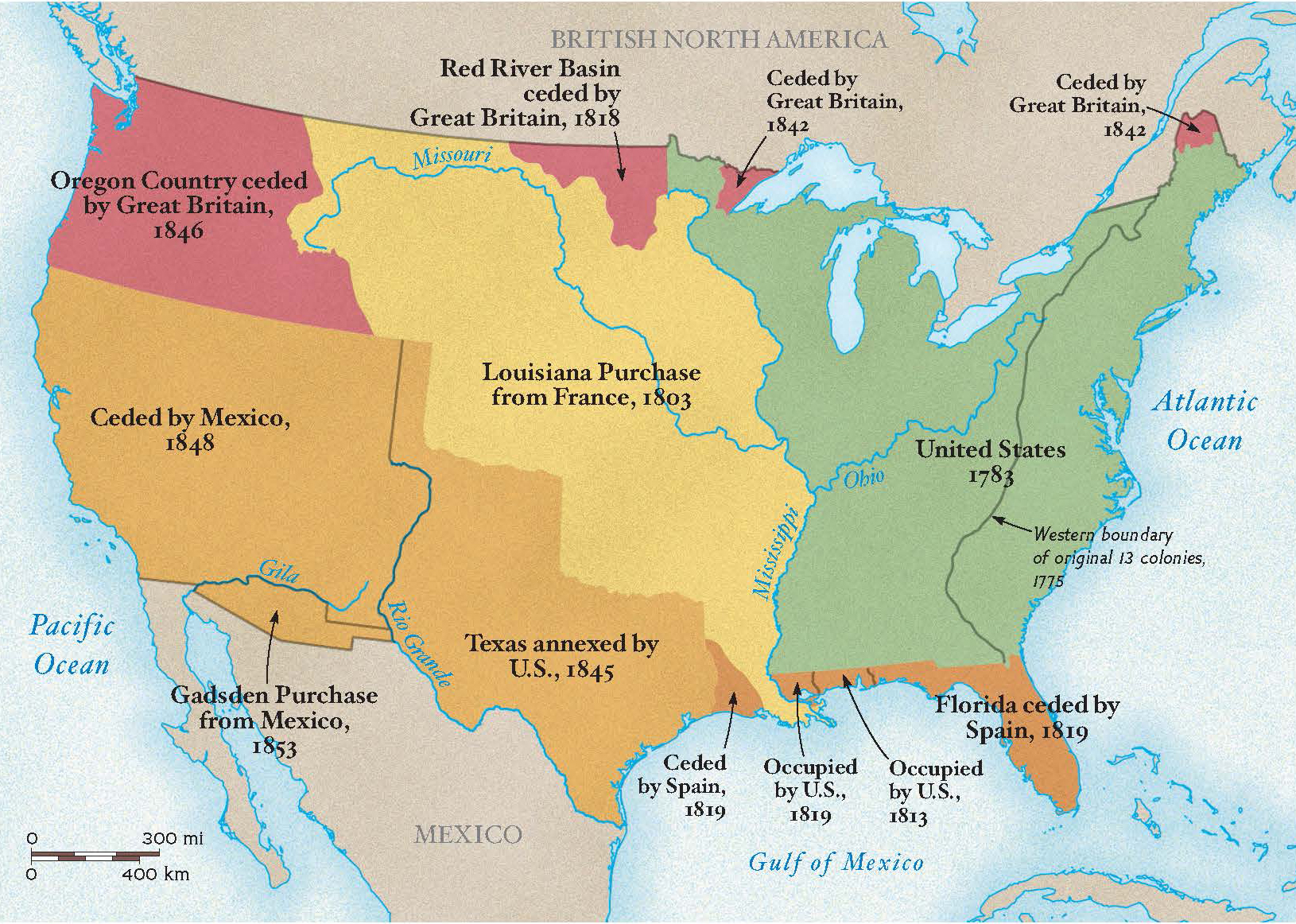
Despite these reservations, the idea of expanding American territory and influence westward gained traction. Proponents of annexation argued for the strategic advantages and the fulfillment of America’s “Manifest Destiny.” After much debate and political maneuvering, the United States finally annexed Texas in 1845, admitting it as the 28th state. Mexico did not recognize Texas’s independence and viewed its annexation by the United States as an act of aggression, which ultimately led to the Mexican-American War.
The Struggle for Statehood
- Economic and Political Challenges of the Republic: The Republic of Texas grappled with debt, internal divisions, and the continued threat of Mexican intervention.
- The Slavery Question: The institution of slavery in Texas was a major point of contention for annexation by the United States.
- Manifest Destiny: The expansionist ideology that fueled American westward ambitions played a significant role in the push for annexation.
- Annexation in 1845: The formal incorporation of Texas into the Union, marking a significant territorial gain for the United States.