
The Genesis of the Game
To truly appreciate the intricacies of playing Texas Hold’em, one must first understand its origins. While the exact birthplace remains a subject of some debate, the prevailing narrative places its genesis in the early 20th century in the town of Robstown, Texas. It’s believed to have evolved from earlier forms of poker, gradually gaining popularity due to its dynamic nature and the strategic depth it offered. The game’s journey from the smoky backrooms of Texas to the glittering casinos of Las Vegas and the global stage of online poker is a testament to its enduring appeal. Its simplicity in basic rules, combined with an almost infinite ceiling for strategic mastery, has cemented its status as the preeminent poker variant worldwide. Understanding this historical context imbues the player with a greater appreciation for the game’s evolution and its current widespread embrace.

The Fundamental Rules of the Game
At its core, Texas Hold’em is played with a standard 52-card deck. The objective is to form the best five-card poker hand by combining your two private “hole” cards with the five community cards dealt face-up on the table.
The Deal and Betting Rounds
The game begins with the dealer (or the player designated as the dealer through a rotating “button”) dealing two cards face down to each player. These are the players’ private hole cards, unseen by opponents.
Following the deal, the first betting round, known as the “pre-flop,” commences. Play starts with the player to the immediate left of the big blind (more on blinds later). Players have the option to “call” the current bet, “raise” it, or “fold” (discard their hand and forfeit any chance of winning the current pot).
The Flop
After the pre-flop betting round concludes, the dealer reveals three community cards face-up in the center of the table. These are known as “the flop.” These cards are shared by all players and can be used in conjunction with their hole cards to form winning hands.
A second round of betting follows the flop, again starting with the player to the left of the dealer button.
The Turn
Once the betting for the flop is complete, the dealer reveals a fourth community card, known as “the turn.” This brings the total number of community cards to four.
A third betting round ensues after the turn.
The River
The final community card, the fifth and last one, is revealed face-up. This card is called “the river.”
The final betting round occurs after the river.
The Showdown
If more than one player remains in the hand after the river betting round, a “showdown” occurs. Players reveal their hole cards, and the player with the best five-card poker hand, using any combination of their two hole cards and the five community cards, wins the pot. The ranking of poker hands is crucial here, from the lowest (high card) to the highest (royal flush).
Understanding Blinds and the Dealer Button
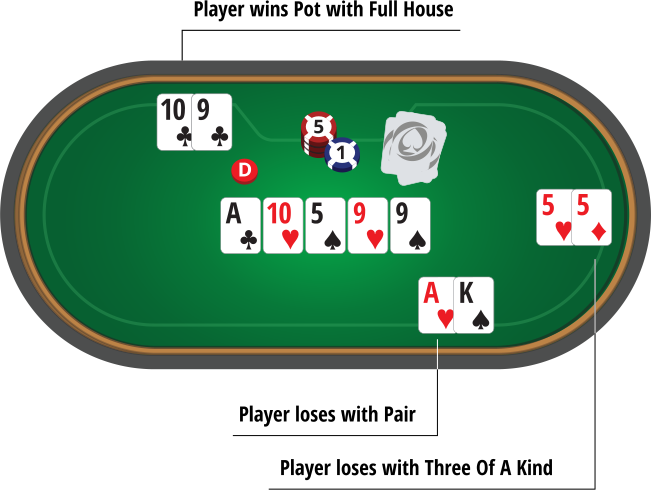
The concept of blinds is fundamental to initiating action in Texas Hold’em. To ensure there is always something to play for in the pot, two players are compelled to post mandatory bets before any cards are dealt.
The Small Blind and Big Blind
The player immediately to the left of the dealer button posts the “small blind,” which is typically half the size of the big blind. The player to the left of the small blind posts the “big blind,” which is the minimum bet for that round of play. These blinds rotate clockwise around the table with each new hand, ensuring all players eventually contribute to the blinds.
The Dealer Button
The “dealer button” is a marker that indicates the theoretical dealer for the current hand. In games played in casinos or with a designated dealer, the button simply signifies the order of betting. It moves one position to the left after each hand. The players to the left of the big blind act first in pre-flop, and the player in the small blind position (if still in the hand) usually acts first after the flop, with action proceeding clockwise. The player in the dealer button position acts last in post-flop betting rounds, which is a significant strategic advantage as they have the last say on whether to call, raise, or fold after observing all other players’ actions.
Hand Rankings: The Backbone of Victory
Mastering the hand rankings is paramount to success in Texas Hold’em. These rankings determine who wins the pot when multiple players reach the showdown.
The Hierarchy of Hands (from highest to lowest)
- Royal Flush: Ace, King, Queen, Jack, Ten, all of the same suit. (e.g., A♠ K♠ Q♠ J♠ 10♠)
- Straight Flush: Five cards in sequence, all of the same suit. (e.g., 9♥ 8♥ 7♥ 6♥ 5♥)
- Four of a Kind: Four cards of the same rank. (e.g., 7♣ 7♦ 7♥ 7♠ 2♠)
- Full House: Three cards of one rank and two cards of another rank. (e.g., K♦ K♥ K♣ 5♠ 5♥)
- Flush: Five cards of the same suit, not in sequence. (e.g., A♦ 10♦ 7♦ 4♦ 2♦)
- Straight: Five cards in sequence, but not all of the same suit. (e.g., 8♠ 7♥ 6♣ 5♦ 4♠)
- Three of a Kind: Three cards of the same rank. (e.g., Q♣ Q♥ Q♦ 9♠ 3♥)
- Two Pair: Two cards of one rank and two cards of another rank. (e.g., J♠ J♥ 6♣ 6♦ K♥)
- One Pair: Two cards of the same rank. (e.g., 10♥ 10♠ 7♣ 5♦ 2♥)
- High Card: If no player has any of the above hands, the player with the highest-ranking single card wins. (e.g., A♣ K♠ 9♥ 5♦ 3♠)
In cases where players have the same hand ranking (e.g., two players have a pair of Kings), the highest kicker card (the highest remaining card in the hand not part of the pair) determines the winner. If the kickers are also the same, the pot is split.
Strategic Considerations for Aspiring Players
Beyond understanding the rules, successful Texas Hold’em play involves a blend of psychology, probability, and disciplined decision-making.
Position is Power
As mentioned, playing in later positions (closer to the dealer button) offers a significant advantage. Acting last allows you to see how your opponents have acted before you decide your own move. This information is invaluable, enabling you to make more informed decisions about betting, bluffing, or folding.
Pot Odds and Implied Odds
Understanding “pot odds” is crucial for making profitable calls. Pot odds are the ratio of the current size of the pot to the cost of a contemplated call. If your chances of winning the hand are better than the pot odds, calling is generally a mathematically sound decision. “Implied odds” considers potential future bets you might win if you complete your hand, allowing for more speculative calls.
Bluffing and Reading Opponents
Bluffing is an integral part of Texas Hold’em, allowing you to win pots even with weaker hands. However, effective bluffing requires careful consideration of your image at the table, your opponents’ tendencies, and the board texture. Reading your opponents’ “tells”—subtle physical or verbal cues—can also provide insights into the strength of their hands, influencing your own betting strategy.
Bankroll Management
A disciplined approach to bankroll management is essential for long-term success. This involves playing at stakes that are appropriate for your available funds, ensuring that a few losing sessions do not deplete your entire capital. Setting win and loss limits for each session can also help maintain discipline.
By internalizing these fundamental aspects—from the basic rules and hand rankings to strategic nuances like position and pot odds—aspiring players can embark on their journey to mastering the captivating game of Texas Hold’em.
LifeOutOfTheBox is a participant in the Amazon Services LLC Associates Program, an affiliate advertising program designed to provide a means for sites to earn advertising fees by advertising and linking to Amazon.com. Amazon, the Amazon logo, AmazonSupply, and the AmazonSupply logo are trademarks of Amazon.com, Inc. or its affiliates. As an Amazon Associate we earn affiliate commissions from qualifying purchases.