
Navigating the complexities of child support in Texas can feel overwhelming, especially for parents seeking clarity and fairness. This guide aims to demystify the process, providing a comprehensive understanding of how child support is calculated in the Lone Star State, with a focus on its impact on family travel, accommodation choices, and overall lifestyle considerations. While the core of child support is financial, its implications ripple through many aspects of a family’s life, influencing decisions from selecting a family-friendly resort for a vacation to budgeting for experiences in local culture.
Understanding Texas Child Support Guidelines
The foundation of child support calculation in Texas rests on the Revised Uniform State Child Support Guidelines, codified in the Texas Family Code. These guidelines are designed to ensure that children receive the financial support they need from both parents, reflecting the principle that parents have a joint responsibility for their children’s well-being. The primary method used is a percentage of the obligor’s (the parent paying support) net monthly income.
Net Monthly Income Calculation
The first crucial step in determining child support is accurately calculating the obligor’s net monthly income. This is not simply the gross salary.
Gross Income Sources
Gross income includes a wide array of earnings, such as:
- Wages and salaries
- Overtime pay
- Commissions
- Bonuses
- Self-employment income
- Disability benefits
- Unemployment benefits
- Retirement benefits
- Alimony received
- Interest and dividends
Deductions for Net Income
From the gross income, certain deductions are permitted to arrive at the net monthly income. These typically include:
- Federal income tax (calculated for a single person claiming one exemption)
- State income tax (Texas has no state income tax)
- Social Security taxes
- Medicare taxes
- Cost of the child’s health insurance premium (if paid by the obligor)
- Cost of the child’s dental insurance premium (if paid by the obligor)
It’s important to note that only the portion of health and dental insurance premiums specifically for the child is deducted. If the obligor is responsible for providing health insurance, the cost of that coverage is factored in. This can have direct implications for families planning for travel, as the ability to cover comprehensive health insurance for children can influence the choice of destination and the types of activities undertaken. For instance, families might opt for less adventurous travel if robust health coverage for their children is a concern.
Applying the Percentage Guidelines
Once the net monthly income is established, Texas law applies a statutory percentage based on the number of children being supported. These percentages are presumed to be in the best interest of the child.
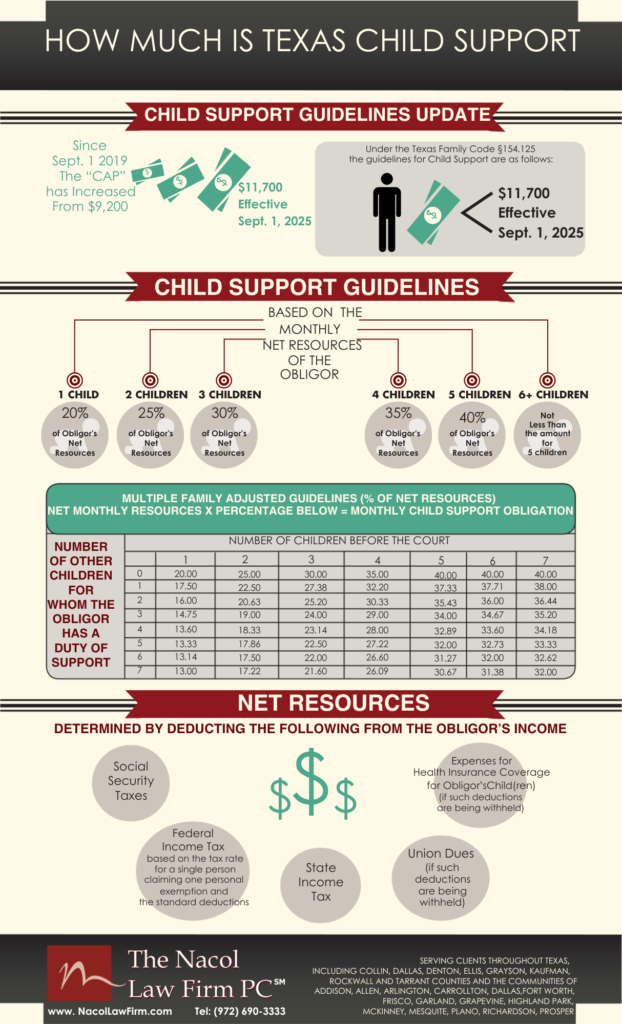
- 1 child: 20% of net monthly income
- 2 children: 25% of net monthly income
- 3 children: 30% of net monthly income
- 4 children: 35% of net monthly income
- 5 children: 40% of net monthly income
- 6 or more children: Not less than 40% of net monthly income
Income Cap
Texas law also sets an income cap for the application of these guidelines. As of recent updates, this cap is set at $9,200 net monthly income per child. This means that even if an obligor’s net monthly income exceeds this amount, the percentage calculation is applied only up to the $9,200 mark for each child. Any income above this cap is considered “discretionary” and may be addressed by the court in extraordinary circumstances or through private agreement.
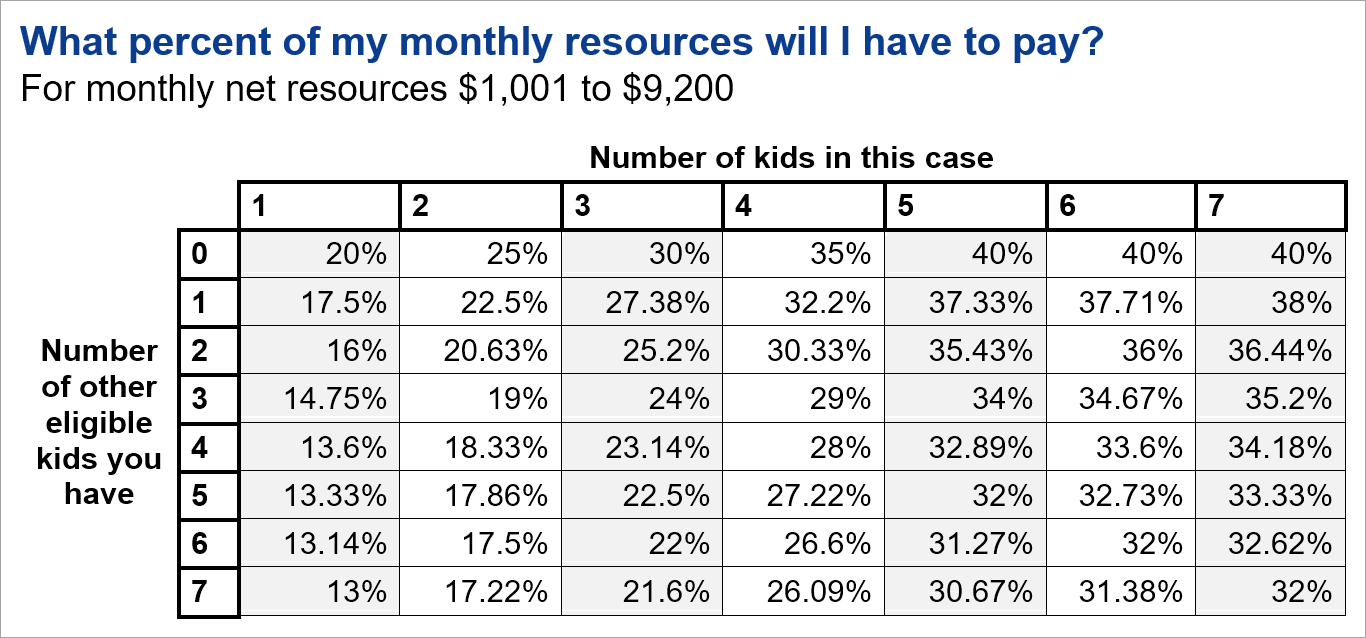
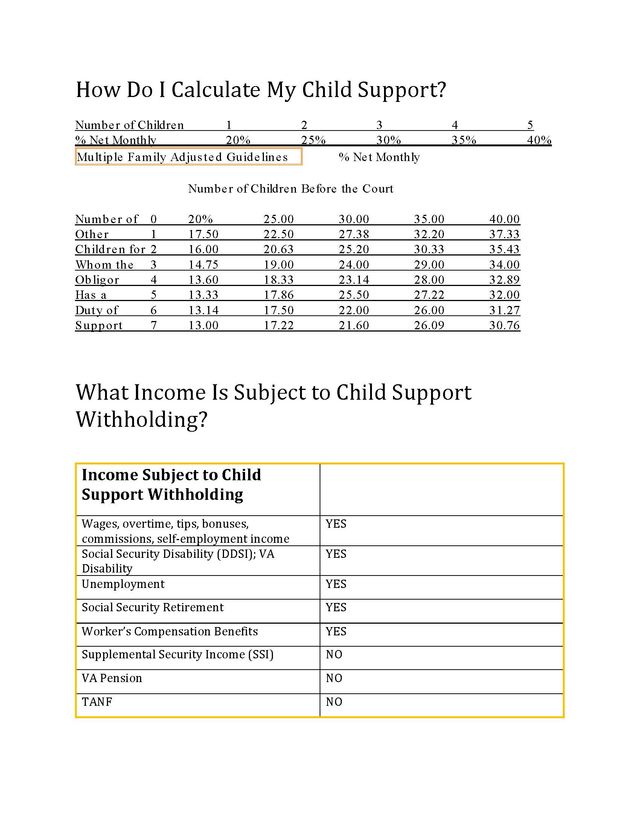
Calculating Support for Multiple Families
A key consideration in Texas is how child support is calculated when an obligor has children from different relationships. The guidelines are adjusted to reflect the obligor’s responsibility to all children. For example, if an obligor has two children in one household and one child in another, the percentage for the first household would be calculated based on the total number of children (three), and then that amount would be adjusted downward to account for the child in the second household. This ensures that support is distributed more equitably across all dependent children.
Factors Influencing Child Support Deviations
While the guidelines provide a standard framework, Texas courts have the discretion to deviate from these guidelines if applying them would be unjust or inappropriate. These deviations are typically based on the best interest of the child and can consider a wide range of factors, many of which are relevant to family lifestyle and travel.
Best Interest of the Child
The overarching principle guiding any deviation is the best interest of the child. This is a broad standard that allows courts to consider unique circumstances.
Parental Ability to Pay and Standard of Living
A primary consideration is the ability of each parent to contribute to the child’s support and the child’s accustomed standard of living. This includes the financial resources of both parents, their earning capacities, and their current financial situations. If one parent has significantly more financial means, the court might order higher support to maintain a standard of living that the child would have enjoyed if the parents had remained together. This directly impacts lifestyle choices, including the frequency and quality of family trips, the types of accommodations available for vacations, and access to extracurricular activities that might be considered essential to a child’s upbringing.
Child’s Needs
The specific needs of the child are also paramount. This can include:
- Medical Expenses: Beyond basic health insurance, extraordinary medical, dental, or psychological expenses can lead to deviations. The court will consider how these expenses are to be allocated between the parents. This is particularly relevant for families planning travel, as unexpected medical needs can arise, and having a clear understanding of responsibility is crucial.
- Educational Needs: If a child has special educational requirements or attends a private school, the court may factor these costs into the support order.
- Age and Number of Children: The age and developmental stage of the children can influence their needs.
Other Factors
Other factors the court may consider include:
- The age of the child: Older children may have different financial needs than younger ones.
- The financial resources of the child: While rare, if a child has significant independent financial resources, it might be considered.
- The financial contributions of the parents: This includes contributions made by each parent for the child’s benefit, even outside of direct support payments.
- The time a child actually spends with each parent: While primary custody is a factor, the practical time spent can influence support calculations, especially concerning the sharing of expenses during periods of possession.
Health Insurance and Medical Support
A significant component of child support in Texas involves providing medical support for the children.
Health Insurance Premiums
As previously mentioned, the cost of the child’s portion of health and dental insurance premiums paid by the obligor is deducted from their gross income to arrive at net income. The court will order one parent to provide health insurance for the children, typically the parent with the greater net income, if it is available at a reasonable cost.
Reasonable Cost Standard
“Reasonable cost” is generally defined as no more than 5% of the obligor’s net monthly income for health insurance premiums. If the cost exceeds this, the court may order the other parent to provide insurance or allocate the cost differently.
Uninsured Medical Expenses
Beyond premiums, the court will also address the allocation of uninsured medical expenses, such as deductibles, co-payments, and expenses not covered by insurance. Typically, these are ordered to be shared by the parents in proportion to their net incomes. This shared responsibility for healthcare costs is vital for families, especially when considering travel. Knowing how potential medical expenses will be covered can influence insurance choices and destination selection, ensuring that families can travel with peace of mind. For instance, a family might prioritize travel within their home state or to destinations with readily accessible healthcare if a child has a chronic condition.
Modifications and Enforcement of Child Support Orders
Child support orders are not static. Circumstances change, and Texas law provides mechanisms for modifying and enforcing these orders.
Modification of Orders
A material and substantial change in circumstances is generally required to modify a child support order. Common reasons for modification include:
- Significant change in income: A substantial increase or decrease in the obligor’s income.
- Change in custody or visitation: If the possession and access schedule changes significantly.
- Emancipation of a child: When a child reaches the age of majority or otherwise becomes emancipated.
- Change in the child’s needs: Such as the onset of a disability or significant medical expenses.
A modification can either increase or decrease the child support amount. This flexibility allows the orders to remain relevant to the child’s actual needs and the parents’ financial realities. For families, this means that adjustments can be made to accommodate evolving lifestyle aspirations and travel plans. If a parent’s income increases, they might be able to afford more extensive family vacations or upgrade accommodation choices. Conversely, a decrease in income may necessitate a re-evaluation of travel budgets.
Enforcement of Orders
Texas courts take child support enforcement very seriously. Failure to pay child support as ordered can result in severe consequences, including:
- Wage garnishment: Direct deduction of support from the obligor’s paycheck.
- License suspension: Suspension of driver’s licenses, professional licenses, and recreational licenses.
- Passport denial: In cases of significant arrearages.
- Contempt of court: Which can lead to fines and jail time.
Ensuring consistent child support payments is paramount for maintaining a stable environment for children and allowing parents to plan for their children’s future, including educational pursuits and family enrichment activities such as tourism and memorable experiences.
The Broader Impact on Family Lifestyle and Travel
While the calculation of child support is a legal and financial process, its downstream effects are deeply intertwined with a family’s lifestyle, including their ability to engage in travel and enjoy various accommodations and activities.
Accommodation and Travel Planning
The amount of child support ordered can directly influence a family’s ability to afford certain types of accommodation and travel. For the custodial parent, predictable child support payments can provide the financial stability needed to budget for family vacations, potentially allowing for stays at resorts or renting villas for extended family trips. For the non-custodial parent, the support obligation is a significant financial commitment that impacts disposable income available for leisure activities. This might mean choosing more budget-friendly hotels or opting for staycations over distant travel.
Experiential and Cultural Engagement
Beyond just accommodation, child support plays a role in a family’s ability to expose children to diverse local cultures, engage in enriching activities, and create lasting memories. Consistent support can facilitate access to museums, theme parks, educational tours, and other experiences that contribute to a child’s development and understanding of the world. The ability to plan these experiences, whether it’s a trip to a landmark like the Alamo in San Antonio or exploring the vibrant arts scene in Austin, is directly linked to the financial resources available.
Budgeting for Family Trips
Ultimately, child support is a crucial element in family budgeting. Parents on both sides of a support order must factor these obligations into their financial planning. This includes setting aside funds for essential needs, but also for discretionary spending that enhances family life. Whether it’s planning a long-term stay in an apartment near a family attraction or saving for a significant travel adventure, understanding the financial framework provided by child support is key. It allows parents to make informed decisions about their lifestyle and to ensure their children benefit from a well-rounded upbringing that includes opportunities for exploration and enjoyment.
By understanding the intricate process of calculating child support in Texas, parents can better manage their financial responsibilities, make informed decisions about their family’s lifestyle, and ensure that their children continue to receive the support they need to thrive, both financially and experientially.
LifeOutOfTheBox is a participant in the Amazon Services LLC Associates Program, an affiliate advertising program designed to provide a means for sites to earn advertising fees by advertising and linking to Amazon.com. Amazon, the Amazon logo, AmazonSupply, and the AmazonSupply logo are trademarks of Amazon.com, Inc. or its affiliates. As an Amazon Associate we earn affiliate commissions from qualifying purchases.