
Texas Hold ‘Em, a game steeped in history and brimming with strategic depth, has transcended its humble origins to become the most popular poker variant played worldwide. Its rise to prominence is a testament to its elegant simplicity, coupled with a complexity that continues to challenge and captivate millions. This guide delves into the heart of what makes Texas Hold ‘Em such an enduring and exciting game, exploring its rules, fundamental strategies, and its significant cultural impact, particularly within the realm of entertainment and social gatherings.
The Genesis and Evolution of Texas Hold ‘Em
The precise origins of Texas Hold ‘Em are somewhat shrouded in mystery, with various accounts pointing to different locations and timeframes. However, the prevailing theory suggests that the game emerged in the early 20th century in Robstown, Texas. From its Texan roots, it gradually spread across the United States, gaining a solid following in the card rooms of Las Vegas.
The game’s trajectory took a dramatic turn in the early 2000s. The advent of online poker platforms and the televising of major tournaments, such as the World Series of Poker (WSOP), catapulted Texas Hold ‘Em into mainstream consciousness. Suddenly, amateur players found themselves competing on a global stage, and the allure of large prize pools and the thrill of high-stakes competition became accessible to a much wider audience. This era marked a significant cultural shift, transforming poker from a niche pastime into a globally recognized sport and entertainment phenomenon. The strategic nuances and the dramatic narratives that unfolded at the poker table became must-see television, drawing in new players and enthusiasts alike.
From Card Rooms to the Digital Age
Initially, Texas Hold ‘Em was played in smoky, backroom card rooms and casinos. The intimate setting fostered a unique social dynamic, where players could read each other’s physical tells and engage in banter. The introduction of online platforms revolutionized accessibility. Players could now join games from the comfort of their homes, playing against opponents from around the globe. This digital transformation democratized the game, lowering the barrier to entry and allowing for rapid skill development through continuous practice. The sheer volume of hands played online meant that players could experience more scenarios and refine their strategies at an unprecedented pace.
Understanding the Mechanics: Rules and Gameplay
At its core, Texas Hold ‘Em is played with a standard 52-card deck. The objective is to form the best possible five-card poker hand by combining your two private “hole cards” with the five community cards dealt on the table.
The Basics of a Hand
- Dealing the Hole Cards: Each player is dealt two cards face down, known as their “hole cards” or “pocket cards.” These cards are private and can only be seen by the player holding them.
- The Flop: After the first round of betting, three community cards are dealt face up in the center of the table. These are called the “flop.”
- The Turn: Following another round of betting, a fourth community card is dealt face up. This is known as the “turn” or “fourth street.”
- The River: After a final round of betting, the fifth and final community card is dealt face up. This is the “river” or “fifth street.”
- The Showdown: If more than one player remains after the final betting round, the remaining players reveal their hole cards. The player with the best five-card poker hand, using any combination of their two hole cards and the five community cards, wins the pot.
Betting Rounds and Actions
Betting is a crucial element of Texas Hold ‘Em, adding layers of strategy and psychology to the game. Players can choose from several actions during their turn:
- Check: If no bet has been made before you in the current betting round, you can “check.” This means you pass your turn without betting, but you remain in the hand.
- Bet: You can initiate the betting by placing the minimum required wager.
- Call: If a bet has already been made, you can “call” by matching the amount of the previous bet.
- Raise: You can increase the current bet by a specified amount. This forces other players to call the increased amount, raise further, or fold.
- Fold: If you believe your hand is not strong enough to win, or if the cost to continue is too high, you can “fold.” This means you give up your hand and forfeit any chance of winning the current pot.
Hand Rankings
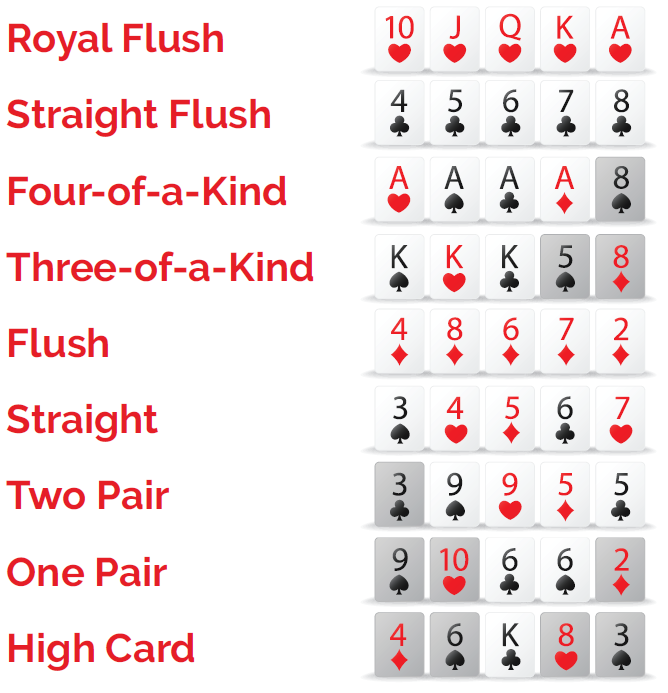
The hierarchy of poker hands is fundamental to understanding Texas Hold ‘Em. From highest to lowest, these are:
- Royal Flush: A, K, Q, J, 10 of the same suit.
- Straight Flush: Five cards in sequence, all of the same suit (e.g., 9, 8, 7, 6, 5 of hearts).
- Four of a Kind: Four cards of the same rank (e.g., four Kings).
- Full House: Three cards of one rank and two cards of another rank (e.g., three Queens and two 7s).
- Flush: Five cards of the same suit, not in sequence.
- Straight: Five cards in sequence, but not all of the same suit (e.g., 7, 6, 5, 4, 3 of mixed suits).
- Three of a Kind: Three cards of the same rank.
- Two Pair: Two cards of one rank and two cards of another rank.
- One Pair: Two cards of the same rank.
- High Card: If no player has any of the above hands, the player with the highest-ranking single card wins.
Strategic Depth: Beyond the Cards
While luck plays a role in the short term, Texas Hold ‘Em is a game of skill and strategy over the long run. Success hinges on understanding not just the rules but also the art of reading opponents, managing your bankroll, and making calculated decisions.
Positional Awareness
Your position at the table relative to the dealer button is paramount. Players acting later in a betting round (late position) have the advantage of seeing how their opponents act before making their own decisions. This allows for more informed choices, whether it’s bluffing or value betting. Conversely, acting early (early position) requires more caution, as you must commit to a bet or fold before others have acted.
Reading Opponents and Tells
One of the most fascinating aspects of Texas Hold ‘Em is the psychological battle. Experienced players learn to observe their opponents for “tells” – subtle physical cues or betting patterns that might indicate the strength of their hand. This could range from a change in breathing or eye contact to the speed at which they place their chips. In online play, these tells manifest as betting patterns, timing, and bet sizing.
Bankroll Management
Effective bankroll management is crucial for any serious poker player. It involves setting aside a specific amount of money for playing poker and adhering to strict rules about the stakes you play and the number of buy-ins you risk in a single session. This discipline ensures that you can withstand the natural swings of the game without depleting your entire poker fund.
Bluffing and Value Betting
Bluffing is an integral part of poker, allowing players to win pots even with weak hands by making opponents believe they have a stronger hand. However, bluffs must be executed judiciously and against the right opponents. Conversely, “value betting” involves betting when you believe you have the best hand, aiming to extract as much money as possible from your opponents. The art lies in balancing these two approaches.
The Cultural Significance of Texas Hold ‘Em
Texas Hold ‘Em has woven itself into the fabric of popular culture. It’s no longer just a card game; it’s a social lubricant, a competitive sport, and a source of entertainment. From the high-stakes tables of Monaco to casual home games in Sydney, the game fosters camaraderie and friendly competition.
Media and Entertainment
The dramatic narratives of poker tournaments, complete with underdog stories and epic bluffs, have captivated audiences through television broadcasts and films. This media exposure has significantly contributed to the game’s global appeal, inspiring countless individuals to learn and play. The rise of poker streamers on platforms like Twitch has further cemented its place in modern entertainment.

Social Gatherings and Home Games
Texas Hold ‘Em is a popular choice for social gatherings and friendly competitions. Hosting a poker night is a common way to bring friends together, offering an engaging activity that combines skill, strategy, and a bit of social interaction. These informal games often serve as a stepping stone for many to learn the game before venturing into more competitive environments.
In conclusion, Texas Hold ‘Em is a game of elegant design and profound depth. Its accessible rules make it easy to learn, while its strategic intricacies provide a lifetime of challenge and reward. Whether played for leisure or competition, the thrill of the game lies in the blend of chance, skill, and the captivating human element of reading your opponents. It’s a testament to its enduring appeal that Texas Hold ‘Em continues to be the undisputed king of poker variations, a game that brings people together across the globe.
LifeOutOfTheBox is a participant in the Amazon Services LLC Associates Program, an affiliate advertising program designed to provide a means for sites to earn advertising fees by advertising and linking to Amazon.com. Amazon, the Amazon logo, AmazonSupply, and the AmazonSupply logo are trademarks of Amazon.com, Inc. or its affiliates. As an Amazon Associate we earn affiliate commissions from qualifying purchases.