
Navigating the legal landscape of relationships, particularly when it comes to marital status, can be a complex endeavor for many. For those considering or currently experiencing a committed partnership in Alabama, a common question arises: does the state recognize common-law marriage? This inquiry is not merely a legal technicality; it has significant implications for property division, inheritance, and various other rights and responsibilities associated with marriage. Understanding Alabama’s stance on this matter is crucial for individuals seeking clarity on their legal standing.
Understanding Common-Law Marriage
Common-law marriage, also known as informal marriage or marriage in fact, is a legal framework where a couple is considered married without having undergone a formal ceremony or obtaining a marriage license. Instead, the marriage is established through the couple’s conduct and intent. While the specifics vary by jurisdiction, common-law marriage generally requires three core elements:
1. Present Agreement to Be Married
This is the cornerstone of any common-law marriage. Both parties must have a mutual understanding and intent to be married at the present time. This is not a promise to marry in the future but a current agreement to be husband and wife. This agreement can be expressed verbally or through actions that clearly demonstrate this intent. For instance, if a couple explicitly states to friends, family, or in a legal document, “We are married,” this can serve as evidence of a present agreement.
2. Cohabitation
Following the present agreement, the couple must live together as husband and wife. This element signifies a shared life and a commitment to a marital relationship beyond mere dating or friendship. Cohabitation implies a continuous living arrangement, often in the same household, where the couple presents themselves to the world as being married. The duration and nature of cohabitation can be important factors in establishing this element, though there is typically no minimum time requirement mandated by law, beyond what is necessary to demonstrate the other elements.
3. Publicly Holding Out as Married
This is perhaps the most visible and often the most critical element. The couple must represent themselves to the community as being married. This “holding out” can manifest in numerous ways, such as:
- Using the same last name: While not always a definitive indicator, a married couple commonly shares a surname.
- Filing joint tax returns: This is a significant piece of evidence indicating a marital status.
- Listing each other as a spouse on insurance policies or employment forms: This action publicly declares a marital connection.
- Referring to each other as “husband” or “wife” in conversations with friends, family, and acquaintances: This consistent declaration of marital status is vital.
- Attending social events as a married couple: Presenting oneself as married in public gatherings reinforces the claim.
- Maintaining joint bank accounts or property under both names: This can further demonstrate a shared marital life.
The key here is consistency and public acknowledgment. The couple must present a united front to their community, signifying their commitment as a married unit.
Alabama’s Position on Common-Law Marriage
Historically, Alabama was one of the states that recognized common-law marriages. However, the legal landscape has evolved. Alabama officially abolished common-law marriages through statutory law. This change was enacted with the intent to bring clarity and certainty to marital status, requiring couples to obtain formal marriage licenses and undergo ceremonies to be legally recognized as married.
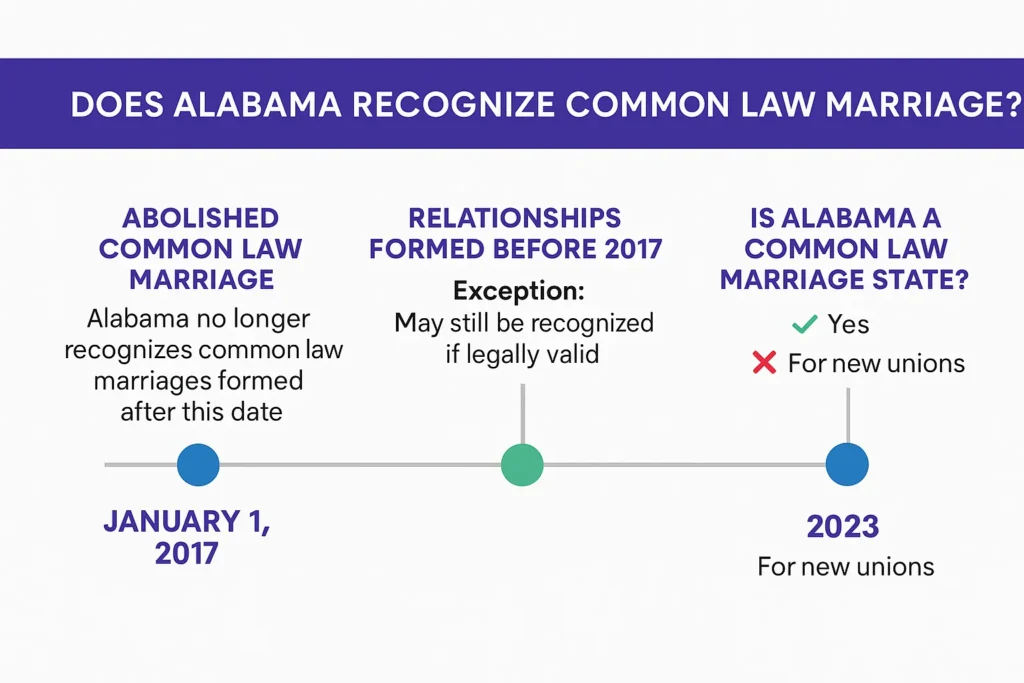
Specifically, Alabama Code § 30-1-2 states that common-law marriages entered into after January 1, 2017, are not valid. This means that for any couple who claims to have entered into a common-law marriage on or after this date, Alabama law will not recognize it as a legal union.
The Cut-Off Date: January 1, 2017
The crucial aspect of Alabama’s abolition of common-law marriage is the specific cut-off date. Any common-law marriage that was validly established in Alabama before January 1, 2017, will continue to be recognized by the state. This “grandfather clause” is a vital distinction. It acknowledges that many couples had entered into common-law marriages in good faith under the previous legal framework, and it would be unjust to invalidate those unions overnight.

Therefore, the determination of whether a common-law marriage is valid in Alabama hinges on when the couple asserts they entered into the marriage.
- Before January 1, 2017: If a couple can prove they met all the elements of a common-law marriage (present agreement, cohabitation, and public holding out) before the cut-off date, their marriage may be considered legally valid in Alabama.
- On or after January 1, 2017: Any purported common-law marriage established on or after this date will not be recognized as legal in Alabama.
Proving a Valid Common-Law Marriage (Pre-2017)
For couples who believe they established a valid common-law marriage in Alabama before January 1, 2017, the burden of proof lies with them. This often involves presenting substantial evidence to a court to demonstrate that all three essential elements were met. This evidence can be varied and may include:
- Witness Testimony: Testimony from friends, family members, neighbors, or colleagues who can attest to the couple presenting themselves as married.
- Documentary Evidence: This could include joint tax returns filed before 2017, joint bank account statements, insurance policies listing the other as a spouse, leases or deeds held jointly, and any written agreements or declarations of marital intent.
- Affidavits: Sworn statements from individuals with firsthand knowledge of the couple’s relationship and their public portrayal as married.
- Photographs and Communications: While less definitive on their own, these can provide corroborating evidence of a long-standing, married-like relationship.
The court will meticulously examine the totality of the circumstances to determine if a genuine common-law marriage existed according to the laws in effect at that time. It’s important to note that simply living together for an extended period is generally not sufficient; the intent and public representation are paramount.
Implications of Alabama’s Stance
The abolition of common-law marriage in Alabama has significant implications for individuals and couples. For those who wish to enter into a marital relationship, the path is now clear: obtain a marriage license and participate in a formal ceremony. This provides legal certainty and avoids potential disputes down the line.
For couples who believe they have a pre-2017 common-law marriage, the inability to prove its existence can have serious consequences, especially in the event of separation or the death of one partner. Without legal recognition, a partner might not have rights to:
- Inheritance: A surviving partner in an unrecognized common-law marriage may not be entitled to inherit property from the deceased partner’s estate.
- Alimony or Spousal Support: In the event of a separation, a partner in an unrecognized common-law marriage generally cannot claim spousal support.
- Division of Property: Assets acquired during the relationship may not be subject to equitable distribution as they would be in a legally recognized divorce.
- Health Insurance and Benefits: Access to health insurance or other benefits through a partner’s employer may be denied.
- Decision-Making Authority: In medical emergencies, an unrecognized partner may not have the legal standing to make healthcare decisions.
Navigating Legal Relationships in Alabama Today
Given Alabama’s current legal framework, couples who wish to formalize their commitment have two primary legal avenues:
Formal Marriage
The most straightforward and legally recognized path is a formal marriage. This involves obtaining a marriage license from the county probate judge and participating in a ceremony officiated by a licensed officiant. This process ensures legal recognition of the union and all the rights and responsibilities that come with it.
Civil Unions and Domestic Partnerships
It is important to note that Alabama does not currently offer civil unions or domestic partnerships that provide the same comprehensive legal protections as marriage. While some other states have enacted such provisions, Alabama’s legal system primarily recognizes formal marriage as the framework for committed, legally binding partnerships.

Conclusion
In summary, Alabama is not a common-law marriage state for unions entered into on or after January 1, 2017. The state abolished common-law marriages to provide greater legal clarity and certainty. However, common-law marriages that were validly established before this date are still recognized. For individuals seeking to enter into a marital relationship in Alabama today, the legally sound and advisable course of action is to pursue a formal marriage through the established licensing and ceremonial process. Understanding these distinctions is vital for protecting one’s legal rights and ensuring a clear understanding of marital status within the state.
LifeOutOfTheBox is a participant in the Amazon Services LLC Associates Program, an affiliate advertising program designed to provide a means for sites to earn advertising fees by advertising and linking to Amazon.com. Amazon, the Amazon logo, AmazonSupply, and the AmazonSupply logo are trademarks of Amazon.com, Inc. or its affiliates. As an Amazon Associate we earn affiliate commissions from qualifying purchases.