
Alabama, a state rich in history, culture, and natural beauty, often evokes images of Southern charm, civil rights landmarks, and the vibrant Crimson Tide football team. However, a curious inquiry often arises when discussing its iconic symbols: why an elephant? This particular mascot, while not officially adopted by the state government, has become inextricably linked with Alabama, primarily through its most prominent institution. Understanding this association requires a journey into the history of collegiate athletics, media perception, and the evolution of team spirit in the American South.
The Birth of a Tusker: From Newspaper Jibe to Sporting Icon
The story of Alabama’s elephant mascot is not one rooted in ancient mythology or state decree. Instead, its origin is far more contemporary and, arguably, more impactful: a playful jab that morphed into an enduring symbol. The year was 1930. The University of Alabama football team, under the legendary coach Wallace Wade, was enjoying a remarkably successful season, culminating in a victory over the heavily favored Stanford University. The championship game, played in Pasadena, California, saw the Crimson Tide emerge victorious.

It was after this momentous win that the narrative surrounding the elephant began to take hold. According to historical accounts, sports writer Ed Pope of the Atlanta Journal-Constitution is often credited with coining the term. He reportedly referred to the Alabama players as “Wade’s Junkyard Dogs” due to their relentless and tough style of play. However, another prominent sportswriter, Morgan Blake of the Birmingham News, is more consistently cited for solidifying the elephant association. Blake, observing the sheer power and unexpected dominance of the Alabama team, penned an article describing them as “the greatest [football] team that ever was… an elephant team.” The imagery was powerful: a large, formidable force that was difficult to stop and whose presence commanded respect.
The “elephant” moniker resonated with the public and, more importantly, with the student body and alumni of the University of Alabama. It was a far more majestic and impactful image than “junkyard dogs.” Elephants, after all, are known for their strength, intelligence, memory, and unyielding presence. These qualities began to be attributed to the Alabama football team, and the nickname, though initially informal, started to stick.
The Crimson Tide and the Tuscaloosa Connection
While the elephant was gaining traction as a nickname, the official team color of Alabama has always been crimson. The “Crimson Tide” moniker itself has its own interesting backstory, dating back to a 1907 football game against rival Auburn University. In that game, played in a torrential downpour, Alabama’s crimson uniforms were caked with mud, making them appear as a “crimson tide” washing over their opponents. This vivid description, penned by a sportswriter, captured the imagination and became the official team name.
The elephant, however, offered a distinct and potent visual representation that went beyond just the color. It provided a tangible mascot that fans could rally behind. The juxtaposition of the fluid, powerful “Crimson Tide” with the solid, unmovable “Elephant” created a dual identity that was both poetic and formidable. This symbiotic relationship between the color and the animal began to solidify the elephant’s place in Alabama’s sporting folklore.
From Nickname to Mascot: The Evolution of Big Al
The transition from a press box observation to an official mascot was not instantaneous. For decades, the elephant remained largely a symbolic nickname, appearing in newspaper cartoons and fan chants. It was during the latter half of the 20th century that the University of Alabama began to more formally embrace the elephant as its mascot.
The actual creation of a physical mascot costume is attributed to the late 1970s or early 1980s. The first iterations were likely rudimentary, but the concept of a costumed elephant representing the university gained momentum. This coincided with a period of renewed success for the Alabama football program, further embedding the elephant imagery into the collective consciousness of its supporters.

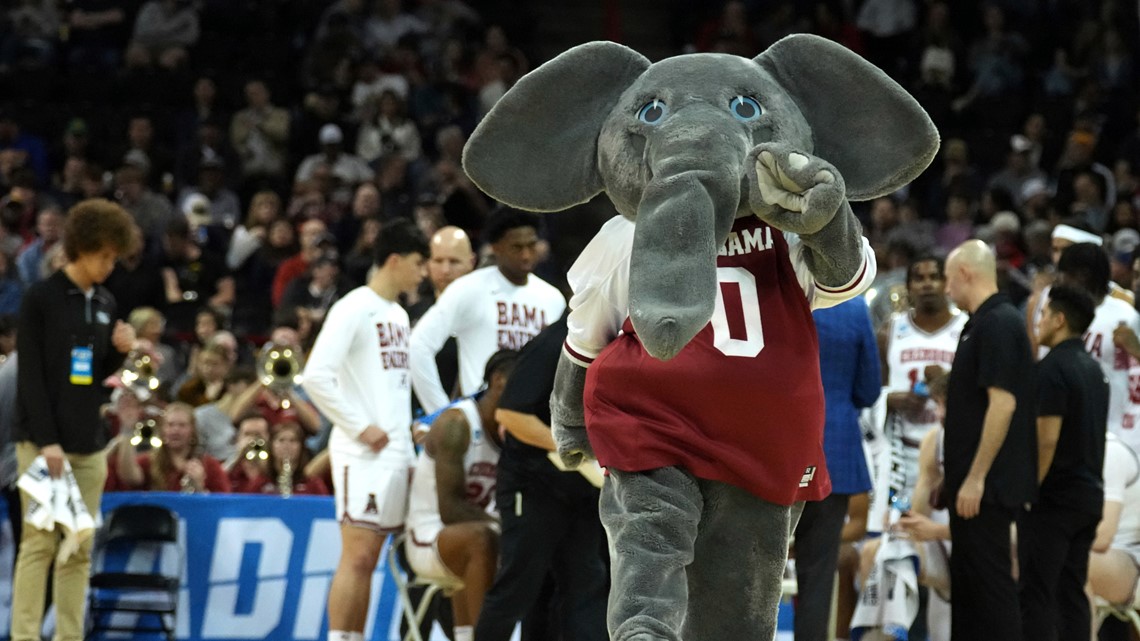
The current iteration, affectionately known as “Big Al,” is a familiar and beloved figure at University of Alabama sporting events, parades, and community gatherings. Big Al is a large, friendly-looking elephant, typically clad in Alabama’s signature crimson and white. His antics and enthusiastic presence contribute significantly to the game-day atmosphere, enhancing the fan experience and reinforcing the university’s identity.
The Psychology of a Mascot: Why Elephants Endure
The enduring appeal of the elephant as a mascot can be understood through several psychological and symbolic lenses. The elephant is universally recognized as a symbol of strength, power, and endurance. These are qualities that sports teams aspire to embody. Furthermore, elephants are known for their loyalty and close-knit social structures, which can be mirrored in the sense of community and shared identity fostered by a university and its fan base.
Moreover, the elephant’s intelligence and memory are often highlighted. This can translate to the idea of a team with a rich history, capable of remembering past victories and learning from past defeats. The sheer size and presence of an elephant also project an image of invincibility, a characteristic that fans want their teams to project onto the field or court.
The choice of an animal mascot is rarely arbitrary. It is often a reflection of perceived traits, historical context, or aspirational qualities. In Alabama’s case, the elephant perfectly captured the essence of a powerful, resilient, and historically significant football program.
Beyond Football: The Elephant’s Wider Significance
While the elephant’s association with Alabama is overwhelmingly tied to its football program, its presence extends beyond the gridiron. Big Al is a ubiquitous presence at various university events, including basketball games, baseball tournaments, and other athletic competitions. He also represents the university at community events, philanthropic activities, and outreach programs throughout the state of Alabama.
The elephant has become a unifying symbol for the entire University of Alabama community, encompassing students, faculty, alumni, and supporters. It transcends athletic rivalries and represents a shared heritage and pride. For many, the image of the elephant is synonymous with the spirit of ‘Bama.
The State Symbol Debate: A Historical Footnote
It is important to note that the elephant is not an official state mascot of Alabama. The state bird is the Northern Flicker, and the state flower is the Camellia. The elephant’s status is, therefore, primarily associated with the University of Alabama and its athletic programs.
However, the pervasive nature of the symbol means that for many, the elephant is intrinsically linked to the identity of the state, particularly its sporting culture. The nickname and mascot have become so ingrained that it is difficult to imagine Alabama without its iconic tusker.
The Legacy of the Elephant: A Symbol of Strength and Pride
The journey of the elephant from a newspaper description to a beloved mascot is a testament to the power of narrative and the enduring appeal of potent imagery. It is a story that highlights how sports, through their inherent drama and passion, can forge strong cultural symbols. The University of Alabama’s elephant mascot, Big Al, stands as a proud emblem of strength, resilience, and the unwavering spirit of the Crimson Tide. It is a symbol that has not only defined a university’s athletic identity but has also become a cherished part of the broader cultural landscape of Alabama. The next time you see an elephant representing the Crimson Tide, remember its humble origins and the powerful legacy it carries.
LifeOutOfTheBox is a participant in the Amazon Services LLC Associates Program, an affiliate advertising program designed to provide a means for sites to earn advertising fees by advertising and linking to Amazon.com. Amazon, the Amazon logo, AmazonSupply, and the AmazonSupply logo are trademarks of Amazon.com, Inc. or its affiliates. As an Amazon Associate we earn affiliate commissions from qualifying purchases.