
Establishing a Limited Liability Company (LLC) in Arizona is a strategic move for entrepreneurs seeking to protect their personal assets while operating a business. This structure offers a compelling blend of pass-through taxation and liability protection, making it a popular choice for small businesses and startups across the state. The process, while requiring attention to detail, is generally straightforward. This guide will walk you through each essential step, from initial planning to the final filing, ensuring you navigate the requirements with confidence.
Understanding the Basics of an Arizona LLC
Before diving into the procedural aspects, it’s crucial to grasp what an Arizona LLC is and the benefits it confers. An LLC is a hybrid business structure that combines the pass-through taxation of a partnership or sole proprietorship with the limited liability of a corporation. This means that the owners, known as members, are generally not personally responsible for the debts and liabilities of the business.

Key Advantages of an LLC
- Limited Liability Protection: This is the cornerstone benefit. Your personal assets—such as your home, car, and savings—are shielded from business debts and lawsuits. If the business incurs debt or faces litigation, only the assets owned by the LLC are at risk.
- Pass-Through Taxation: Unlike C-corporations, which face double taxation (once at the corporate level and again when profits are distributed to shareholders), LLCs typically avoid this. Profits and losses are passed through directly to the members’ personal income tax returns, and taxed at their individual rates.
- Flexibility in Management: LLCs offer significant flexibility in how they are managed. They can be managed by their members (member-managed) or by a designated manager or group of managers (manager-managed). This allows businesses to tailor their operational structure to their specific needs.
- Simpler Compliance: Compared to corporations, LLCs generally have fewer formal operating requirements. There are no mandatory annual board meetings or complex record-keeping obligations in the same way as a corporation.
Types of Arizona LLCs
Arizona recognizes several types of LLCs, though the most common for new businesses is the standard Domestic LLC.
- Domestic LLC: This is an LLC formed within Arizona by filing with the Arizona Corporation Commission.
- Foreign LLC: An LLC formed in another state or country that wishes to do business in Arizona must register as a foreign LLC.
For the purpose of this guide, we will focus on establishing a Domestic LLC in Arizona.
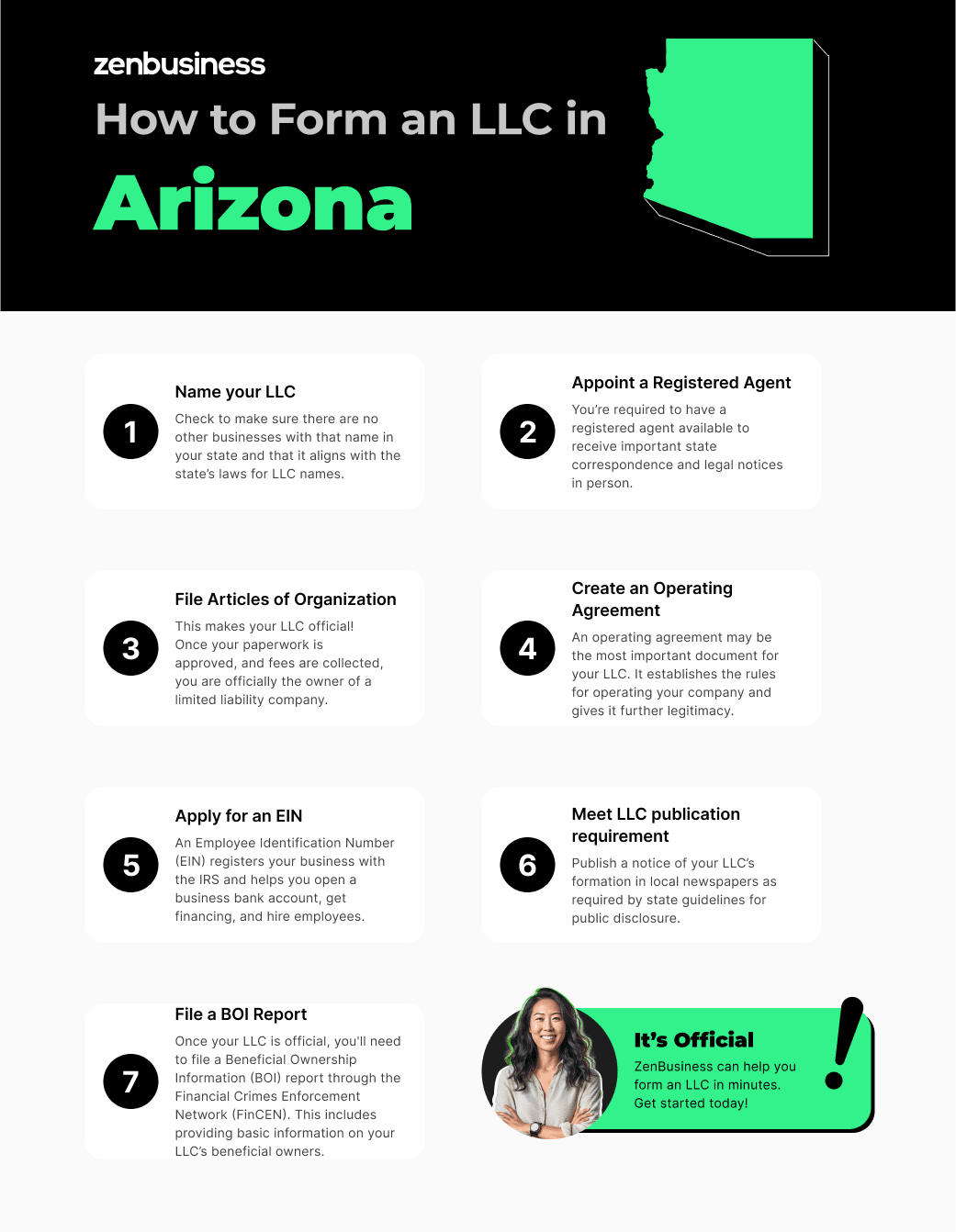
Step 1: Choose a Business Name
Selecting a unique and compliant business name is a critical first step. Your chosen name must adhere to specific naming conventions set forth by the Arizona Corporation Commission (ACC).
Naming Requirements
- Uniqueness: The name must be distinguishable from all other business entities registered with the ACC. You cannot choose a name that is already in use by a corporation, LLC, or other registered entity in Arizona.
- Required Designator: The name must include an LLC designator, such as “Limited Liability Company,” “LLC,” or “L.L.C.”
- Prohibited Words: Certain words are restricted or prohibited, such as “Bank,” “Trust,” “Insurance,” or other words that may imply the company is a government agency or a type of business that requires specific licensing not relevant to an LLC.
Checking Name Availability
To ensure your desired name is available, you must conduct a search of the ACC’s business entity database.
- Access the ACC Website: Navigate to the Arizona Corporation Commission website.
- Business Entity Search: Locate the business entity search tool. This will allow you to enter your proposed name and see if it’s already registered.
- Reserve Your Name (Optional): If your desired name is available, you have the option to reserve it for up to 120 days by filing a Name Reservation form with the ACC. This is recommended if you are not immediately ready to file your formation documents but want to secure the name.
Step 2: Appoint a Registered Agent
Every LLC in Arizona must designate and maintain a registered agent. This individual or company serves as the official point of contact for the LLC to receive legal documents, such as service of process, and official state correspondence.
Requirements for a Registered Agent
- Physical Address: The registered agent must have a physical street address within Arizona. A P.O. Box is not acceptable for the registered agent’s address.
- Availability: The agent must be available during normal business hours to accept important documents.
- Acceptance of Service: The agent must agree to accept legal and official notices on behalf of the LLC.
Who Can Be a Registered Agent?
- An Individual Resident of Arizona: This can be you, another member of your LLC, or a trusted individual who meets the criteria.
- A Domestic Business Entity: An Arizona-based company that is authorized to do business in the state.
- A Foreign Business Entity: A company from another state or country that is registered to do business in Arizona.
Many entrepreneurs choose to use a commercial registered agent service. These services specialize in fulfilling the registered agent requirement, offering reliability, confidentiality, and extended business hours, which can be particularly beneficial if you travel frequently or work remotely.
Step 3: File Articles of Organization
The Articles of Organization (also known as a Certificate of Formation) is the legal document that officially creates your LLC with the state of Arizona. This document is filed with the Arizona Corporation Commission.
Information Required in the Articles of Organization
While the exact wording may vary slightly, the Articles of Organization typically require the following information:
- Name of the LLC: The exact name you have chosen and verified.
- Name and Address of the Registered Agent: The name and physical street address of your designated registered agent in Arizona.
- Principal Office Address: The primary business address of your LLC. This is where the business is primarily conducted.
- Management Structure: Indicate whether the LLC will be member-managed or manager-managed.
- Name and Address of Organizer(s): The name and address of the person or entity filing the Articles of Organization. This is often the initial owner.
- Effective Date: You can specify an effective date for your LLC, which can be up to 90 days in the future. If no date is specified, it becomes effective upon filing.
Filing the Articles of Organization
- Obtain the Form: You can download the Articles of Organization form from the Arizona Corporation Commission website or prepare your own document following the state’s guidelines.
- Complete the Form: Fill out all required fields accurately.
- Submission: File the completed Articles of Organization with the ACC. This can typically be done online, by mail, or in person.
- Filing Fee: There is a filing fee associated with submitting the Articles of Organization. Check the ACC website for the current fee schedule.

Once the ACC approves and files your Articles of Organization, your LLC is legally formed in Arizona.
Step 4: Create an Operating Agreement
While not legally required by the state of Arizona for LLCs, an Operating Agreement is a crucial internal document that outlines the ownership structure, operating procedures, and member responsibilities of your LLC. It is highly recommended for all LLCs, regardless of size or number of members.
Purpose of an Operating Agreement
The Operating Agreement acts as a roadmap for your business, detailing how it will be run and how decisions will be made. It can:
- Define Ownership Percentages: Clearly state each member’s ownership stake and their contributions.
- Outline Member Responsibilities: Specify the roles and duties of each member or manager.
- Establish Voting Rights: Detail how decisions will be made and what constitutes a majority or unanimous vote.
- Specify Profit and Loss Distribution: How profits and losses will be allocated among members.
- Detail Procedures for Adding or Removing Members: Outline the process for bringing in new members or for existing members to leave the LLC.
- Address Dissolution: Define how the LLC will be dissolved and its assets distributed if the business ceases operations.
A well-drafted Operating Agreement can prevent disputes among members and provide clarity in various business scenarios, strengthening the operational integrity of your LLC.
Step 5: Obtain an EIN (Employer Identification Number)
An Employer Identification Number (EIN), also known as a Federal Tax Identification Number, is a unique nine-digit number assigned by the Internal Revenue Service (IRS) to business entities for tax identification purposes. It is essentially a Social Security number for your business.
When You Need an EIN
You will generally need an EIN if your LLC:
- Has more than one member (i.e., it’s a multi-member LLC).
- Plans to hire employees.
- Operates as a corporation or partnership for tax purposes.
- Files tax returns for excise taxes, alcohol, tobacco, or firearms.
- Is involved with certain types of organizations, such as trusts, estates, real estate mortgage investment conduits, or non-profit organizations.
Even if your LLC is single-member and doesn’t plan to hire employees, obtaining an EIN is often advisable. It allows you to open a business bank account, which is crucial for maintaining the separation between personal and business finances and preserving your limited liability protection.
How to Apply for an EIN
Applying for an EIN is a free and straightforward process conducted through the IRS website:
- Visit the IRS Website: Go to the IRS.gov website.
- Apply for an EIN Online: Look for the “Apply for an Employer Identification Number (EIN) Online” link.
- Complete the Application: You will be asked to provide information about your LLC, including its name, address, and responsible party.
- Receive Your EIN: Upon successful completion, you will receive your EIN immediately.
Step 6: Open a Business Bank Account
Separating your personal finances from your business finances is a critical step in maintaining the limited liability protection your LLC provides. Opening a dedicated business bank account is essential for this separation.
Why a Separate Bank Account is Crucial
- Liability Protection: Commingling personal and business funds can “pierce the corporate veil,” making you personally liable for business debts.
- Financial Clarity: A dedicated account simplifies bookkeeping, accounting, and tax preparation.
- Professionalism: It presents a more professional image to clients, vendors, and financial institutions.
What You’ll Need
When you go to open your business bank account, you will typically need:
- Articles of Organization: A copy of your filed document.
- EIN: Your Employer Identification Number.
- Government-Issued ID: For the LLC members or authorized signatories.
- Business Formation Documents: Potentially your Operating Agreement.
Most banks have specific requirements, so it’s advisable to contact your chosen financial institution in advance to confirm what documentation they will need.
Ongoing Compliance in Arizona
Once your LLC is established, there are ongoing responsibilities to ensure it remains in good standing with the state and federal authorities.
Annual Report
Arizona does not require a traditional annual report for LLCs. Instead, LLCs are required to pay an annual statutory fee to the Arizona Corporation Commission. This fee ensures that the ACC has current contact information for the LLC.
Tax Obligations
- Federal Taxes: You will need to file federal tax returns for your LLC. The specific forms depend on your LLC’s tax classification (e.g., disregarded entity, partnership, S-corp, C-corp).
- State Taxes: Arizona has its own state tax laws. Depending on your business activities, you may need to register for and pay state income tax, transaction privilege tax (sales tax), and other applicable taxes. Consult with a tax professional familiar with Arizona tax law.
By diligently following these steps and maintaining ongoing compliance, you can successfully establish and operate your Limited Liability Company in Arizona, reaping the significant benefits of liability protection and operational flexibility.
LifeOutOfTheBox is a participant in the Amazon Services LLC Associates Program, an affiliate advertising program designed to provide a means for sites to earn advertising fees by advertising and linking to Amazon.com. Amazon, the Amazon logo, AmazonSupply, and the AmazonSupply logo are trademarks of Amazon.com, Inc. or its affiliates. As an Amazon Associate we earn affiliate commissions from qualifying purchases.