
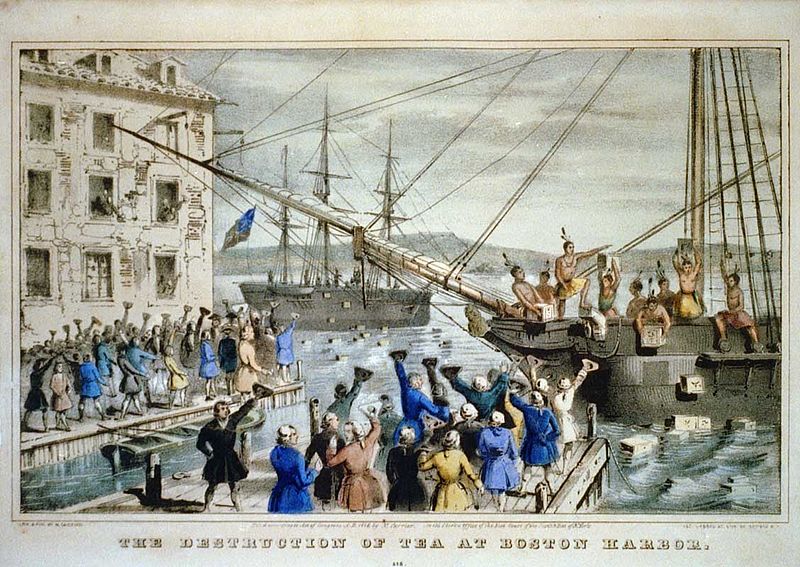
The audacious act of defiance known as the Boston Tea Party on December 16, 1773, sent shockwaves across the Atlantic, reaching the opulent halls of power in London and igniting a furious debate within the British government. The colonists, disguised as Mohawk Indians, had boarded three ships docked in Boston Harbor and systematically dumped 342 chests of tea, belonging to the British East India Company, into the frigid waters. This protest, a dramatic escalation of simmering discontent over taxation without representation, was not met with a measured response. Instead, it precipitated a series of punitive measures designed to reassert parliamentary authority and quell the burgeoning spirit of rebellion in the American colonies.

The Immediate Aftermath: Outrage and Retaliation
News of the destruction of private property, particularly valuable cargo belonging to a vital British enterprise, was met with unbridled outrage by King George III and his ministers. The prevailing sentiment in Parliament was that the colonists had crossed a line, moving from civil disobedience to outright criminality. The perceived insolence and disrespect for British law demanded a swift and severe response. This was not merely about the financial loss, though that was substantial; it was about the principle of parliamentary supremacy, which the actions in Boston seemed to fundamentally challenge.
The Debate in Parliament
Within days of receiving dispatches from the Governor of Massachusetts, Lord North, the Prime Minister, moved with alacrity. He presented a series of legislative proposals to Parliament, which were met with widespread support across the political spectrum. While some few voices, like that of Edmund Burke, cautioned against overly harsh measures and urged for a more conciliatory approach, the dominant mood was one of retribution. The government’s argument was that the radical elements in Massachusetts had to be brought to heel, and that a strong hand was necessary to preserve the integrity of the British Empire. The Boston Tea Party was seen not as a legitimate protest, but as an act of anarchy that could inspire similar unrest elsewhere.
The Coercive Acts: A Draconian Response
The British response coalesced into a package of five legislative acts, passed in the spring of 1774, which the colonists would come to vehemently refer to as the “Intolerable Acts.” These measures were specifically designed to punish Massachusetts and, by extension, to serve as a stark warning to the other colonies. The intention was clear: to isolate Boston, cripple its economy, and demonstrate the futility of challenging British authority.
The Boston Port Act
The most immediate and impactful of the Coercive Acts was the Boston Port Act. This act ordered the closure of the port of Boston until the destroyed tea was paid for and the East India Company was reimbursed for its losses. This was a devastating blow to the city’s economy, which relied heavily on maritime trade. The act effectively put a stranglehold on commerce, impacting merchants, dockworkers, and countless others who depended on the port for their livelihoods. The intent was to starve the city into submission, forcing its inhabitants to pressure their leaders into appeasing British demands.
The Massachusetts Government Act
Another cornerstone of the punitive response was the Massachusetts Government Act. This act drastically altered the colony’s charter, effectively turning a self-governing colony into one under direct British control. Town meetings, a vital forum for colonial political discourse, were severely restricted. The governor’s council, previously an elected body, was now appointed by the Crown. Furthermore, judges and other officials, who had previously been elected or appointed with the consent of colonial assemblies, were now appointed directly by the governor or the Crown. This was a direct assault on the colonists’ perceived rights as Englishmen and their established forms of self-governance.
The Administration of Justice Act
To ensure that those accused of crimes, particularly those involving the enforcement of British law, would face a fair trial from the perspective of the Crown, the Administration of Justice Act was enacted. This act allowed for accused royal officials and soldiers to be sent to another colony or to Great Britain for trial if the governor deemed it impossible to secure an impartial jury in Massachusetts. Colonists viewed this with deep suspicion, labeling it the “Murder Act” because they feared it would allow British officials to commit acts of violence against them with impunity, knowing they would likely not be convicted in their home colony.
The Quartering Act
While not entirely new, the Quartering Act of 1774 was significantly expanded and applied more stringently to all colonies. It required colonial authorities to house and supply British soldiers, even in private homes if suitable barracks were not available. For colonists already resentful of the presence of British troops, this measure was seen as an imposition and a violation of their property rights. It served as a constant physical reminder of British power and control.
The Unintended Consequences: Uniting the Colonies
Ironically, the stringent and punitive nature of the Coercive Acts, intended to isolate and subdue Massachusetts, had the opposite effect. Instead of fostering fear and compliance, the harsh measures galvanized intercolonial solidarity. The other colonies, witnessing the severity with which Boston was being treated, began to see their own liberties as being under threat. The “Intolerable Acts” became a rallying cry, uniting thirteen disparate colonies under a common banner of grievance against perceived British tyranny.
The First Continental Congress
In response to the Coercive Acts, delegates from twelve of the thirteen colonies (Georgia did not send a representative initially) convened in Philadelphia in September 1774 for the First Continental Congress. This was a landmark event, marking a significant step towards unified colonial action. The Congress did not immediately call for independence, but it did adopt a Declaration of Rights and Grievances, protested the Coercive Acts, and established the Continental Association, an agreement to boycott British goods. This coordinated economic pressure was a powerful demonstration of colonial unity and resolve.

Escalation Towards Conflict
The British response, therefore, proved to be a critical turning point in the lead-up to the American Revolution. While the intention was to punish and control, the Coercive Acts inadvertently fostered a sense of shared identity and purpose among the colonies. The destruction of tea in Boston Harbor, a symbolic act of defiance, was met with a legislative hammer blow that, rather than breaking the colonial spirit, forged it into something stronger and more unified. The events of 1774 set the stage for the armed conflict that would erupt less than a year later at Lexington and Concord, ultimately leading to the birth of a new nation. The British, in their zeal to assert authority, had inadvertently sown the seeds of their own imperial unraveling.
LifeOutOfTheBox is a participant in the Amazon Services LLC Associates Program, an affiliate advertising program designed to provide a means for sites to earn advertising fees by advertising and linking to Amazon.com. Amazon, the Amazon logo, AmazonSupply, and the AmazonSupply logo are trademarks of Amazon.com, Inc. or its affiliates. As an Amazon Associate we earn affiliate commissions from qualifying purchases.