
Understanding the legal landscape of relationships is paramount for anyone building a life in, or even just visiting, the Golden State. For many, the concept of common law marriage evokes images of long-term cohabitation granting the same rights and responsibilities as a formal, solemnized union. However, when it comes to California, the reality is distinct and often misunderstood, having significant implications for personal finance, property, and family planning within your chosen lifestyle.
Understanding Common Law Marriage
Common law marriage, at its core, is a legal framework that recognizes a couple as legally married without a formal ceremony or marriage license. This recognition typically hinges on several key conditions being met, demonstrating the couple’s intent to be married and their public presentation as such. It’s a concept steeped in historical tradition, dating back to times when formal ceremonies were less accessible.
Historical Context and Definition
Historically, common law marriage arose out of necessity, particularly in remote areas or during periods when state-sanctioned ceremonies were difficult to arrange. The underlying principle was that if a couple presented themselves to the community as husband and wife, and intended to be married, the state would recognize their union for legal purposes. The definitive characteristics generally include:
- Intent to Marry: Both parties must agree to be married and intend to enter into a marital relationship.
- Holding Out: The couple must publicly represent themselves as married to friends, family, and the community. This often involves using the same surname, referring to each other as “my spouse,” or filing joint tax returns.
- Cohabitation: The couple must live together as husband and wife.
It’s important to note that merely living together, even for an extended period, does not automatically constitute common law marriage in states where it is recognized. The intent and public declaration are critical components.
States Where it is Recognized
While many people assume common law marriage is widespread, it is actually quite rare in the United States today. The vast majority of states have abolished it, often replacing it with formal marriage requirements and, in some cases, domestic partnership laws. Currently, only a handful of states and the District of Columbia still recognize common law marriage if specific criteria are met. These include Colorado, Iowa, Kansas, Montana, New Hampshire (for inheritance purposes only), Oklahoma, Rhode Island, South Carolina, Texas, Utah, and the District of Columbia. Each of these jurisdictions has its own specific legal requirements and precedents for establishing such a union. This limited recognition highlights the need for careful investigation based on location.
The California Stance: A Clear “No”
For individuals and couples living in or relocating to California, a common question arises: does this state recognize common law marriage? The answer is an unequivocal no. California abolished common law marriage in 1895, making it one of the earliest states to do so. Since then, the state has consistently maintained that for a marriage to be legally recognized within its borders, it must be solemnized according to specific statutory requirements.
Legal Requirements for Marriage in California
In California, a marriage is a civil contract between two people, which requires:
- A Marriage License: Couples must obtain a valid marriage license from a county clerk’s office. This license is generally valid for 90 days from the date of issue.
- Solemnization: The marriage must be solemnized by an authorized person, such as a judge, retired judge, commissioner, assistant commissioner, priest, minister, rabbi, or other religious officiant. In some cases, couples can also get married through a confidential marriage process or by a notary public specifically authorized to perform marriages.
- Witnesses (for public licenses): For a public marriage license, at least one witness must be present at the ceremony and sign the marriage certificate.
- Registration: The officiant must return the signed marriage license to the county clerk’s office for registration, at which point the marriage becomes legally effective.
Without these steps, no matter how long a couple lives together, how they present themselves to the public, or how many children they may have, California will not recognize their relationship as a legal marriage.
Distinguishing Between Marriage and Domestic Partnerships
While common law marriage does not exist, California does offer an alternative legal status for couples who wish to formalize their relationship without entering into a traditional marriage: the domestic partnership.
A California domestic partnership grants many of the same rights, responsibilities, and protections as marriage under state law. This includes rights related to community property, inheritance, hospital visitation, and certain insurance benefits. Both same-sex and opposite-sex couples who meet specific criteria (e.g., being over 18, not currently married or in another domestic partnership) can register as domestic partners with the California Secretary of State.
It is crucial to understand that a domestic partnership is a registered legal status, requiring formal action similar to obtaining a marriage license. It is not something that arises automatically from cohabitation or intent. For couples seeking to define their commitment and secure legal protections without traditional marriage, a domestic partnership offers a robust option, aligning with a diverse range of lifestyle choices in California.
Implications for California Residents and Visitors
The absence of common law marriage in California has profound implications for unmarried couples, influencing everything from property ownership to inheritance rights. Understanding these distinctions is crucial for anyone planning their life, finances, and relationships within the state.

Property Rights and Financial Considerations
For unmarried couples in California, property acquired during cohabitation is not automatically considered community property, which is the default for married couples. Instead, property ownership is typically determined by title, contributions, or explicit agreements. This means:
- Separate Property: Property acquired by each individual before or during the relationship, if kept separate, remains their individual property.
- Joint Tenancy or Tenancy in Common: If property (like a house or car) is purchased jointly, the ownership stakes are determined by how the title is held. Without explicit agreements, dividing assets upon separation can become complex and contentious.
- No Automatic Spousal Support: Unlike married couples who may be entitled to spousal support (alimony) upon divorce, unmarried partners have no automatic right to financial support from their ex-partner after a breakup.
- “Palimony” and Express/Implied Contracts: While there’s no automatic right to support, California courts may enforce express or implied contracts between unmarried partners regarding financial arrangements or property division. This concept, sometimes colloquially referred to as “palimony” (from the landmark case Marvin v. Marvin), allows for a former partner to sue for their share of assets or support if they can prove such an agreement existed, oral or written. However, proving an implied contract can be difficult and costly, often requiring extensive litigation.
Therefore, for unmarried couples, having clear written agreements (like cohabitation agreements or property sharing agreements) is highly advisable to define financial responsibilities, asset ownership, and what happens in case of separation.
Child Custody and Support
Regardless of marital status, parents in California have equal rights and responsibilities concerning their children. If a child is born to unmarried parents, both parents typically have rights to seek custody and visitation, and both are obligated to provide financial support for the child. The legal process for determining custody, visitation, and child support is the same whether the parents were married, domestic partners, or simply cohabitating. The focus remains on the child’s best interests.
Estate Planning and Inheritance
Without a will or trust, California intestacy laws dictate how property is distributed upon death. These laws prioritize legal spouses, registered domestic partners, and blood relatives. Unmarried partners have no automatic inheritance rights under these laws. If an unmarried partner dies without a will, their long-term companion could be left with no legal claim to their estate, regardless of how intertwined their lives or finances were.
To protect an unmarried partner’s interests, careful estate planning is essential. This includes creating a will, establishing trusts, naming beneficiaries on financial accounts, and designating healthcare and financial powers of attorney. These documents become critical components of a thoughtful lifestyle plan, ensuring your wishes are honored and your partner is protected.
Recognizing Out-of-State Common Law Marriages
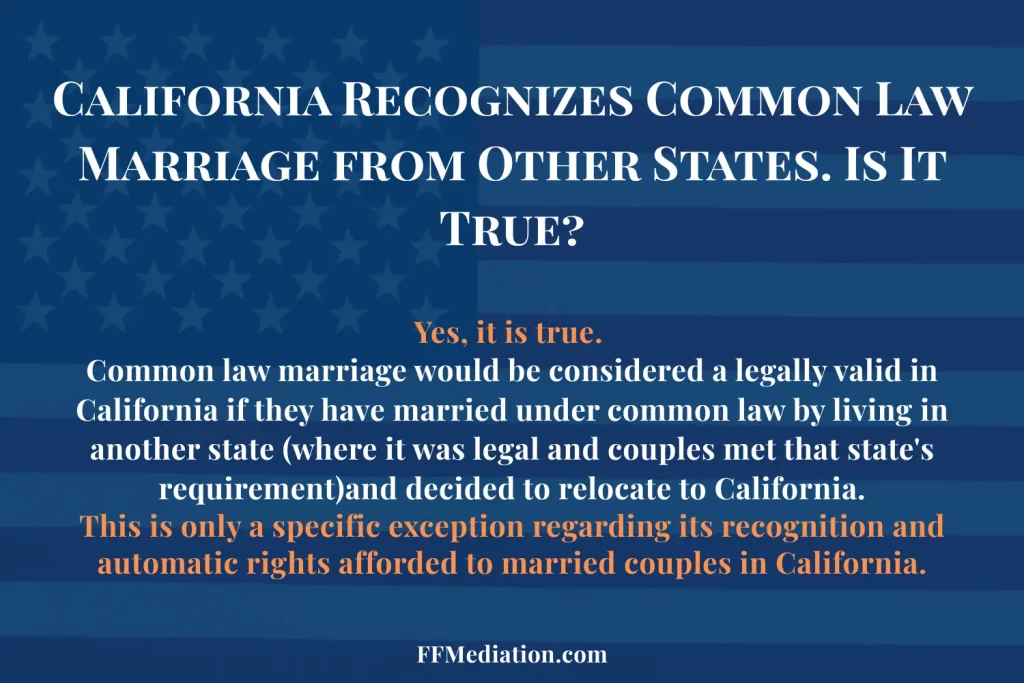
While California does not permit the formation of common law marriages within its borders, it generally recognizes common law marriages that were validly established in other states or jurisdictions where such unions are legal. This recognition is largely due to the “Full Faith and Credit Clause” of the U.S. Constitution.
The Full Faith and Credit Clause
Article IV, Section 1 of the U.S. Constitution, known as the Full Faith and Credit Clause, generally requires states to respect the “public acts, records, and judicial proceedings of every other state.” This means that if a couple validly entered into a common law marriage in a state where it is recognized, California will typically treat that marriage as valid if the couple subsequently moves to California.
This principle is vital for maintaining uniformity and predictability in legal matters across state lines. For instance, if a couple formed a valid common law marriage in Texas and then moved to Los Angeles, California courts would generally recognize them as married, entitling them to the same rights and responsibilities as couples who formally married in California. This means that if they were to separate, they would likely need to undergo a formal divorce proceeding in California to dissolve their union, complete with community property division and potential spousal support.
Proving a Valid Common Law Marriage
The challenge often lies in proving that a common law marriage was, in fact, validly established in the first place in the originating state. When seeking to assert rights as a common law spouse in California, the burden of proof rests on the individual claiming the marriage. They must present evidence demonstrating that they met all the legal requirements for a common law marriage in the state where it was allegedly formed. This could involve:
- Declarations of Marriage: Any formal declarations or registrations of common law marriage, if available in the originating state.
- Joint Tax Returns: Filing taxes as “married filing jointly.”
- Public Representation: Testimonies from friends, family, or colleagues confirming they held themselves out as married.
- Shared Accounts/Property: Joint bank accounts, property titles, or loan documents.
- Consistent Use of Shared Name: Evidence of consistently using a shared surname.
Without sufficient evidence, even a long-term cohabiting couple from a common law marriage state may face significant hurdles in establishing their marital status in California courts, potentially affecting their ability to claim spousal rights.

Why This Matters for Your California Lifestyle
The distinct legal approach of California to marriage and relationships profoundly shapes the lifestyle choices and protections available to its residents. For many, the perception of common law marriage being a universal concept can lead to critical oversights in personal planning.
Living in California, whether you’re a long-time resident of San Francisco, a new arrival in San Diego, or establishing roots in Sacramento, requires proactive measures if you choose to live with a partner without formal marriage. Failing to understand that cohabitation alone provides no marital protections can result in financial hardship, complicated property disputes, and emotional distress should the relationship end or a partner pass away.
For couples committed to building a life together, regardless of their path to formalizing their union, clarity is key. This means considering legal options like registered domestic partnerships, or meticulously drafting cohabitation agreements, property agreements, wills, and other estate planning documents. These legal tools ensure that your lifestyle choices are legally supported, protecting your interests, assets, and loved ones. Consulting with a California family law attorney is always recommended to navigate these complexities and ensure your personal and financial arrangements align with your intentions and the state’s legal framework, allowing you to confidently embrace all that the California lifestyle has to offer.
LifeOutOfTheBox is a participant in the Amazon Services LLC Associates Program, an affiliate advertising program designed to provide a means for sites to earn advertising fees by advertising and linking to Amazon.com. Amazon, the Amazon logo, AmazonSupply, and the AmazonSupply logo are trademarks of Amazon.com, Inc. or its affiliates. As an Amazon Associate we earn affiliate commissions from qualifying purchases.