
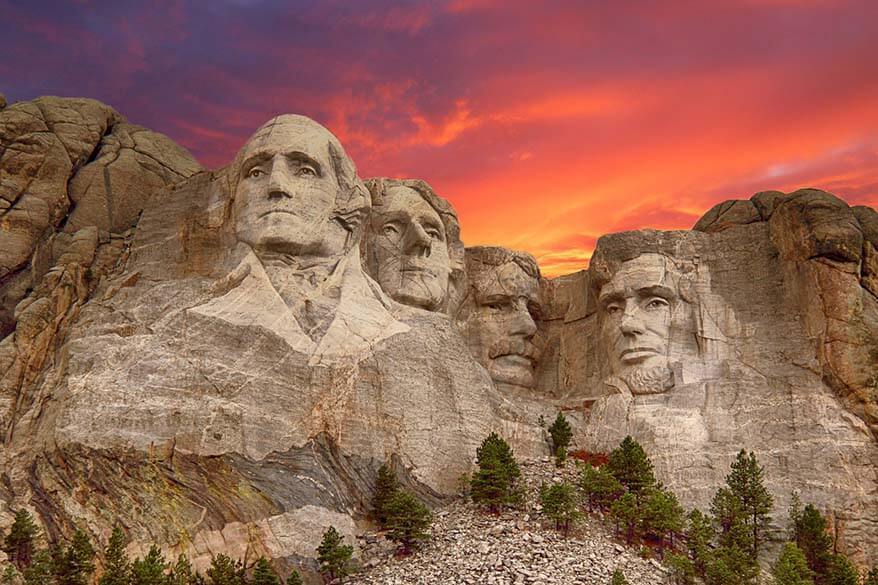
The iconic Mount Rushmore National Memorial, a colossal granite sculpture depicting four revered U.S. presidents, is not situated within a major city. Instead, this profound national landmark is nestled in the Black Hills region of South Dakota, its immediate proximity being to the small town of Keystone. While Keystone serves as the closest community, providing essential services and a charming base for visitors, the larger metropolitan hub of Rapid City often functions as the primary gateway to the monument and the broader Black Hills area. Understanding Mount Rushmore’s location involves appreciating its deliberate placement within a natural canvas, a decision intrinsically linked to its historical development and symbolic resonance as a monumental work of art and a testament to American democracy.
The Geographic Setting of Mount Rushmore National Memorial
Mount Rushmore’s placement is a critical aspect of its identity as a landmark. It rises dramatically from the ancient, forested landscape of the Black Hills, a sacred region to the Lakota Sioux and a geological marvel. This setting was intentionally chosen for its grandeur and the inherent artistic medium it provided. The monument itself is carved into the southeastern face of Rushmore Mountain, a granite peak that offered both the necessary scale and durability for such an ambitious project.
The Proximate Town: Keystone, South Dakota
The nearest community to Mount Rushmore National Memorial is Keystone, South Dakota. Located just a few miles from the monument, Keystone emerged largely to support the construction and subsequent tourism surrounding Mount Rushmore. This small town, with its quaint main street and historic character, serves as the most direct point of access for many visitors. Its development is inextricably linked to the landmark, acting as a functional outpost that respects the natural and monumental integrity of its famous neighbor. While not a large city, Keystone’s existence and sustained activity are a direct consequence of Mount Rushmore’s profound draw, underscoring how a monumental landmark can shape the very communities around it. The town itself stands as a living testament to the economic and cultural impact of the national memorial.
The Black Hills Context: A Natural Pedestal
The broader geographical context of the Black Hills is paramount to understanding Mount Rushmore. These ancient mountains, rising abruptly from the Great Plains, are a geological anomaly. Composed primarily of granite and other igneous and metamorphic rocks, they possess a unique beauty and ecological diversity. The choice of Mount Rushmore as the site was not arbitrary; the exposed granite face of Rushmore Mountain provided the ideal medium for a sculpture of this magnitude. The natural grandeur of the Black Hills augments the monument’s impact, framing it within a landscape that is both rugged and profoundly beautiful. The forested slopes and dramatic rock formations provide a spectacular backdrop, enhancing the visual and symbolic power of the carved faces. The entire region, therefore, acts as a natural pedestal for this monumental work, embedding it deeply within the fabric of South Dakota’s natural heritage. This integration of human artistry with raw natural beauty is a defining characteristic of Mount Rushmore as a landmark.
The Monument’s Genesis: History and Vision
The conception and realization of Mount Rushmore represent an extraordinary chapter in American monumental art. The idea originated with Doane Robinson, a South Dakota historian, who in 1923 envisioned carving heroic figures into the Black Hills to attract tourism to the state. His vision, however, quickly transcended mere economic stimulus, evolving into a profound statement on American history and ideals under the hands of its chief sculptor.
Conceptualization and Gutzon Borglum’s Role
Doane Robinson initially sought to depict Western heroes like Lewis and Clark or Red Cloud. However, when the renowned Danish-American sculptor Gutzon Borglum was brought into the project in 1924, his artistic ambition and nationalistic fervor reshaped the entire undertaking. Borglum, known for his earlier monumental works such as the Stone Mountain carving in Georgia (though never completed by him), saw an opportunity for a truly national monument. He convinced Robinson and the project’s sponsors that the sculpture should embody the birth, growth, preservation, and development of the United States. This elevated the project from a regional attraction to a national shrine. Borglum’s vision was not just about carving faces, but about embedding a narrative of American idealism into the very bedrock of the nation. His tireless lobbying, artistic genius, and unwavering dedication were instrumental in securing federal funding and support, culminating in the official dedication of the Mount Rushmore National Memorial Commission by President Calvin Coolidge in 1925.
The Four Presidents: Symbolic Representation
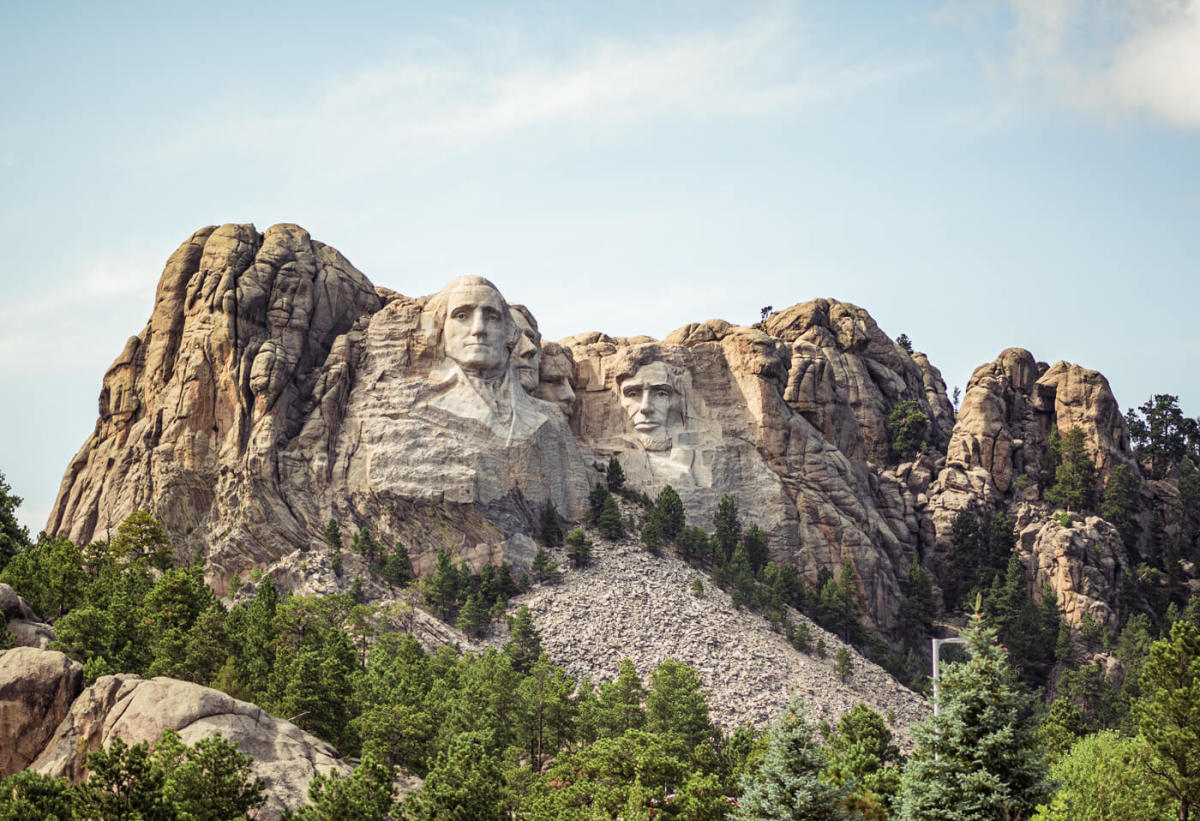
The choice of the four presidents carved into Mount Rushmore was meticulously deliberate, each figure representing a crucial phase of American history, as interpreted by Gutzon Borglum.
- George Washington: As the “Father of His Country” and the nation’s first president, Washington represents the birth of the United States and its struggle for independence and self-governance. His leadership during the Revolutionary War and his role in establishing the new republic are foundational.
- Thomas Jefferson: The principal author of the Declaration of Independence and the president responsible for the Louisiana Purchase, Jefferson symbolizes the growth and expansion of the nation, embodying the spirit of westward exploration and democratic ideals.
- Theodore Roosevelt: A champion of conservation, business regulation, and the Panama Canal project, Roosevelt represents the development of the United States into a world power during the 20th century. His energy and progressive reforms aimed to ensure the nation’s continued vitality and strength.
- Abraham Lincoln: The president who led the nation through its greatest internal crisis, the Civil War, Lincoln represents the preservation of the United States and the pursuit of equality. His leadership during a time of division secured the union and paved the way for a more unified future.
Together, these four faces present a narrative arc of American history, carved into the enduring granite as a perpetual reminder of the nation’s journey and its core principles.
Architectural Feat and Artistic Legacy
Mount Rushmore is not merely a colossal carving; it is an extraordinary blend of architectural engineering, artistic vision, and the raw power of nature. From 1927 to 1941, under the leadership of Gutzon Borglum and later his son, Lincoln Borglum, hundreds of workers transformed a mountain face into a monumental sculpture, employing innovative techniques for the era.
Engineering on Granite
The construction of Mount Rushmore was an unparalleled engineering challenge. Ninety percent of the mountain’s 450,000 tons of rock was removed using dynamite, a method that required immense precision and skill to avoid damaging the final forms. Workers, often dangling from bosun chairs 500 feet in the air, used jackhammers, drills, and chisels to refine the features. Borglum devised a “pointing machine,” similar to a pantograph, to transfer the scale models he created in his studio to the mountain face, ensuring accuracy in proportion and detail. This ingenious system allowed for the precise scaling up of small plaster models to the immense size of the mountain. The finished faces are approximately 60 feet (18 meters) high, with eyes 11 feet (3.4 meters) wide and mouths 18 feet (5.5 meters) wide. The sheer scale, combined with the difficult terrain and the limitations of 20th-century technology, makes Mount Rushmore a monumental achievement in structural and sculptural engineering, pushing the boundaries of what was thought possible in large-scale art.
The Enduring Shrine of Democracy
As an architectural and artistic legacy, Mount Rushmore stands as a testament to the enduring ideals of American democracy. Its placement in the remote yet accessible Black Hills elevates it beyond a mere tourist attraction; it is a “Shrine of Democracy,” as Borglum intended. The monument’s grandeur lies not just in its physical size but in its symbolic power. It embodies the nation’s origins, expansion, preservation, and development, etched into the granite for millennia. The stoic gazes of the four presidents—Washington, Jefferson, Roosevelt, and Lincoln—serve as a perpetual reminder of leadership, vision, and the sacrifices made to forge and maintain the United States. This massive sculpture transcends its material form to become a powerful cultural artifact, a physical manifestation of national identity and historical narrative. Its design principles, emphasizing clear lines and recognizable features, ensure its impact and legibility from a distance, making it an iconic piece of American monumental architecture.
Mount Rushmore as a National Symbol
Beyond its geographical location and the sheer audacity of its creation, Mount Rushmore National Memorial holds an unparalleled status as a national symbol. It is not merely a collection of faces carved into rock; it is a repository of American aspirations and a focal point for national identity, managed by the National Park Service.
A Beacon of American Ideals
Mount Rushmore was conceived as an eternal beacon, illustrating the ideals upon which the United States was founded and developed. The towering visages of George Washington, Thomas Jefferson, Theodore Roosevelt, and Abraham Lincoln collectively represent the birth of the nation, its expansion, its preservation, and its development into a global power. Each president embodies distinct, yet interconnected, facets of the American experience—liberty, democracy, innovation, and unity. The monument serves as a powerful reminder of the enduring principles enshrined in the nation’s founding documents and the leaders who championed them. It is a place where these abstract ideals are rendered concrete and monumental, inviting reflection on the past, present, and future of the American experiment. The monument’s location in the natural wilderness of the Black Hills further enhances its symbolic weight, suggesting a deeply rooted and enduring connection between the nation’s history and its vast, untamed landscapes.

Preservation and Interpretation
The National Park Service is tasked with the monumental responsibility of preserving Mount Rushmore for future generations while also interpreting its complex history and symbolism. This involves intricate geological monitoring to detect any potential structural issues in the granite, regular cleaning and sealing processes, and continuous research into the monument’s creation and its impact. Beyond the physical preservation, the National Park Service plays a crucial role in providing educational content, ensuring that visitors understand not only the artistic and engineering marvel but also the historical context and the enduring significance of the four presidents and the ideals they represent. The interpretive programs delve into the stories of the workers, the vision of Gutzon Borglum, and the broader implications of such a grand undertaking on a national scale. Through these efforts, Mount Rushmore remains a living landmark, continuously offering new insights and perspectives on American history, identity, and the extraordinary human endeavor to etch national narratives into the very landscape.
LifeOutOfTheBox is a participant in the Amazon Services LLC Associates Program, an affiliate advertising program designed to provide a means for sites to earn advertising fees by advertising and linking to Amazon.com. Amazon, the Amazon logo, AmazonSupply, and the AmazonSupply logo are trademarks of Amazon.com, Inc. or its affiliates. As an Amazon Associate we earn affiliate commissions from qualifying purchases.