
For many travelers, understanding local laws is as crucial as planning their itinerary. When visiting the Sunshine State, a common question, particularly for those licensed to carry firearms in their home states, pertains to the legality of concealed carry. As of July 1, 2023, Florida implemented significant changes to its firearms laws, shifting from a “permit-required” concealed carry system to a “constitutional carry” or “permitless carry” framework. This guide aims to clarify these regulations for visitors, ensuring a compliant and informed travel experience.
Understanding Florida’s Concealed Carry Laws for Travelers
Florida’s legislative adjustments have a direct impact on how both residents and non-residents approach concealed carry within the state’s borders. Previously, a valid Florida Concealed Weapon or Firearm License (CWFL) was mandatory for carrying a concealed firearm. While the CWFL still exists and offers certain benefits, it is no longer a prerequisite for concealed carry for eligible individuals.
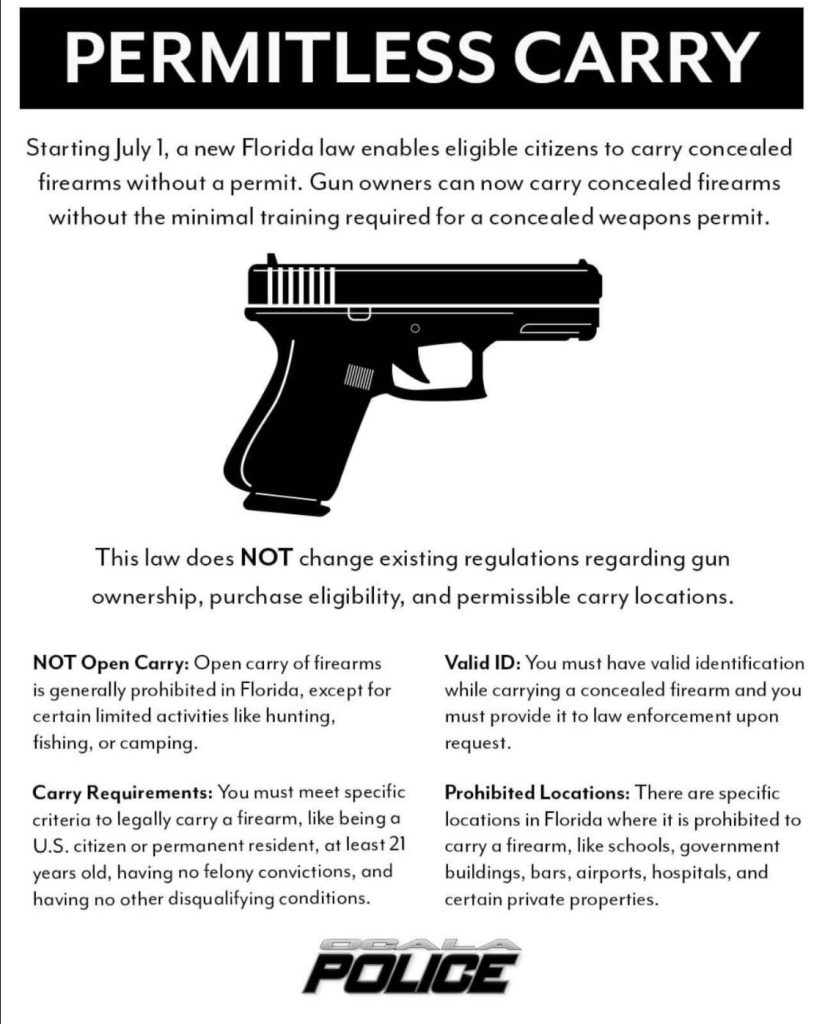
Constitutional Carry and Non-Residents
Under the new “constitutional carry” law (House Bill 543), any person who is 21 years of age or older, not prohibited by law from possessing a firearm, is now permitted to carry a concealed firearm or other weapon in Florida without a license. This extends to non-residents who meet these same eligibility criteria under Florida law.
It is imperative for travelers to understand that meeting Florida’s eligibility requirements is paramount. These requirements typically mirror federal prohibitions on firearm possession, including factors such as felony convictions, domestic violence misdemeanor convictions, specific mental health adjudications, and other disqualifying conditions. A non-resident who is legally prohibited from possessing a firearm in their home state or under federal law would also be prohibited from carrying one concealed in Florida, regardless of the new constitutional carry provisions.
While a license is no longer required for concealed carry, carrying openly remains largely prohibited, with limited exceptions such as during fishing, camping, or hunting, or while actively going to and from a shooting range. The focus of the new law is specifically on concealed carry.
Reciprocity Agreements and the Role of the CWFL
Prior to July 1, 2023, Florida maintained an extensive network of reciprocity agreements with other states, recognizing their concealed carry permits. With the advent of constitutional carry, the concept of reciprocity for carrying a concealed firearm has evolved. Non-residents who meet Florida’s eligibility requirements may now carry concealed without needing to rely on a reciprocity agreement or their home state’s permit.
However, the Florida Concealed Weapon or Firearm License (CWFL) continues to be issued and offers benefits that may still be appealing to residents and even some frequent visitors. These benefits include the ability to purchase a firearm without a waiting period (typically three business days, though some counties like Miami-Dade and Broward have a five-day waiting period), and it provides a clear, official document affirming eligibility for concealed carry, which can be beneficial when interacting with law enforcement. Furthermore, a CWFL may still be desired for reciprocity when traveling from Florida to other states that recognize the Florida license. For travelers primarily concerned with carrying within Florida, the constitutional carry law simplifies matters, removing the need to navigate complex reciprocity charts for basic concealed carry.
The Importance of Due Diligence
Despite the simplification, due diligence remains critical. Florida’s firearms laws are detailed and specific. Ignorance of the law is not a valid defense. Travelers should review the current statutes, particularly Florida Statute § 790.06, and potentially consult with a Florida attorney if they have specific concerns about their eligibility or particular circumstances. Websites like the Florida Department of Agriculture and Consumer Services, which oversees CWFLs, often provide updated information on state firearm laws.
For instance, understanding what constitutes a “weapon” versus a “firearm” under Florida law is important, as the constitutional carry provision applies to “concealed weapon or firearm.” This includes not only handguns but also other defensive tools like knives, chemical sprays, and stun guns, provided they are carried concealed and the individual meets the eligibility criteria.
Navigating Permitted and Prohibited Locations
While Florida’s constitutional carry law allows eligible individuals to carry a concealed firearm without a license, it does not grant unrestricted carry everywhere. There are specific locations, both public and private, where carrying a firearm, even concealed, remains strictly prohibited. Understanding these “no-carry zones” is paramount for anyone traveling armed in Florida.
Public Places and Private Property
The new law maintains existing prohibitions on carrying firearms in certain public venues. These include, but are not limited to:
- Any place of nuisance as defined in Florida Statute § 823.05.
- Any police station, sheriff’s office, or highway patrol station.
- Any courthouse or courtroom.
- Any polling place during an election.
- Any meeting of the governing body of a county, public school district, municipality, or special district.
- Any meeting of the Legislature or a committee thereof.
- Any school, college, or university facility unless the person is a law enforcement officer or armed security. This includes elementary and secondary schools, and even property owned by them, such as sports fields.
- Any professional athletic event not related to firearms.
- Any portion of an establishment licensed to dispense alcoholic beverages for consumption on the premises, which portion of the establishment is primarily devoted to such purpose. This means you can’t carry in bars or the bar areas of restaurants.
- Any airport passenger terminal beyond the security checkpoint (sterile area).
Private property owners in Florida retain the right to prohibit firearms on their premises, even if the person is otherwise legally entitled to carry. A “no firearms” sign, or direct verbal notice from the property owner or their agent, carries legal weight. Disregarding such a prohibition could lead to being asked to leave, and refusal to do so could result in a trespassing charge. This applies to businesses, restaurants, hotels, and other private establishments throughout cities like Orlando, Miami, Tampa, and Jacksonville. Travelers should be observant of signage and respectful of private property rights.
Federal Restrictions and Florida Exceptions
Beyond state laws, federal laws also impose restrictions on firearm possession in certain areas. For example, carrying firearms in federal buildings, post offices, national parks (though permissible in some areas if compliant with state laws and securely stored), and military bases is generally prohibited. Even with Florida’s constitutional carry, federal regulations supersede state laws in these specific federally controlled zones.

An important exception to note in Florida is the ability to store a firearm in a private vehicle. Even in a prohibited location like a school parking lot or an employer’s parking lot, an individual with a lawful purpose may store a firearm securely and out of sight in their vehicle, provided the vehicle is otherwise lawfully present. This provision, often referred to as the “parking lot law,” offers some flexibility but requires the firearm to be securely encased or not readily accessible.
Specific No-Carry Zones for All
Certain events and venues, regardless of their nature, may implement their own temporary or permanent prohibitions on firearms. Large public gatherings, concerts, festivals, or specific attractions might have security protocols that prohibit all weapons. For instance, theme parks like Walt Disney World Resort in Orlando and Universal Orlando Resort strictly forbid firearms on their properties, and guests are typically subject to bag checks and metal detectors. It is the traveler’s responsibility to check the specific policies of any attraction, event, or venue they plan to visit to avoid legal complications or denied entry.
Traveling with a Firearm: Air, Land, and Sea Considerations
For visitors traveling to Florida with a firearm, the method of transport introduces an additional layer of regulations. Federal and state laws, as well as carrier-specific policies, must be meticulously followed to avoid serious legal repercussions.
Air Travel Regulations (TSA Compliance)
Flying with a firearm into or out of Florida airports like Orlando International Airport, Miami International Airport, or Tampa International Airport is governed by federal Transportation Security Administration (TSA) regulations. Firearms are strictly prohibited in carry-on luggage and must be transported in checked baggage only. The firearm must be unloaded and declared to the airline at the check-in counter. It must be stored in a hard-sided, locked container, and the passenger must retain the key or combination. Ammunition must also be securely packed, typically in its original manufacturer’s box or suitable container, separate from the firearm, or in the same hard-sided case if properly separated. Travelers should always check with their specific airline regarding their firearm transportation policies, as these can sometimes be more restrictive than TSA requirements. Failure to comply with TSA and airline rules can lead to significant fines, arrest, and confiscation of the firearm.
Road Trips Across State Lines
When driving to Florida, travelers must be aware of the firearm laws of every state they pass through. The federal Firearm Owners’ Protection Act (FOPA) provides a safe harbor for individuals transporting unloaded firearms in a locked container from one place where they can legally possess it to another. However, this protection is specifically for transportation and does not grant the right to carry a firearm in states where it might be prohibited.
Once in Florida, as discussed, eligible individuals can carry concealed without a license. Still, understanding the specific concealed carry laws of each state on a multi-state road trip is essential. A firearm carried openly in one state might need to be concealed or securely stored in another, even if just passing through. Planning the route with a focus on states with favorable or reciprocal laws can mitigate risks.
Cruise Ships and Waterways
Cruising from Florida’s bustling ports like PortMiami or Port Canaveral with a firearm is generally prohibited. Cruise lines universally ban firearms and other weapons on board their vessels, with very few exceptions for law enforcement or military personnel in official capacities. Passengers found with firearms during boarding will have them confiscated, and may be denied boarding or face legal consequences.
Similarly, while navigating Florida’s extensive waterways, state law governs. Carrying a concealed firearm on a boat or other vessel within Florida waters generally follows the same constitutional carry rules as on land, provided the individual is eligible. However, if the vessel enters federal waters or the waters of another state or country, different laws will apply. It is crucial to be aware of the jurisdiction you are in when carrying a firearm on waterways.
Best Practices for Responsible Armed Travel in Florida
Responsible firearm ownership and carry extend beyond simply knowing the law; it involves a commitment to safety, discretion, and proactive adherence to best practices, especially for those visiting an unfamiliar state.
Staying Informed and Law-Abiding
The landscape of firearm laws can change. Before and during a trip to Florida, it is advisable to check for any legislative updates. Official state websites and reputable legal resources are the best sources of information. Always err on the side of caution. If there is any doubt about the legality of carrying a firearm in a specific location or situation, it is best to leave the firearm securely stored or not carry it at all. Compliance with all federal, state, and local ordinances is not just a legal obligation but a moral one for responsible firearm owners.
Securing Your Firearm
Whether you choose to carry or not, proper storage of firearms is critical. When a firearm is not on your person, it should be stored in a manner that prevents unauthorized access, especially if traveling with children or staying in accommodations where others might have access. A locked safe, a secure gun case, or a vehicle’s locked glove compartment (when permissible by law) are appropriate options. In hotel rooms, utilizing the room safe or a personal lock box is recommended. Discretion is key; avoid openly displaying firearms or discussing their presence with strangers. The goal is to remain secure and compliant without drawing unnecessary attention.

Seeking Legal Counsel When in Doubt
For complex situations, or if there are any lingering questions about your specific eligibility or the nuances of Florida’s firearm laws, consulting a Florida-licensed attorney specializing in firearms law is the most prudent course of action. They can provide tailored advice based on individual circumstances and ensure complete understanding and compliance. While this guide provides general information, it is not a substitute for professional legal advice.
Navigating Florida’s concealed carry laws as a traveler requires careful attention to detail. The constitutional carry law has simplified the permit requirement, but the extensive list of prohibited locations and the need to meet eligibility criteria remain. By staying informed, exercising due diligence, and prioritizing responsible practices, visitors can ensure their trip to the Sunshine State is both enjoyable and legally compliant.
LifeOutOfTheBox is a participant in the Amazon Services LLC Associates Program, an affiliate advertising program designed to provide a means for sites to earn advertising fees by advertising and linking to Amazon.com. Amazon, the Amazon logo, AmazonSupply, and the AmazonSupply logo are trademarks of Amazon.com, Inc. or its affiliates. As an Amazon Associate we earn affiliate commissions from qualifying purchases.