
The popular perception of Florida often conjures images of endless, sun-drenched beaches, sprawling theme parks, and serene, flat landscapes. While the state certainly delivers on the promise of stunning coastlines and a generally low elevation, the question “Is Florida flat?” demands a more nuanced answer, revealing a surprisingly diverse and subtly contoured natural environment that profoundly shapes its identity as a unique landmark. Far from a uniform pancake, the Sunshine State boasts an intricate geological history and a topography that, while lacking dramatic mountain ranges, is rich in subtle elevations, distinctive ridges, and an extensive network of waterways that define its character.

Unpacking Florida’s Topography: More Than Meets the Eye
The notion of Florida being uniformly flat is a simplification that overlooks the fascinating geological processes that have shaped the peninsula over millions of years. Its very existence is a testament to marine sediment deposition and fluctuating sea levels.
The Perception of Flatness: Why the Myth Persists
Much of Florida’s heavily populated coastal areas, particularly around major cities like Miami and Orlando, do present a very low-lying, often almost imperceptible gradient. When driving along coastal highways or through developed urban centers, one rarely encounters significant inclines or declines. This prevalence of flat, easily traversable terrain in the areas most visited by tourists contributes heavily to the widespread belief. Furthermore, the highest point in Florida is Britton Hill, a mere 345 feet (105 meters) above sea level, located in the Panhandle region near the Alabama border. Compared to states with towering mountain ranges, this elevation is undeniably modest, reinforcing the “flat” descriptor.
Geological Formations: The Karst Landscape
Beneath the surface, Florida‘s geology tells a complex story. The state is primarily composed of limestone, a porous rock formed from the remains of ancient marine organisms when the area was submerged under shallow seas. This limestone foundation is critical to understanding Florida’s subtle topography. Rainwater, slightly acidic, seeps through the porous limestone, dissolving it over time and creating a vast underground network of caves, conduits, and aquifers. This geological phenomenon is known as karst topography. While it might not manifest as dramatic peaks, it leads to the formation of sinkholes, springs, and depressions that are integral to the state’s natural landscape. The presence of these subterranean features means that even seemingly flat land can conceal significant geological activity and natural wonders.
Elevating Expectations: Florida’s Subtle Heights
Despite the overwhelming perception, Florida does possess areas of higher elevation and distinct topographical features that break the monotonous plane. These subtle undulations are essential landmarks in their own right, defining unique ecosystems and offering different perspectives on the state’s natural beauty.
The Highest Point: Britton Hill and the Panhandle’s Gentle Rolls
As mentioned, Britton Hill stands as the highest natural point in Florida. While not a mountain in any traditional sense, it is part of the state’s often overlooked Panhandle region, which exhibits a more rolling terrain compared to the southern peninsula. This area, closer to the foothills of the Appalachian Mountains (geologically speaking, though quite distant), features sandy hills and gentle slopes, offering a different landscape experience than the flat coastal plains. The elevations here, though modest, support different types of forests, including longleaf pine savannas, making it a distinct natural landmark.
Ridgeology: The Lake Wales Ridge and Central Florida’s Spine
Perhaps the most significant topographical feature challenging the “flat” narrative is the Lake Wales Ridge. Stretching for approximately 100 miles down the center of Florida, from north of Orlando to south of Lake Placid, this ancient sand ridge reaches elevations of up to 300 feet (91 meters). Formed as a series of islands when sea levels were much higher, the Lake Wales Ridge is an ecological marvel. Its sandy, well-drained soils support a unique ecosystem known as Florida scrub, home to numerous endemic species found nowhere else on Earth. Landmarks along this ridge include critical habitat preserves and state parks dedicated to protecting this rare environment. This central spine of Florida is a testament to the state’s hidden geological complexity and vital as a natural landmark for its biodiversity and distinct relief.
Water’s Influence: Shaping Florida’s Low-Lying Landscape
Water is undeniably the most dominant force in shaping Florida’s natural landmarks. Its low elevation means that the interaction between land and water is constant and pervasive, creating a mosaic of wetlands, springs, and coastal features.
The Everglades: A River of Grass
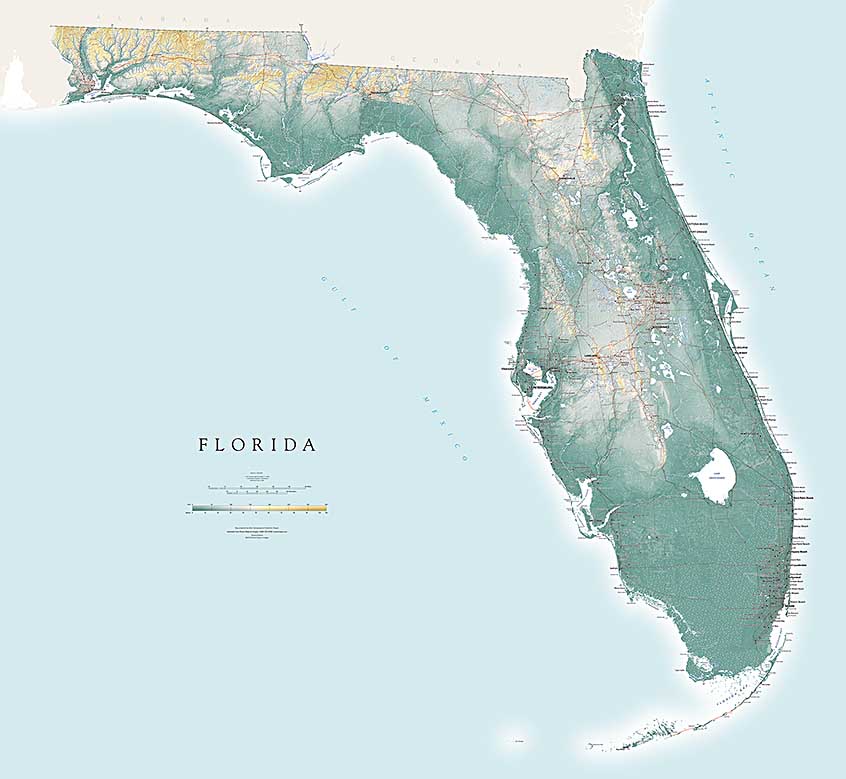
The Everglades National Park, a globally recognized natural landmark, epitomizes Florida’s relationship with flatness and water. Often described as a “River of Grass,” this vast wetland ecosystem is indeed incredibly flat, with an average elevation of less than six feet above sea level. This extreme flatness, however, is precisely what makes it unique. It allows a slow-moving sheet of water to flow southward from Lake Okeechobee to Florida Bay, nourishing an unparalleled diversity of plant and animal life. The subtle differences in elevation, sometimes only inches, dictate the distribution of sawgrass marshes, cypress swamps, pinelands, and hardwood hammocks, creating a dynamic and incredibly rich natural landmark despite its lack of vertical relief.
Coastal Dynamics: Beaches, Dunes, and Barrier Islands
Florida’s extensive coastline, bordering both the Gulf of Mexico and the Atlantic Ocean, is another region where subtle elevation plays a crucial role. While the beaches themselves are relatively flat, the formation of sand dunes behind them creates noticeable, albeit gentle, rises. These dunes, held together by resilient vegetation, serve as natural barriers, protecting inland areas from storm surges and providing critical habitat. Furthermore, Florida is famous for its numerous barrier islands, long, narrow strips of land separated from the mainland by lagoons or estuaries. These islands, formed by millennia of sand deposition and wave action, represent a distinct coastal topography—flat on their surface but elevated just enough to stand apart from the shallow waters surrounding them.
Springs and Sinkholes: Subterranean Wonders
The karst topography beneath Florida gives rise to one of its most mesmerizing natural landmarks: its freshwater springs. These natural vents, where underground water flows to the surface, are often nestled within slight depressions or at the base of small bluffs. Locations like Weeki Wachee Springs State Park and Silver Springs State Park are world-renowned for their crystal-clear waters and unique ecosystems, drawing visitors into Florida’s hidden aquatic landscapes. Conversely, sinkholes—collapsed portions of the ground where limestone has dissolved—can create dramatic, localized depressions, some forming deep lakes or ponds, altering the immediate flatness of the landscape in surprising ways. These features are direct manifestations of the state’s unique geology and are significant natural landmarks.
The Unique Ecosystems Born from Flatness
The relative flatness and the pervasive influence of water have cultivated a remarkable array of ecosystems across Florida, each a distinctive natural landmark supporting unique flora and fauna.
Biodiversity in Low Relief: From Swamps to Pinelands
From the vast cypress swamps and mangrove forests along the coasts to the dry, sandy pinelands of the interior, Florida’s diverse natural environments are a direct consequence of its topography and hydrology. Even slight changes in elevation or water table levels can lead to dramatically different plant communities. The flat, wet prairies, for instance, are home to specific grasses and wildflowers, while the slightly elevated hammocks (small clusters of hardwood trees) provide drier refuges. These distinct ecological zones, though not marked by dramatic elevation changes, are incredibly rich in biodiversity and represent complex natural landmarks.
Conservation Challenges and Opportunities
The low-lying nature of much of Florida presents significant conservation challenges, particularly in the face of climate change and rising sea levels. Coastal wetlands, critical for storm protection and wildlife, are highly vulnerable. However, this unique topography also offers opportunities for innovative conservation strategies, focusing on water management, habitat restoration, and protecting key ecological corridors that traverse these subtle landscapes. Protecting these subtle yet critical natural landmarks is vital for the state’s future.
Experiencing Florida’s Diverse “Flatness”
To truly appreciate Florida as a natural landmark, one must move beyond the superficial perception of flatness and delve into its rich, subtle variations.
Outdoor Activities for Every Terrain
Florida’s varied, though low-relief, topography supports a wide range of outdoor activities that highlight its natural landmarks. Kayaking or airboat tours through the Everglades reveal a landscape defined by water. Hiking trails in the Panhandle or along the Lake Wales Ridge offer gentle climbs and distinct ecological zones, a stark contrast to the coastal plains. Exploring the crystalline waters of Florida’s springs provides a glimpse into the karst system. Even the beaches, seemingly flat, invite exploration of dune ecosystems and barrier island formations.
Appreciating the Nuance
Ultimately, while Florida may not boast the towering peaks of other regions, to dismiss it as simply “flat” is to miss its profound and understated natural grandeur. Its unique geological history, pervasive water influence, and subtly varied topography create a landscape that is anything but monotonous. The state itself is a magnificent natural landmark, defined by its intricate interplay of land and water, where beauty lies not in dramatic heights, but in the subtle undulations, the endless horizons, and the extraordinary biodiversity born from its distinctive, low-lying character. From the gentle rolls of the Panhandle to the ancient Lake Wales Ridge and the sprawling Everglades, Florida’s natural landmarks are a testament to the power of subtlety and the intricate beauty of a landscape shaped by water and time.
LifeOutOfTheBox is a participant in the Amazon Services LLC Associates Program, an affiliate advertising program designed to provide a means for sites to earn advertising fees by advertising and linking to Amazon.com. Amazon, the Amazon logo, AmazonSupply, and the AmazonSupply logo are trademarks of Amazon.com, Inc. or its affiliates. As an Amazon Associate we earn affiliate commissions from qualifying purchases.