
Navigating the legal landscape of a new destination is an essential part of responsible tourism, and for visitors to Florida, understanding the state’s gun laws is particularly pertinent. Known for its vibrant culture, stunning beaches, and world-class attractions, the Sunshine State also has a unique approach to firearm regulations that sets it apart from many other jurisdictions. For tourists, whether they are gun owners themselves or simply want to be informed about the local environment, grasping these laws can ensure a smoother, safer, and more compliant visit. This guide aims to demystify Florida’s gun laws, presenting them from the perspective of a traveler.
Navigating Florida’s Gun Landscape: Key Laws for Tourists
Florida has long been recognized for its robust protection of Second Amendment rights. The state’s constitution affirms the right of the people to keep and bear arms in defense of themselves and of the lawful authority of the state. This constitutional underpinning informs many of the state’s current firearm statutes. For tourists planning a trip to destinations like Miami, Orlando, or the Florida Keys, understanding the basics of this legal framework is crucial.
Florida’s Constitutional Right to Bear Arms
At its core, Florida respects an individual’s right to own and possess firearms. This right is enshrined in Article I, Section 8 of the Florida Constitution, which states: “The right of the people to keep and bear arms in defense of themselves and of the lawful authority of the state shall not be infringed, except that the manner of bearing arms may be regulated by law.” This foundational principle ensures that while regulations exist, they generally do not prohibit gun ownership for law-abiding citizens. Tourists should be aware that open carry of firearms is generally prohibited in Florida unless specifically exempted by law, such as during hunting, fishing, or target shooting. This means that while gun ownership is common, seeing firearms openly displayed in public places is rare and, in most cases, illegal.
Permitless Carry: A Recent Development
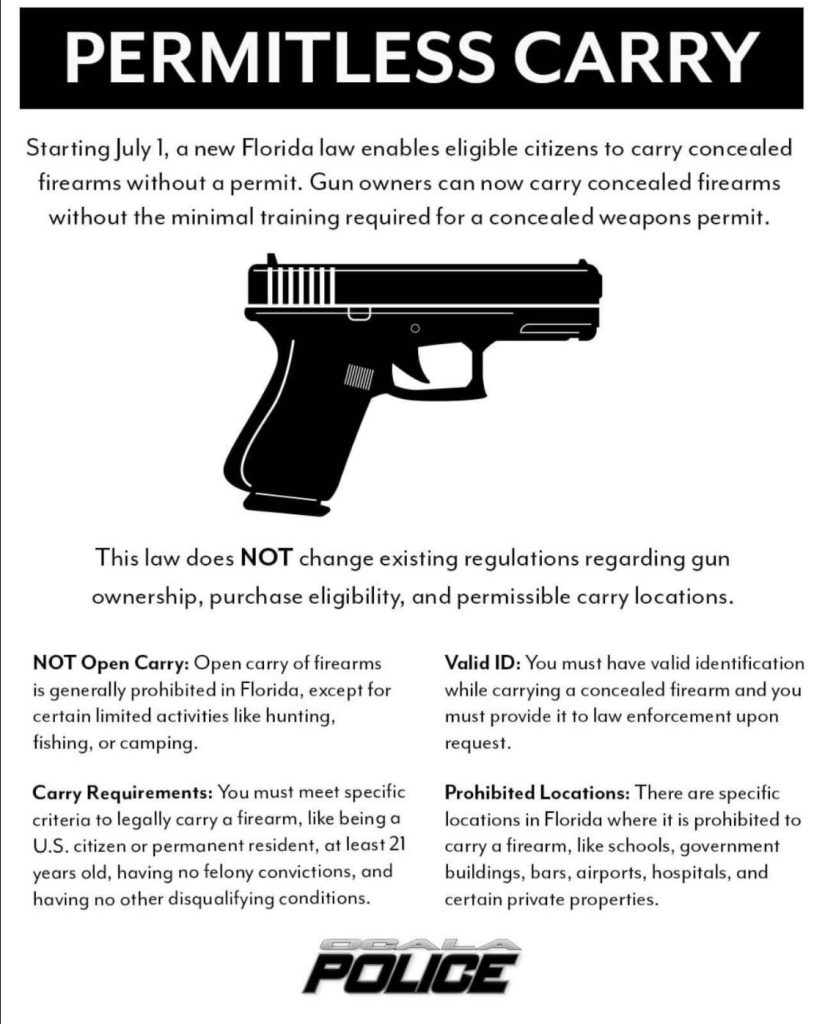
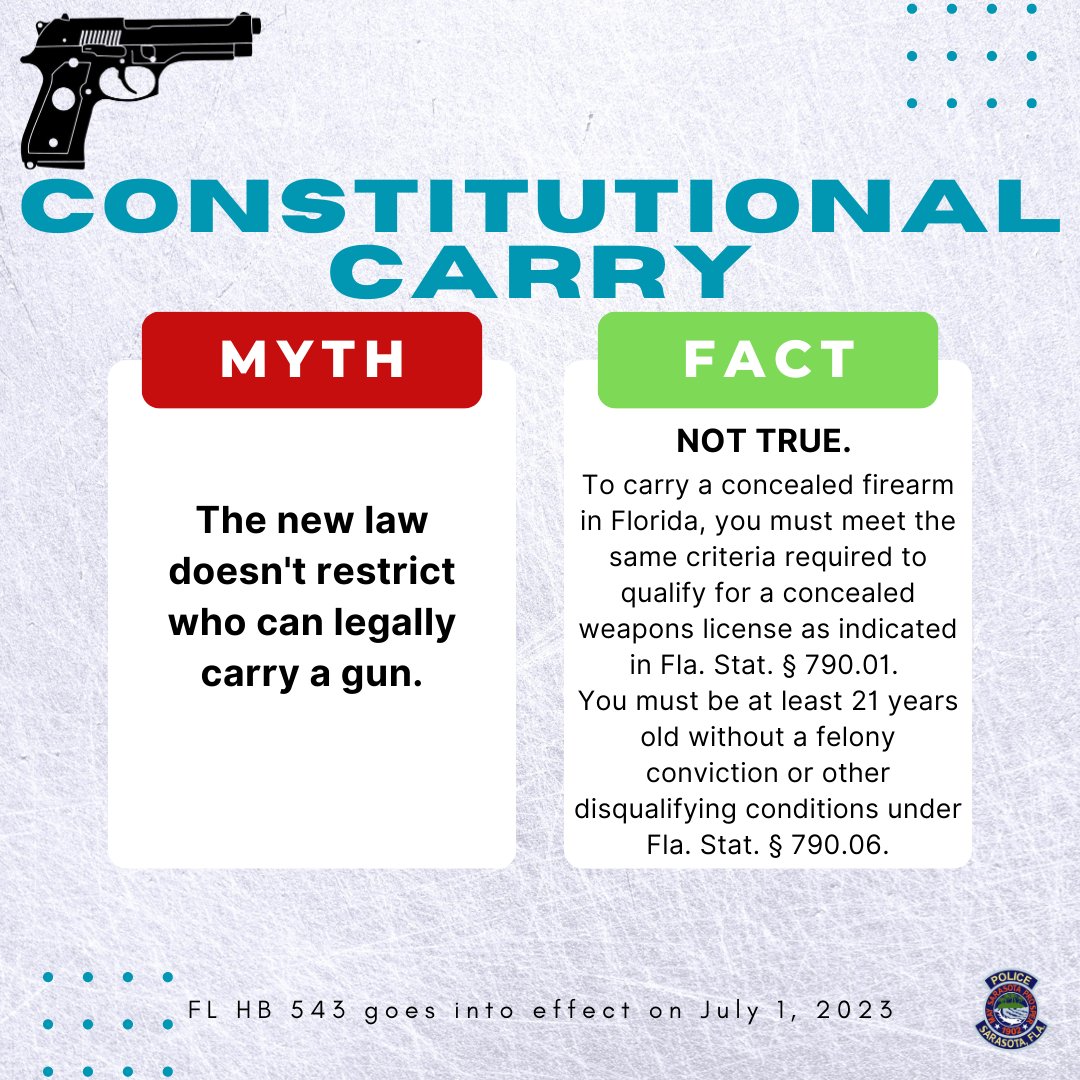
A significant shift in Florida’s gun laws occurred recently with the implementation of permitless carry, effective July 1, 2023. Prior to this, individuals generally needed a Concealed Weapon or Firearm License (CWFL) to carry a firearm concealed in public. With permitless carry, individuals who are 21 years of age or older, not otherwise prohibited by law from possessing a firearm, are now permitted to carry a concealed firearm without a state-issued license.
For tourists, this means that if you meet the age and eligibility requirements, and are legally able to possess a firearm under both federal and state law, you may carry a concealed firearm in Florida without a Florida CWFL or a reciprocal permit from your home state. However, it is vital to understand that permitless carry only applies to concealed carry. Open carry remains generally prohibited. Furthermore, all other existing restrictions regarding prohibited places (e.g., schools, airports) and prohibited persons (e.g., convicted felons) still apply. It is incumbent upon the individual to know and follow all applicable laws.
Permits, Reciprocity, and Firearm Purchase for Non-Residents
While permitless carry simplifies concealed carry for eligible individuals, understanding the nuances of permits, reciprocity, and firearm purchases is still valuable for tourists, especially those who travel with firearms or consider acquiring one during their visit.
Concealed Weapon or Firearm License (CWFL)
Even with permitless carry, the Florida Concealed Weapon or Firearm License (CWFL) remains relevant. A CWFL offers certain advantages, such as allowing license holders to carry in some locations where permitless carry might not be explicitly clear, or providing enhanced legal protections in certain situations. For example, CWFL holders are typically exempt from the three-day waiting period for handgun purchases.
Interstate Reciprocity for CWFL Holders
For tourists who possess a concealed carry permit from another state, Florida maintains reciprocity agreements with many other states. This means that if your home state’s permit is recognized by Florida, you may carry a concealed firearm in Florida according to the terms of your home state’s permit, provided you are also in compliance with Florida law. While permitless carry makes this less critical for concealed carry for eligible individuals, understanding reciprocity is still important for those who prefer to rely on their existing license or for specific scenarios. It’s always advisable to verify the current reciprocity status of your permit before traveling. The Florida Department of Agriculture and Consumer Services website is the authoritative source for this information.
Purchasing Firearms in Florida as a Visitor
Non-residents can purchase firearms in Florida, but federal and state laws impose specific restrictions. Generally, federal law prohibits an individual from purchasing a handgun from a licensed dealer in a state where they are not a resident. However, a non-resident may purchase a rifle or shotgun from a licensed dealer in Florida, provided the sale complies with the laws of both Florida and the purchaser’s state of residence. All firearm purchases from licensed dealers require a background check (Form 4473 and a NICS check). As mentioned, handgun purchases typically have a three-day waiting period, unless the purchaser holds a Florida CWFL or meets other specific exemptions. Tourists considering a firearm purchase should consult with a licensed Florida dealer to ensure full compliance with all applicable laws.
Prohibited Places: Where You Cannot Carry a Firearm
Regardless of whether you are carrying with a permit or through permitless carry, Florida law designates numerous locations where carrying a firearm is strictly prohibited. Ignorance of these restrictions is not a valid defense, and violations can lead to severe penalties, including felony charges. This is arguably the most critical section for any tourist carrying a firearm in the state, as many popular tourist destinations fall under these prohibitions.
Specific No-Carry Zones
The list of prohibited places is extensive and includes:
- Any place of nuisance as defined in s. 823.05.
- Any police station, sheriff’s office, or highway patrol station.
- Any courthouse or courtroom.
- Any polling place during an election.
- Any meeting of the governing body of a county, public school district, municipality, or special district.
- Any meeting of the Legislature or a committee thereof.
- Any school, college, or professional athletic event not related to firearms.
- Any elementary or secondary school facility or administration building.
- Any career center.
- The inside of the passenger terminal and sterile area of any airport (like Orlando International Airport or Miami International Airport).
- Any portion of an establishment licensed to dispense alcoholic beverages for consumption on the premises, which portion is primarily devoted to such purpose. This means you generally cannot carry in bars or the bar areas of restaurants.
- Any college or university facility, unless the licensee is a registered student, employee, or faculty member of the college or university and the weapon is a stun gun or nonlethal electric weapon or device designed solely for defensive purposes and the licensee has a valid CWFL.
- Any child care facility.
Tourists visiting popular attractions like Walt Disney World, Universal Studios Florida, or professional sports stadiums in cities like Tampa and Jacksonville should be aware that these venues typically have their own strict no-firearm policies, often reinforced by security screenings. Even if a location is not explicitly listed in state statute as a prohibited place, private property owners retain the right to prohibit firearms on their premises, and failing to comply with such a request can lead to trespass charges.
Federal vs. State Prohibitions
It’s also important for tourists to remember that federal law imposes its own set of firearm prohibitions, which apply nationwide. For instance, federal law prohibits firearms in post offices and other federal buildings. Everglades National Park and other national parks generally allow concealed carry for those legally permitted to do so by state law, but specific rules regarding visitor centers or other facilities might apply, and discharging a firearm is typically restricted. Always check the specific regulations for any federal property you plan to visit.
Responsible Firearm Transportation and Storage for Visitors
For tourists traveling to Florida with firearms, or those who acquire one during their stay, understanding proper transportation and storage methods is paramount to avoid legal issues and ensure safety.
Vehicular Transport Regulations
When transporting a firearm in a vehicle in Florida, the law specifies how it must be secured. A firearm (other than a handgun) generally must be securely encased or otherwise not readily accessible for immediate use. A handgun, if not being carried concealed by an eligible individual (under permitless carry or with a CWFL), must be securely encased or otherwise not readily accessible for immediate use within the interior of the vehicle. “Securely encased” means enclosed in a holster with a strap, snap, or flap, or in a gun case, gun box, or other container, or in a luggage compartment. This applies whether you are driving your own car or a rental car. Never transport a loaded firearm openly visible in the passenger compartment.
Storage in Accommodations
When staying in hotels, resorts (like those near Key West), or rental apartments, tourists should consider how to safely and securely store firearms. While Florida law doesn’t specifically detail storage requirements for private accommodations, general principles of responsible gun ownership apply.
- Secure Storage: Always store firearms in a manner that prevents unauthorized access, especially by children. Use a gun safe, lockbox, or other secure container.
- Hotel Policies: Be aware that some hotels or private vacation rentals may have policies prohibiting firearms on their property. While such policies cannot override state law regarding legal carry, they can result in you being asked to leave the premises if violated. It’s prudent to inquire about such policies if you plan to bring a firearm to your accommodation.
- Never Leave Unattended: Avoid leaving firearms unattended in vehicles, especially in popular tourist areas where vehicle break-ins can occur. If you must leave a firearm in a vehicle, ensure it is securely encased and out of sight.
Understanding “Stand Your Ground” and Self-Defense
Florida is well-known for its “Stand Your Ground” law, which is often a topic of interest and discussion. For tourists, it’s important to understand the basics of this law, not as an encouragement for confrontation, but as context for the state’s legal framework regarding self-defense.
The Doctrine Explained
Florida’s “Stand Your Ground” law eliminates the duty to retreat from a place where one has a legal right to be before using deadly force in self-defense, or in defense of another, if that person reasonably believes such force is necessary to prevent death or great bodily harm to himself or herself or another or to prevent the commission of a forcible felony. This law applies not just to homes but also to any place a person is lawfully present.

Implications for Visitors
While the “Stand Your Ground” law provides significant legal protection, its application is complex and highly fact-dependent. For tourists, the key takeaway is that Florida law acknowledges an individual’s right to defend themselves without first attempting to retreat. However, the use of force, particularly deadly force, must always be objectively reasonable under the circumstances. Engaging in any act of self-defense should always be a last resort. For visitors, understanding this law underscores the importance of avoiding confrontations and de-escalating tense situations, rather than relying on the use of force. Legal situations involving self-defense can be incredibly complicated and stressful, even for those protected by “Stand Your Ground.”
In summary, while Florida’s gun laws offer considerable freedom to eligible individuals, they are also accompanied by strict regulations regarding prohibited places and responsible conduct. For tourists, a proactive approach to understanding these laws ensures a safe, enjoyable, and legally compliant visit to the Sunshine State.
LifeOutOfTheBox is a participant in the Amazon Services LLC Associates Program, an affiliate advertising program designed to provide a means for sites to earn advertising fees by advertising and linking to Amazon.com. Amazon, the Amazon logo, AmazonSupply, and the AmazonSupply logo are trademarks of Amazon.com, Inc. or its affiliates. As an Amazon Associate we earn affiliate commissions from qualifying purchases.