
Living in Florida offers an unparalleled lifestyle, from the sun-drenched beaches of Miami to the serene, golf-centric communities of Naples. Whether you are a full-time resident or a seasonal “snowbird” enjoying the warmth of Palm Beach, understanding the legalities of property ownership and estate management in the Sunshine State is a vital component of a well-rounded lifestyle. A common question that arises, particularly for those who have relocated to the United States or moved across state lines, is what happens when a person passes away without a last will and testament. In legal terms, this is known as dying “intestate.”

In Florida, the term “executor” is actually not the official title used in the courts. Instead, the individual responsible for managing an estate is referred to as a “Personal Representative.” When no will exists to name this individual, the state must follow a specific hierarchy to determine who has the right to manage the decedent’s affairs, settle debts, and distribute assets located from Jacksonville down to the Florida Keys.
The Hierarchy of Appointment in Intestate Estates
When a resident of Florida passes away without a will, the probate court in the county where the deceased resided—whether that be Leon County in Tallahassee or Hillsborough County in Tampa—must appoint a Personal Representative. Because there is no written document expressing the deceased’s wishes, Florida law provides a strict order of preference to ensure the estate is handled by someone with a vested interest.
The Surviving Spouse’s Priority
Under the Florida Probate Code, the surviving spouse has the first right to serve as the Personal Representative. This reflects the state’s commitment to protecting the family unit and ensuring that the person most closely tied to the deceased’s daily life and financial affairs in cities like Fort Lauderdale has the authority to settle the estate. If the spouse is willing and legally qualified to serve, the court will almost always grant them “Letters of Administration.”
Selection by Majority Interest
If there is no surviving spouse, or if the spouse is unable or unwilling to serve, the law moves to the next tier: the person selected by a majority in interest of the heirs. This means that if the deceased had several adult children living in Orlando or Sarasota, those children can collectively vote or agree upon one person to act as the Personal Representative. This collaborative approach helps prevent disputes among family members who may have different ideas about how to manage a luxury villa or a family business.
The Nearest Heir
In the event that the heirs cannot reach a majority agreement, the court will appoint the heir who is nearest in degree of kinship. If there are multiple heirs of the same degree (such as three siblings), the court may exercise its discretion to choose the most capable individual or, in some cases, appoint more than one person to serve as “Co-Personal Representatives.” This often happens when the estate involves complex assets, such as commercial real estate in Downtown Miami or agricultural land near the Everglades.
Eligibility and Disqualifications for Personal Representatives
The lifestyle of a Personal Representative is one of significant responsibility and legal fiduciary duty. Consequently, Florida law sets high standards for who can qualify for this role. It is not enough to simply be the next of kin; the individual must also meet specific statutory requirements.
Residency Requirements
One of the most unique aspects of Florida law is the residency requirement for Personal Representatives. To serve in this capacity, a person must generally be a resident of Florida at the time of the decedent’s death. However, there is a major exception for close relatives. Non-residents can serve as Personal Representatives if they are a spouse, child, parent, sibling, or other close blood relative of the deceased. This exception is crucial for the many international families who own vacation homes in Kissimmee or Clearwater, as it allows a family member from another state or country to manage the estate without being a local resident.

Mandatory Disqualifications
Even if someone is the surviving spouse or the sole heir, they may be legally barred from serving if they do not meet the character and capacity requirements. Under the rules enforced by the Florida Supreme Court, an individual is disqualified from serving as a Personal Representative if they:
- Are under the age of 18.
- Have been convicted of a felony in any jurisdiction.
- Are mentally or physically unable to perform the duties of the office.
- Are a professional guardian or employee of a healthcare institution that provides care to the decedent (unless they are a relative).
These safeguards are designed to protect the assets of the estate and ensure that the legacy of the deceased—whether it involves a beachfront condo on the Atlantic Ocean or a quiet retirement home on the Gulf of Mexico—is managed with integrity.
The Probate Process for Intestate Estates
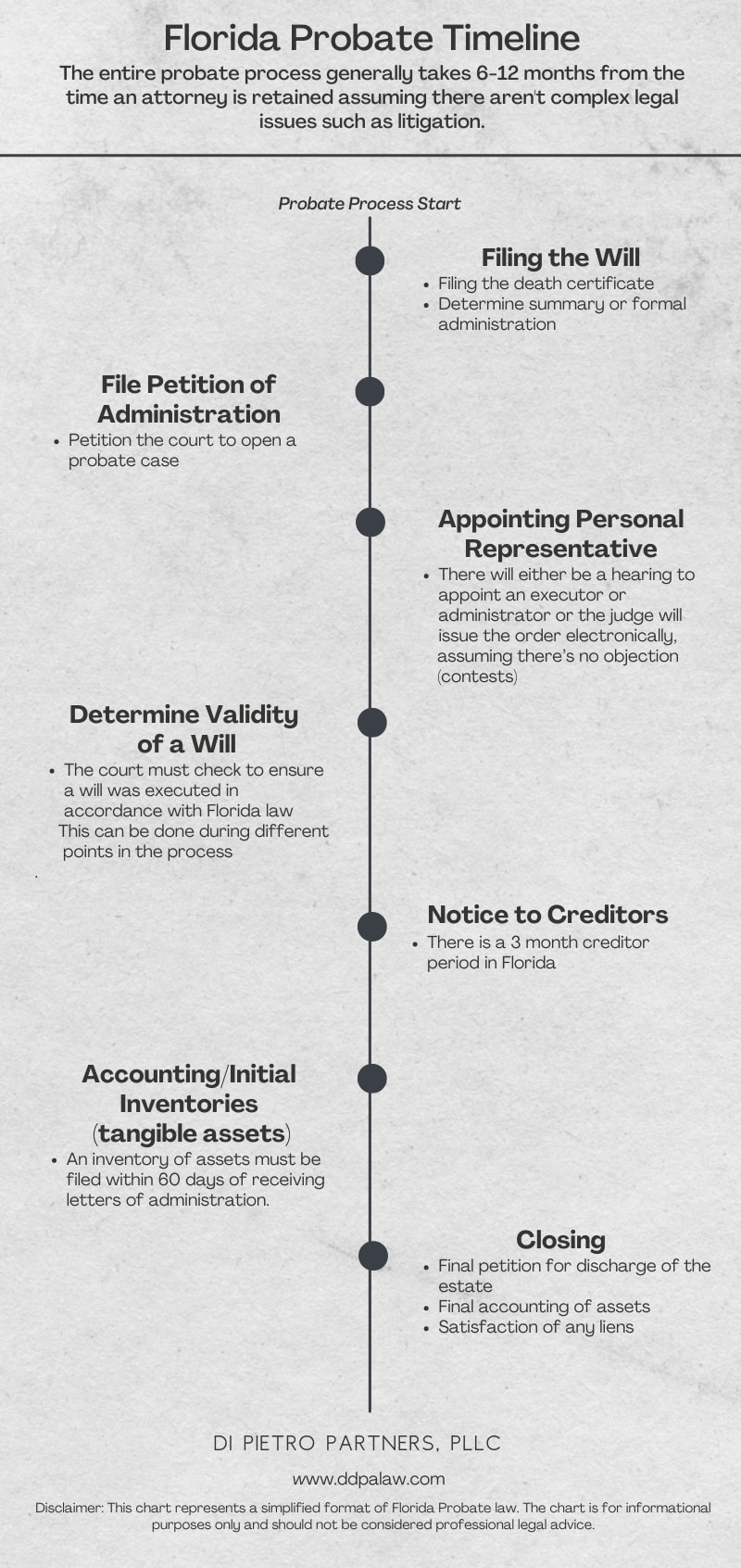
Once the court identifies the appropriate Personal Representative, the formal probate process begins. For those accustomed to the fast-paced lifestyle of Florida, the legal system can sometimes feel slow, but it is a necessary journey to ensure all creditors are paid and all heirs receive their rightful share.
Formal vs. Summary Administration
There are two primary types of probate in Florida. “Summary Administration” is a simplified process available if the total value of the estate (excluding the primary residence, known as “homestead property”) is less than $75,000, or if the decedent has been deceased for more than two years. This is common for retirees in Sun City Center who may have modest assets.
However, if the estate is valued over $75,000, “Formal Administration” is required. This process involves the official appointment of the Personal Representative, the filing of an inventory of assets, and a formal notice to creditors. During this time, the Personal Representative might have to manage properties in Boca Raton or handle maintenance for a yacht docked in St. Petersburg.
Managing Florida Homestead Property
A significant part of the Florida lifestyle is the “Homestead” exemption. In Florida, a person’s primary residence is afforded special protections against creditors. However, when someone dies intestate, the distribution of the homestead property is strictly governed by law. Usually, the surviving spouse receives a “life estate” in the home, while the children receive the “remainder” interest. Alternatively, the spouse can elect to take a 50% interest in the home as a tenant-in-common with the children. Understanding these nuances is essential for families who wish to keep a beloved family home in Coral Gables within the family for future generations.
Protecting Your Florida Lifestyle and Legacy
While Florida law provides a clear pathway for who becomes the Personal Representative when there is no will, the process can be fraught with emotional and financial stress. For those who enjoy the luxury and ease of the Florida lifestyle, the best way to ensure that your affairs are handled by someone you trust is to have a valid will in place.
The Importance of Advance Planning
Without a will, you leave the decision of who manages your estate up to a judge who does not know your family dynamics. By creating a comprehensive estate plan, you can choose a Personal Representative who understands your values and knows how you want your assets in Destin or Daytona Beach to be distributed. This is particularly important for modern families, including domestic partnerships and blended families, as intestate laws may not always reflect the reality of contemporary lifestyle choices.
Consulting with Local Experts
Given the complexities of Florida probate law, it is always advisable to consult with a legal professional who understands the specific regulations of the state. Whether you are navigating the probate of a loved one’s estate or looking to secure your own assets in Pensacola, professional guidance ensures that the transition is as smooth as a sunset cruise in the Gulf Stream.
Ultimately, the goal of the Personal Representative is to preserve the estate and honor the life of the deceased. Whether the assets include a high-rise apartment overlooking Biscayne Bay or a quiet cottage near Everglades National Park, the legal framework in Florida ensures that even without a will, there is a structured path forward. By understanding who is eligible to serve and how the order of preference works, families can navigate the probate process with greater confidence and maintain the legacy of their loved ones in the beautiful state of Florida.
LifeOutOfTheBox is a participant in the Amazon Services LLC Associates Program, an affiliate advertising program designed to provide a means for sites to earn advertising fees by advertising and linking to Amazon.com. Amazon, the Amazon logo, AmazonSupply, and the AmazonSupply logo are trademarks of Amazon.com, Inc. or its affiliates. As an Amazon Associate we earn affiliate commissions from qualifying purchases.