
The story of St. Augustine, located on the northeast coast of Florida, is a tapestry of maritime ambition, religious fervor, and architectural endurance. While many casual observers associate the discovery of the United States with the northern colonies, this “Ancient City” holds the distinction of being the oldest continuously inhabited European-established settlement in the contiguous United States. To understand who discovered St. Augustine, one must look beyond a single name and examine the layers of Spanish exploration that defined the 16th century. The discovery and subsequent founding of this landmark city were driven by the strategic necessity of protecting Spanish treasure fleets and the desire to expand the influence of Spain in the New World.

The Dawn of European Discovery: Juan Ponce de León
Long before a permanent settlement was etched into the sandy soil of the Florida coastline, the region was sighted and named by the famed explorer Juan Ponce de León. His voyage in 1513 marks the first documented European landing on the peninsula, an event that forever changed the trajectory of North American history.
The 1513 Expedition
In March 1513, Juan Ponce de León departed from Puerto Rico with a fleet of three ships. His objective was twofold: to find new lands that might offer gold and resources, and to find the rumored islands of Bimini. On April 2, 1513, he sighted land and came ashore. Because the land was discovered during the season of “Pascua Florida” (the Feast of Flowers) and because the landscape was lush and verdant, he named the territory La Florida. While the exact landing site remains a subject of historical debate, many traditions place his arrival near the present-day St. Augustine area. This initial “discovery” claimed the land for the Spanish Crown, setting the stage for future colonization.
The Myth of the Fountain of Youth
One cannot discuss the discovery of St. Augustine without addressing the legendary Fountain of Youth. Although modern historians suggest that Juan Ponce de León was more interested in political power and wealth than a magical spring, the legend became inextricably linked to his name. Today, the Fountain of Youth Archaeological Park stands as a premier landmark in the city. This site is not just a place of myth; it is a significant historical area that contains evidence of the Timucua people, the native inhabitants who lived in the village of Seloy for centuries before the Europeans arrived.
The Founding of the Ancient City: Pedro Menéndez de Avilés
While Juan Ponce de León is credited with the discovery of the region, the actual discovery of the harbor and the subsequent founding of the city of St. Augustine belong to Pedro Menéndez de Avilés. A brutal but effective admiral, Pedro Menéndez de Avilés was commissioned by King Philip II of Spain to establish a base in Florida and remove any “heretics” who might threaten Spanish interests.
Establishing a Permanent Settlement
On August 28, 1565, the feast day of St. Augustine of Hippo, the Spanish fleet sighted land. They sailed into the protected waters of the Matanzas River and the surrounding bay. On September 8, 1565, Pedro Menéndez de Avilés came ashore with 800 settlers and soldiers. He officially named the settlement St. Augustine in honor of the saint. The founding ceremony took place at a site now known as the Mission Nombre de Dios, where the first Catholic Mass in the permanent settlement was celebrated. This event solidified the city’s place as a religious and administrative landmark for the Spanish Empire.
The Conflict with the French
The primary motivation for the founding of St. Augustine was the presence of the French at Fort Caroline, located near modern-day Jacksonville. The French Huguenots, led by Jean Ribault, posed a direct threat to the Spanish treasure fleets that utilized the Gulf Stream to return to Europe. Shortly after establishing St. Augustine, Pedro Menéndez de Avilés marched north and captured Fort Caroline. A subsequent hurricane wrecked the French fleet, and the survivors were executed at a location south of the city now known as Matanzas Inlet. This brutal beginning ensured that St. Augustine would remain the dominant military landmark in the region for centuries.
Architectural Fortifications: The Castillo de San Marcos
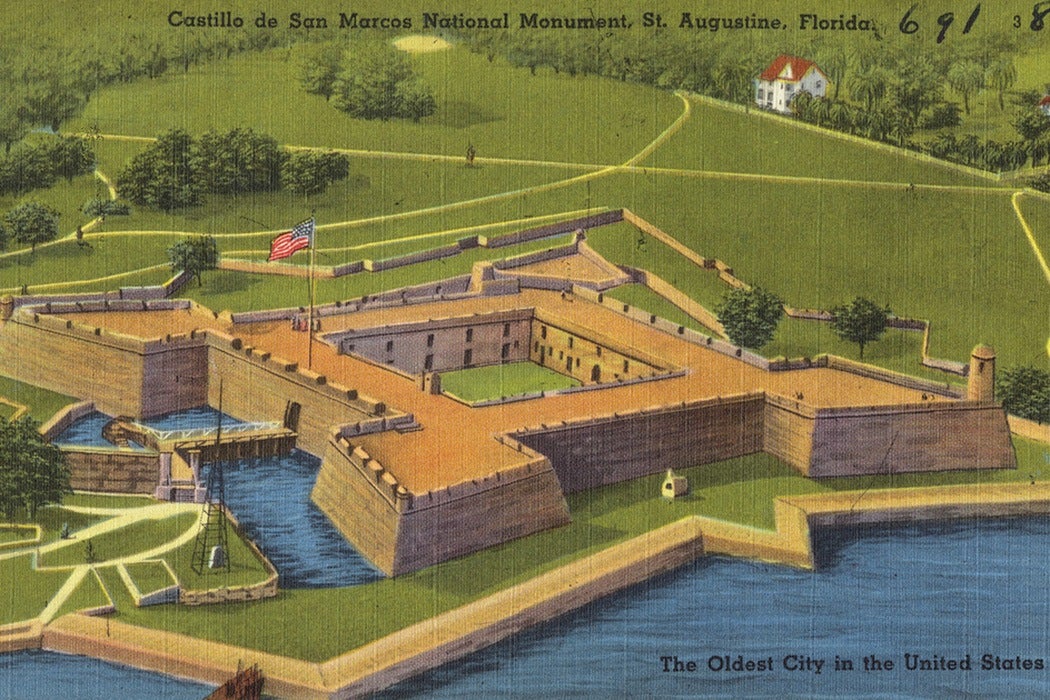
As the Spanish presence in Florida grew, so did the threats from rival powers like England. The early wooden forts built by the settlers were easily burned during raids, most notably by Sir Francis Drake in 1586. This led to the construction of one of the most famous landmarks in the Western Hemisphere: the Castillo de San Marcos.
Engineering the Coquina Fortress
Begun in 1672, the Castillo de San Marcos is a masterpiece of Spanish military engineering. It was constructed using a unique sedimentary rock called coquina, which was quarried from nearby Anastasia Island. Coquina, a compressed shell rock, proved to be an ingenious building material. Instead of shattering when hit by cannonballs, the porous rock absorbed the impact, much like a modern-day sponge. This architectural phenomenon made the fort virtually indestructible, allowing St. Augustine to withstand numerous sieges.
A Symbol of Resilience
The fortress overlooks the Matanzas Bay and has served under the flags of Spain, Great Britain, the Confederate States of America, and the United States. It was never taken by force in battle. Its star-shaped design and massive walls remain the focal point of the city’s historic district. Today, it is managed by the National Park Service and serves as a testament to the strategic foresight of the Spanish discoverers.
Colonial Evolution and the British Interlude
The history of who discovered and controlled St. Augustine is not limited to the Spanish. In the 18th century, the city became a central point of contention between the colonial powers of Europe.
The Siege of 1702
During Queen Anne’s War, the governor of South Carolina, James Moore, led an expedition to capture St. Augustine. While the British successfully burned much of the city, the residents retreated into the Castillo de San Marcos, where they held out for nearly two months. The failure of the British to take the fort reinforced the city’s reputation as an impenetrable Spanish stronghold. To further bolster defenses, the Spanish later built Fort Matanzas, a smaller masonry tower intended to guard the southern approach to the city.
The Transfer of Power
Despite its military resilience, St. Augustine was eventually ceded to the British in 1763 as part of the Treaty of Paris, which ended the Seven Years’ War. In exchange for Florida, Spain regained control of Havana, Cuba. During the British period, the city served as a loyalist haven during the American Revolution. However, the Second Treaty of Paris in 1783 returned Florida to Spain, beginning the Second Spanish Period, which lasted until the United States officially took possession in 1821.
Preserving the Historical Landmark for Future Generations
The “discovery” of St. Augustine by the modern world occurred during the late 19th century, when industrialist Henry Flagler saw the potential of the city as a winter resort for the wealthy. His influence transformed the architectural landscape of the city, blending the ancient Spanish history with Gilded Age opulence.
The Gilded Age Influence
Henry Flagler, a co-founder of Standard Oil, was responsible for the construction of several iconic landmarks that still define the skyline. The Hotel Ponce de Leon, now home to Flagler College, was a masterpiece of Spanish Renaissance architecture. Its intricate carvings, Tiffany stained glass, and grand courtyards were designed to evoke the grandeur of the city’s founders. Across the street, the Alcazar Hotel now houses the Lightner Museum, showcasing a vast collection of decorative arts within its stunning architectural frame.
Modern Day Cultural Significance
Today, walking through St. Augustine feels like stepping back through centuries. Landmarks such as the Oldest Wooden Schoolhouse and the Villa Zorayda provide insight into the diverse cultural influences that have shaped the region. The narrow cobblestone paths of St. George Street reflect the original town plan laid out by the Spanish in the 16th century.
The discovery of St. Augustine was not a singular event but a series of explorations and settlements that established a permanent European foothold in North America. From the first sightings by Juan Ponce de León to the strategic founding by Pedro Menéndez de Avilés, the city has endured as a primary landmark of history. Its architecture, ranging from the rugged coquina of the Castillo de San Marcos to the ornate towers of Flagler College, serves as a physical record of the many nations and individuals who have sought to discover, claim, and preserve this unique corner of Florida. As a National Monument and a living museum, the city remains an essential destination for those seeking to understand the deep roots of colonial history in the Western World.
LifeOutOfTheBox is a participant in the Amazon Services LLC Associates Program, an affiliate advertising program designed to provide a means for sites to earn advertising fees by advertising and linking to Amazon.com. Amazon, the Amazon logo, AmazonSupply, and the AmazonSupply logo are trademarks of Amazon.com, Inc. or its affiliates. As an Amazon Associate we earn affiliate commissions from qualifying purchases.