
The story of how the United States acquired Hawaii is a complex narrative of shifting global powers, economic interests, and the strategic importance of islands situated in the heart of the Pacific Ocean. Far from a simple real estate transaction, the integration of the Hawaiian Islands into the American fold involved a dramatic overthrow of a monarch, the influence of powerful sugar barons, and the geopolitical requirements of a growing naval empire. Today, the remnants of this history are etched into the landmarks of Honolulu and the surrounding landscapes, offering a window into a period when the fate of Polynesian royalty intersected with the ambitions of North America.
The Kingdom of Hawaii and Early Foreign Influence
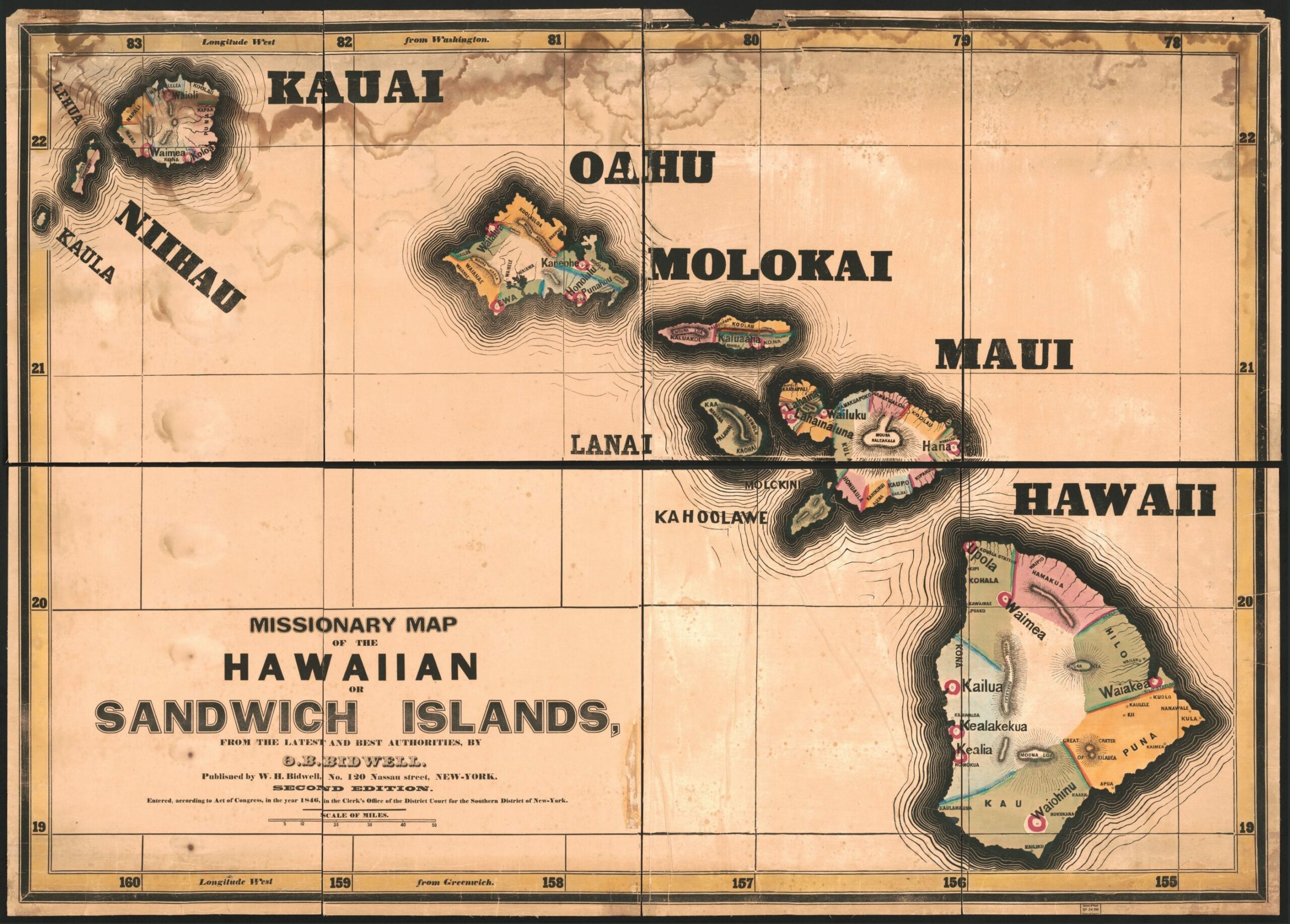
Before it became the 50th state, Hawaii was a recognized sovereign nation known as the Kingdom of Hawaii. Unified at the turn of the 19th century by King Kamehameha I, the archipelago established itself as a thriving center for trade and diplomacy. The strategic location of the islands made them an essential stopover for whalers and merchants traveling between Asia and the Americas.
The Arrival of Explorers and Missionaries
The initial point of contact for the Western world was the arrival of Captain James Cook in 1778. This event catalyzed a massive shift in the social and political structure of the islands. Following the explorers, European and American missionaries began arriving in the 1820s. These groups did more than spread religious beliefs; they established schools, codified the Hawaiian language into a written form, and gradually became influential advisors to the Hawaiian royalty.
The descendants of these early missionaries eventually transitioned from spiritual work to commerce, specifically the cultivation of sugarcane. By the mid-1800s, the sugar industry had become the backbone of the Hawaiian economy. This economic boom led to the necessity of foreign labor, bringing waves of immigrants from China, Japan, and the Philippines, forever altering the demographic landscape of the islands.
The Reciprocity Treaty of 1875
The economic ties between the Kingdom of Hawaii and the United States were formalized through the Reciprocity Treaty of 1875. This agreement allowed Hawaiian sugar to enter the U.S. market duty-free, providing a massive financial advantage to plantation owners. In exchange, the United States gained exclusive access to Pearl Harbor on the island of Oahu as a coaling and repair station for its navy. While this brought prosperity to the elite, it also created a dangerous dependency on American policy, setting the stage for political instability.
The Overthrow: The End of the Monarchy
The tension between the native monarchy and the foreign-descended business elite reached a breaking point during the late 19th century. The plantation owners, many of whom were American citizens or the sons of missionaries, sought greater political control to protect their economic interests.
The Bayonet Constitution
In 1887, a group of armed businessmen known as the Hawaiian League forced King Kalakaua to sign a new constitution at gunpoint. Historically referred to as the Bayonet Constitution, this document severely restricted the power of the monarch and disenfranchised much of the native Hawaiian population by imposing property ownership requirements for voting. This effectively handed control of the legislature to the white plantation owners and businessmen, aligning the kingdom’s governance with American commercial goals.
Queen Liliuokalani and the Coup of 1893
Upon the death of King Kalakaua in 1891, his sister, Queen Liliuokalani, ascended to the throne. She was a staunch advocate for native sovereignty and sought to draft a new constitution that would restore power to the monarchy and the people. Her efforts alarmed the business elite, who feared the loss of their political dominance and the potential for new taxes on the sugar industry.
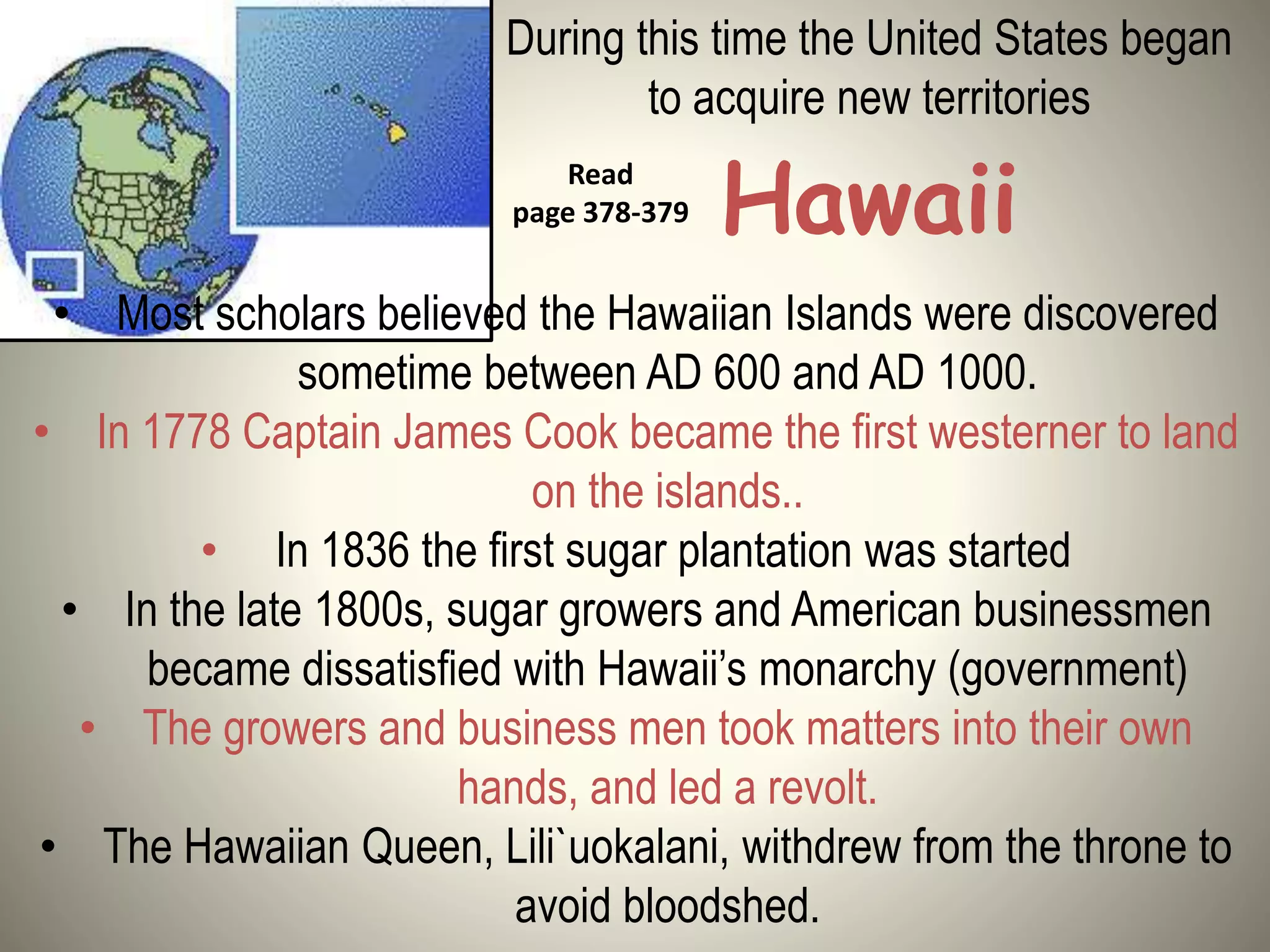
In January 1893, a “Committee of Safety” led by Sanford B. Dole orchestrated a coup. With the unauthorized support of John L. Stevens, the U.S. Minister to Hawaii, a contingent of U.S. Marines from the USS Boston was landed in Honolulu. Faced with the threat of violence and hoping to avoid bloodshed, Queen Liliuokalani surrendered under protest. She believed that the United States government would ultimately recognize the illegality of the action and restore her to the throne.
The Road to Annexation and Statehood
Following the overthrow, the Provisional Government of Hawaii was established, with Sanford B. Dole as its president. Their primary objective was immediate annexation by the United States. However, the political climate in Washington D.C. was divided.
President Grover Cleveland’s Opposition
When President Grover Cleveland took office shortly after the coup, he ordered an investigation led by James Blount. The resulting Blount Report concluded that the overthrow was illegal and that the American people did not support it. Cleveland advocated for the restoration of the Queen, but the Provisional Government refused to step down, instead declaring themselves the Republic of Hawaii in 1894.
The Spanish-American War and the Newlands Resolution
The tide turned with the onset of the Spanish-American War in 1898. The United States realized that Hawaii was a vital strategic outpost for operations in the Philippines and Guam. President William McKinley, who favored expansionism, signed the Newlands Resolution. This joint resolution of Congress officially annexed Hawaii as a territory of the United States.
For the next several decades, Hawaii functioned as a territory, its economy dominated by the “Big Five” corporations that controlled sugar, pineapple, and shipping. It wasn’t until after World War II, during which the islands played a central role following the attack on Pearl Harbor, that the movement for statehood gained unstoppable momentum. In 1959, Hawaii was finally admitted as the 50th state of the Union.
Exploring the Historical Landmarks of the Hawaiian Monarchy
To understand the acquisition of Hawaii, one must visit the physical landmarks that witnessed these historical shifts. Many of these sites are concentrated in the Capitol District of Honolulu and serve as symbols of both royal grandeur and the eventual transition to American governance.
Iolani Palace: The Only Royal Palace on American Soil
The most significant landmark in this history is Iolani Palace. Completed in 1882 by King Kalakaua, it was designed to showcase the kingdom’s modernity and sophistication to the rest of the world. The palace featured electricity and telephone systems before even the White House in Washington D.C..
The palace is also a site of great sorrow. After the overthrow, Queen Liliuokalani was imprisoned in an upper-floor room for several months following a failed counter-revolution by her supporters in 1895. During her imprisonment, she famously composed “Aloha Oe” and other works that remain central to Hawaiian culture. Today, the palace is a meticulously restored museum where visitors can see the throne room, the grand staircase, and the quilt the Queen stitched during her confinement.
Aliiolani Hale and the King Kamehameha Statue
Across the street from Iolani Palace stands Aliiolani Hale. Originally intended to be a palace, it was converted into a government building during its construction. It served as the seat of the kingdom’s legislature and supreme court. It was on the steps of this building that the proclamation of the Provisional Government was read in 1893, effectively signaling the end of the monarchy.
In front of Aliiolani Hale stands the iconic King Kamehameha Statue. This gilded bronze figure commemorates the king who first united the islands. It serves as a reminder of the era of sovereignty that existed before foreign annexation. Every year on Kamehameha Day, the statue is draped in massive flower leis, reflecting the enduring respect the people of Hawaii have for their royal history.
Washington Place and the Legacy of the Queen
Washington Place is another landmark deeply tied to the acquisition narrative. This Greek Revival mansion was the private residence of Queen Liliuokalani and her husband, John Owen Dominis. After she was removed from power and released from her palace imprisonment, she returned to Washington Place, where she lived until her death in 1917. The home later became the official residence of the Governor of Hawaii, symbolizing the literal move from royal home to American political center.

Pearl Harbor: A Landmark of Modern Strategy
While the palaces in Honolulu tell the story of the kingdom’s fall, Pearl Harbor tells the story of why the United States was so determined to keep the islands. The establishment of the naval base was a primary driver for annexation. Today, the Pearl Harbor National Memorial stands as one of the most visited landmarks in Hawaii. It commemorates the events of December 7, 1941, an event that solidified Hawaii’s role as the “Gibraltar of the Pacific” and paved the way for its eventual statehood.
By visiting these landmarks, one can see that the acquisition of Hawaii was not merely a footnote in history but a profound transformation of a culture and a nation. From the halls of Iolani Palace to the docks of Pearl Harbor, the landscape of Oahu preserves the memory of the Kingdom of Hawaii and its integration into the United States.
LifeOutOfTheBox is a participant in the Amazon Services LLC Associates Program, an affiliate advertising program designed to provide a means for sites to earn advertising fees by advertising and linking to Amazon.com. Amazon, the Amazon logo, AmazonSupply, and the AmazonSupply logo are trademarks of Amazon.com, Inc. or its affiliates. As an Amazon Associate we earn affiliate commissions from qualifying purchases.