
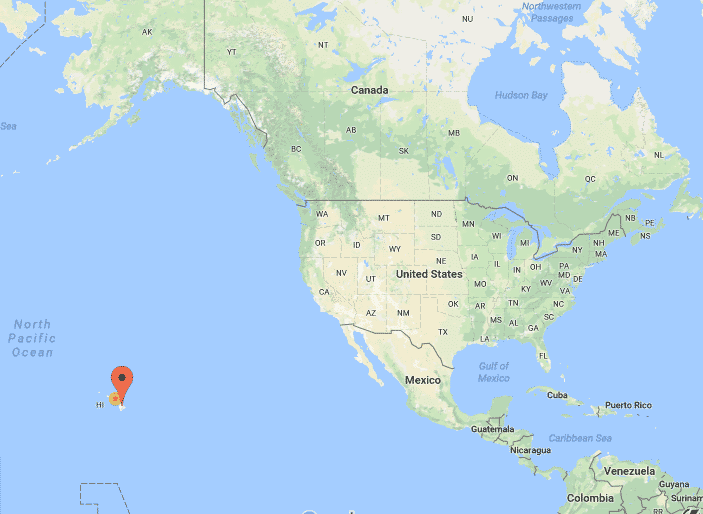
The dream of visiting Hawaii is shared by travelers across the globe. Known as the “Aloha State,” this remote archipelago in the middle of the Pacific Ocean represents the ultimate tropical escape. However, because of its isolated location—roughly 2,400 miles from the nearest continental landmass—the journey requires significant planning. Understanding how far the flight is to Hawaii depends entirely on your point of origin, the prevailing winds, and whether you are flying into the major hub of Honolulu or one of the neighbor islands.
The Geography of the Hawaiian Archipelago
To understand flight durations, one must first grasp the sheer isolation of the Hawaiian Islands. Situated in the Central Pacific, the chain consists of eight main islands, though most travelers frequent Oahu, Maui, Kauai, and the Big Island. Because the islands are located so far from any mainland, every flight to the state is considered a long-haul or “overwater” flight, requiring specialized aircraft equipment and fuel planning.
The Gateway: Daniel K. Inouye International Airport
Most international and long-distance domestic flights arrive at Daniel K. Inouye International Airport in Honolulu. As the primary gateway to the islands, it handles the bulk of the traffic coming from North America, Asia, and Oceania. From here, travelers often take short inter-island hops to reach destinations like Lihue Airport on Kauai or Kahului Airport on Maui. The distance to Honolulu serves as the standard benchmark for most “flight to Hawaii” calculations.
Proximity to the West Coast
The closest major landmass to Hawaii is the West Coast of the United States. Cities like San Francisco, Los Angeles, and Seattle serve as the primary jumping-off points. For travelers starting in California, the flight is approximately 5 to 6 hours. This is the shortest possible duration for anyone coming from the mainland United States.
Regional Breakdown of Flight Durations
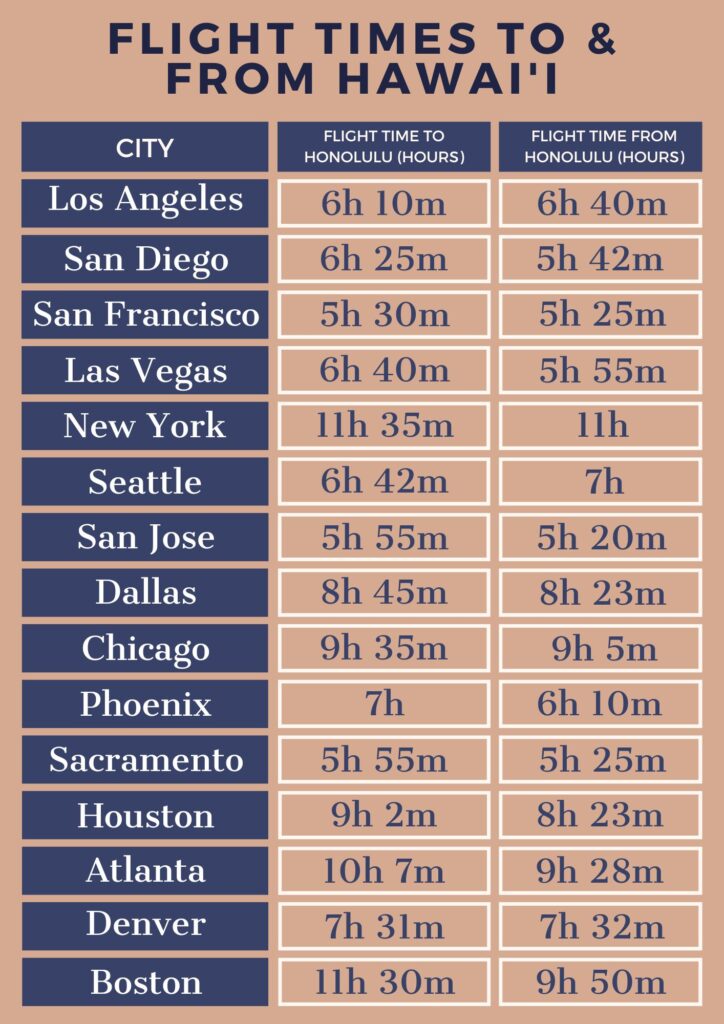
Flight times vary significantly based on whether you are departing from the Americas, the Pacific Rim, or Europe. The direction of travel also plays a role; flights heading west from the United States often take longer than the return journey due to the powerful jet streams that push planes eastward.
Departing from the United States Mainland
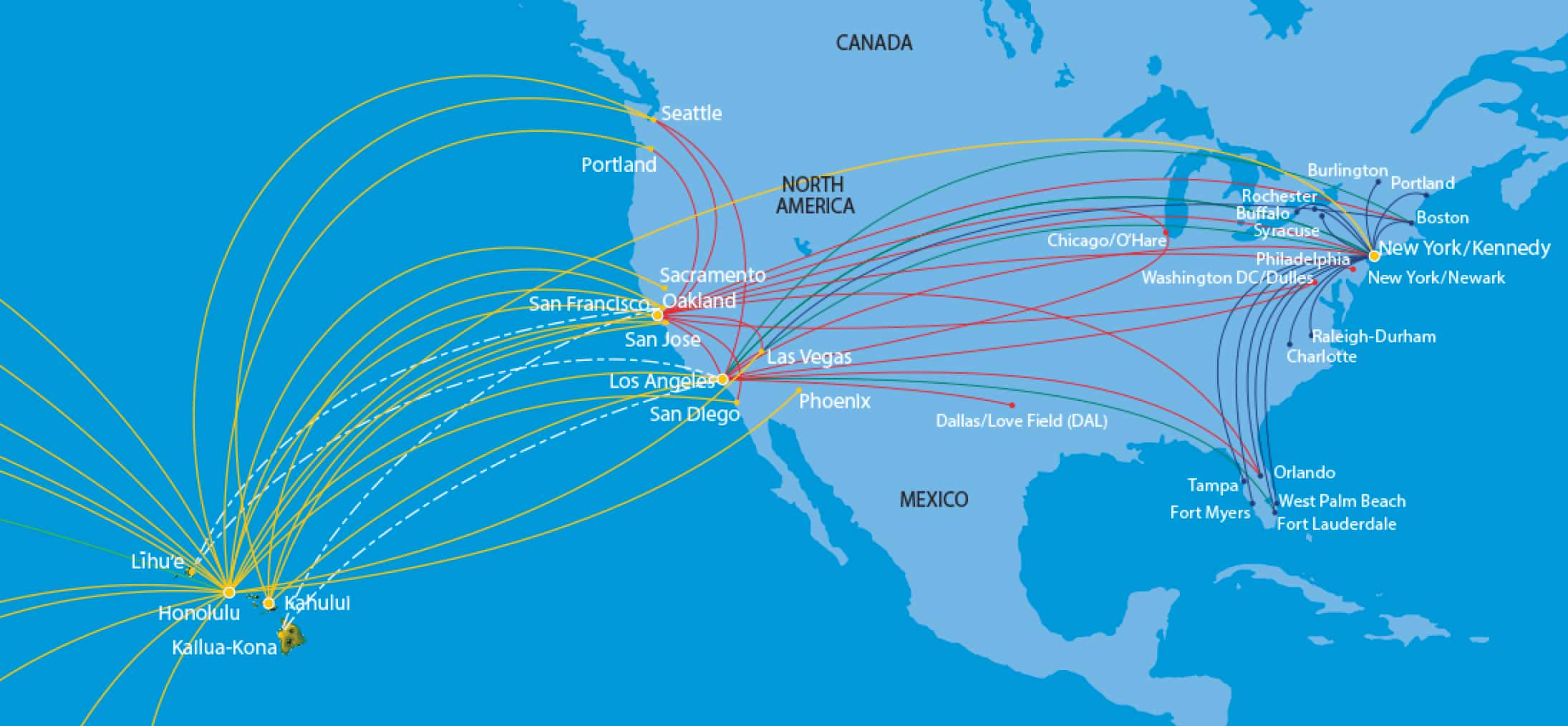
For those on the West Coast, a trip to Hawaii is a relatively standard mid-range flight. A direct flight from San Diego or Los Angeles typically clocks in at around 5 hours and 30 minutes. If you are flying from the Pacific Northwest, such as Portland or Seattle, expect a similar duration, usually between 5 hours and 45 minutes to 6 hours.
As you move further east, the numbers climb. A flight from a mid-country hub like Denver or Dallas takes roughly 7 to 8 hours. Travelers departing from the East Coast, including New York City, Boston, or Atlanta, are looking at a much more grueling journey. A direct flight from John F. Kennedy International Airport to Honolulu is one of the longest domestic routes in the world, often exceeding 10 or 11 hours in the air.
International Routes from Asia and Oceania
Hawaii is a massive draw for tourists from Japan. Flights from Tokyo, specifically from Narita Airport or Haneda Airport, take approximately 7 to 8 hours. Interestingly, the flight from Japan to Hawaii is often shorter than the return trip because of the aforementioned tailwinds.
Travelers from Australia and New Zealand also have a long path across the South Pacific. A direct flight from Sydney to Honolulu takes about 10 hours, while the journey from Auckland is slightly shorter at roughly 8 hours and 45 minutes. From South Korea, departing from Incheon International Airport in Seoul, the flight duration is typically around 8 to 9 hours.
Navigating the Longest Routes
For travelers coming from Europe, Africa, or the Middle East, there are no direct flights to Hawaii. The distance is simply too great for current commercial aircraft to traverse without a refueling stop or a connection.
The European Connection
A traveler from London or Paris faces a significant journey. Most passengers from the United Kingdom will fly into a major United States hub like Los Angeles or San Francisco first. The total travel time, including a layover, can easily reach 18 to 22 hours. If you are flying from Germany or Italy, the itinerary is similarly taxing. Many European visitors choose to break up the trip by staying a night or two in a city like Vancouver or Las Vegas to mitigate the effects of the massive time zone shift.
The Role of Connecting Flights
While direct flights are the fastest way to reach the islands, connecting flights are often more budget-friendly. Many travelers from smaller cities in North America will first fly to Phoenix or Salt Lake City before making the final leg over the ocean. While this adds 2 to 4 hours to the total travel day, it provides an opportunity to stretch one’s legs before the long overwater stretch.
Strategies for a Smooth Transpacific Flight
Given that even the shortest flight to Hawaii is over five hours, preparation is key to a comfortable experience. Transpacific flights are unique because once the aircraft leaves the coast of California or the edge of Japan, there are no emergency landing strips until the plane reaches the islands.
In-Flight Amenities and Comfort
Most airlines operating these routes use wide-body aircraft like the Airbus A330 or the Boeing 787 Dreamliner. These planes are designed for long-haul comfort, featuring better cabin pressure and humidity control to reduce fatigue. When booking, it is worth checking if your flight offers full meal service, as some domestic carriers from the United States mainland may only offer buy-on-board snacks despite the long duration.
Managing Jet Lag
The time difference can be one of the most challenging aspects of the distance. Hawaii follows Hawaii-Aleutian Standard Time and does not observe Daylight Saving Time. For someone traveling from New York City, the time difference can be 5 or 6 hours depending on the time of year. To combat jet lag, experts suggest hydrating aggressively during the flight and immediately syncing your watch to Honolulu time the moment you board.
Beyond the Flight: Arrival and Island Hopping
Once you have crossed the vast Pacific Ocean and landed, the geography of Hawaii continues to influence your travel. Not all visitors stay on Oahu. If your final destination is Kona International Airport on the Big Island or Molokai, you may have an additional short flight ahead of you.
Choosing Your Entry Point
Direct flights from the mainland now service many of the outer islands, not just Honolulu. You can find non-stop service from Los Angeles to Kahului Airport in Maui or Lihue Airport in Kauai. Choosing a direct flight to your specific island can save you the 2 to 3 hours typically required for a layover and connecting flight in Honolulu.
The Experience of Inter-Island Travel
Inter-island flights are a staple of the Hawaii experience. These flights are incredibly short, often lasting only 30 to 45 minutes. For example, the hop from Honolulu to Lanai or Maui offers stunning aerial views of the Pacific Ocean and the volcanic coastlines. While the long-haul flight to get to the state is the “hard” part, these small regional flights are generally considered part of the sightseeing experience.
Final Considerations for the Journey
When calculating “how far” the flight is, remember that environmental factors like the Kona Winds or seasonal storms can add 30 minutes to an hour to your arrival time. Additionally, the time spent at the airport for agricultural inspections—a mandatory part of leaving Hawaii for the United States mainland—should be factored into your total travel day.
Ultimately, whether you are flying 5 hours from San Francisco or 11 hours from New York City, the distance to Hawaii is a small price to pay for the beauty of the Alaskan-sized volcanic peaks, the pristine waters of Hanauma Bay, and the rich cultural heritage of the Polynesian people. The journey is an integral part of the adventure, serving as a transition from the fast-paced modern world to the tranquil, sun-drenched shores of the Pacific.
LifeOutOfTheBox is a participant in the Amazon Services LLC Associates Program, an affiliate advertising program designed to provide a means for sites to earn advertising fees by advertising and linking to Amazon.com. Amazon, the Amazon logo, AmazonSupply, and the AmazonSupply logo are trademarks of Amazon.com, Inc. or its affiliates. As an Amazon Associate we earn affiliate commissions from qualifying purchases.