
The question of when the United States “bought” Hawaii is one of the most common misconceptions in American history. Unlike the Louisiana Purchase from France or the acquisition of Alaska from Russia, there was no financial transaction or “sale” of the islands. Instead, the story of how Hawaii became part of the United States is a complex narrative of political maneuvering, an armed coup, and a strategic annexation that spanned several decades of the late 19th and early 20th centuries. Understanding this history is essential for anyone visiting the Hawaiian Islands, as the legacy of this transition is etched into the very architecture and cultural landscape of landmarks like Honolulu.
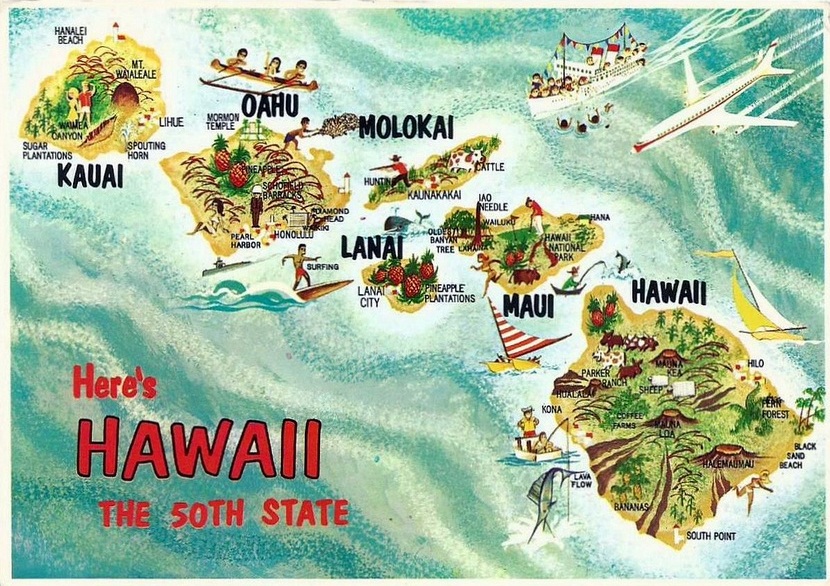
The Sovereign Kingdom and the Rise of Foreign Influence
Before it was a territory or a state, Hawaii was a recognized sovereign nation. The Kingdom of Hawaii was unified by King Kamehameha I in 1810, creating a centralized monarchy that successfully navigated international diplomacy with global powers like Great Britain and the United States. By the mid-1800s, Hawaii was a highly literate nation with a constitutional government and a thriving economy centered on the sandalwood trade and, eventually, sugar.
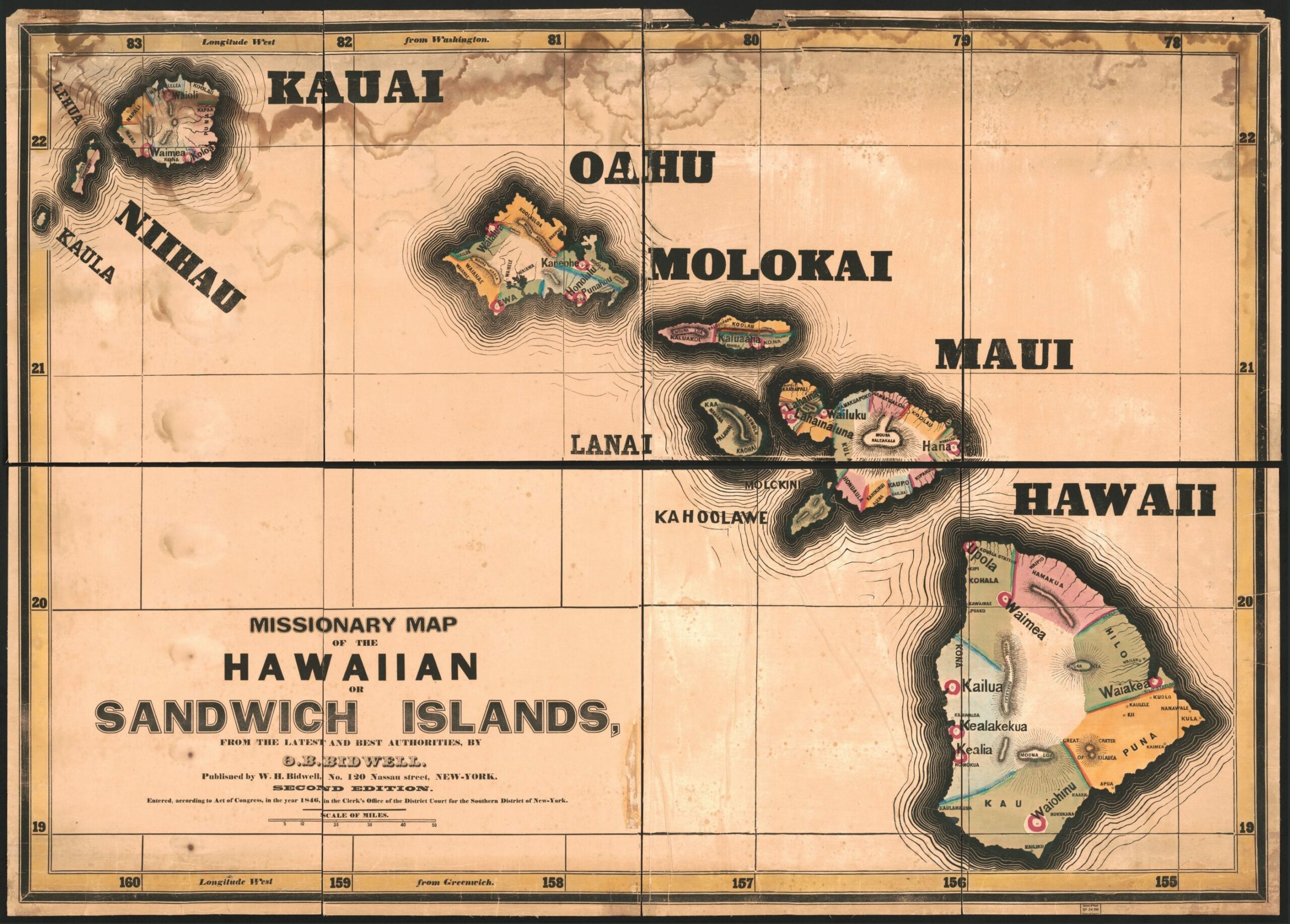
The mid-19th century saw a massive influx of American missionaries and businessmen. These individuals and their descendants, often referred to as the “missionary party,” began to exert significant influence over the islands’ politics and economy. This period marked the beginning of a shift in land ownership. The Great Mahele of 1848, a land redistribution act, allowed foreigners to own property in Hawaii for the first time. This opened the door for large-scale sugar plantations, which soon became the dominant economic force.
As the sugar industry grew, so did the desire of American plantation owners for closer ties to the United States. They sought to eliminate tariffs on Hawaiian sugar entering the American market. This economic pressure culminated in the “Bayonet Constitution” of 1887. Under the threat of violence from the Honolulu Rifles, a paramilitary group composed of primarily white settlers, King Kalakaua was forced to sign a new constitution that stripped the monarchy of much of its power and disenfranchised a large portion of the native Hawaiian population by introducing property requirements for voting.
The Architect of Modern Honolulu: Iolani Palace
One of the most significant landmarks of this era is Iolani Palace in Honolulu. Completed in 1882 by King Kalakaua, it remains the only official royal palace on United States soil. The palace was a symbol of Hawaii as a modern, progressive nation, featuring electricity and telephone lines before the White House. Today, it stands as a poignant reminder of the kingdom’s sovereignty and the sophisticated culture that existed prior to annexation.
The Overthrow of the Monarchy in 1893
The pivotal moment in the transition of Hawaii toward American control occurred in January 1893. When King Kalakaua passed away, his sister, Queen Liliuokalani, ascended to the throne. She was a fierce advocate for Hawaiian independence and sought to introduce a new constitution that would restore power to the monarchy and voting rights to the native people.
In response, a group of American and European businessmen, calling themselves the Committee of Safety, orchestrated a coup. They were aided by the United States Minister to Hawaii, John L. Stevens, who ordered the landing of United States Marines from the USS Boston to “protect American lives and property.” Faced with the overwhelming military force of the United States, Queen Liliuokalani surrendered her authority under protest, stating that she did so to avoid the shedding of her people’s blood.
The Provisional Government and the Republic of Hawaii
Following the overthrow, a Provisional Government was established, led by Sanford B. Dole. Their primary goal was immediate annexation by the United States. However, their plans hit a major roadblock in Washington D.C.. President Grover Cleveland, an anti-imperialist, was appalled by the reports of the illegal overthrow. He commissioned the Blount Report, which concluded that the revolution had been carried out against the wishes of the Hawaiian people and with the unauthorized assistance of U.S. troops.
President Grover Cleveland refused to support annexation and instead called for the restoration of the monarchy. However, the Provisional Government refused to step down and instead declared themselves the Republic of Hawaii in 1894. They waited for a more sympathetic administration to take office in the United States.
The Annexation of 1898: The Strategic Turning Point
The question of “when” Hawaii became part of the United States is officially answered by the year 1898. The political tide shifted with the election of President William McKinley, who was much more open to American expansionism. The outbreak of the Spanish-American War in 1898 provided the final justification for annexation.
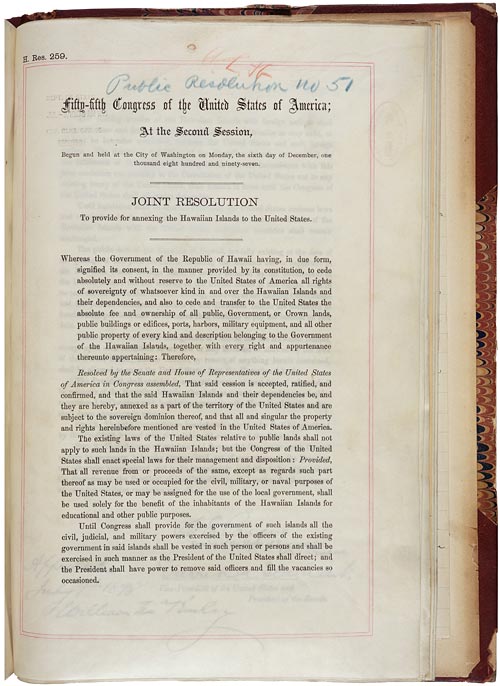
The United States Navy needed a strategic mid-Pacific coaling station to support its operations in the Philippines and Guam. Pearl Harbor on the island of Oahu was identified as the perfect location. Realizing that a formal treaty of annexation might not pass the United States Senate (which required a two-thirds majority), proponents of annexation pushed through the Newlands Resolution. This was a joint resolution of Congress that required only a simple majority in both houses.
On August 12, 1898, the sovereignty of the Republic of Hawaii was transferred to the United_States in a ceremony at Iolani Palace. The Hawaiian flag was lowered, and the Stars and Stripes were raised. Hawaii was now an organized incorporated territory of the United States. It is important to note that no money was paid to the Hawaiian government or its people during this process; the “purchase” simply never happened.
Strategic Landmarks: Pearl Harbor
The strategic value that led to annexation is most visible today at the Pearl Harbor National Memorial. This site, which includes the USS Arizona Memorial, the USS Missouri, and the USS Bowfin Submarine Museum and Park, highlights why the United States was so determined to control the islands. The natural harbor provided a deep-water port that secured American dominance in the Pacific Ocean for the next century.
The Journey to Statehood and Modern Landmarks
After annexation, Hawaii remained a territory for over sixty years. During this time, the islands underwent massive demographic and social changes. The plantation economy continued to thrive, bringing in waves of immigrants from Japan, China, the Philippines, and Portugal, creating the multicultural society Hawaii is known for today.
The push for statehood gained momentum after World War II. The bravery of the 442nd Regimental Combat Team, composed primarily of Japanese-Americans from Hawaii, helped change perceptions in the mainland United States. Finally, on August 21, 1959, President Dwight D. Eisenhower signed the proclamation making Hawaii the 50th state of the Union.
Landmarks of Statehood and Culture
For those exploring the landmarks of Hawaii, the story of its annexation and eventual statehood is visible in many places beyond the capital.
- Diamond Head (Leahi): This iconic volcanic tuff cone served as a critical military lookout during the territorial years. The Fort Ruger fortifications built into the crater are remnants of the era when Hawaii was the “Gibraltar of the Pacific.”
- Bernice Pauahi Bishop Museum: Founded in 1889, this museum is the premier institution for the study and preservation of Hawaiian history and culture. It houses the personal heirlooms of Princess Bernice Pauahi Bishop, the last descendant of the Kamehameha Dynasty.
- Washington Place: The former home of Queen Liliuokalani and later the official residence of the Governor of Hawaii, this landmark embodies the transition from monarchy to American statehood.
- National Memorial Cemetery of the Pacific: Located in Punchbowl Crater, this site honors those who served in the United States Armed Forces, illustrating the deep military ties that defined the relationship between Hawaii and the mainland throughout the 20th century.
The Enduring Legacy of the Annexation
While the United States never “bought” Hawaii in a traditional sense, the events of 1898 forever changed the trajectory of the islands. In 1993, on the 100th anniversary of the overthrow, President Bill Clinton signed the Apology Resolution. This formal act of Congress acknowledged that the overthrow of the Kingdom of Hawaii occurred with the active participation of agents and citizens of the United States and that the native Hawaiian people never directly relinquished their claims to their inherent sovereignty.
Today, visitors to Maui, Kauai, Molokai, Lanai, and the Big Island can see the dual nature of Hawaii. It is a place of incredible natural beauty and American modernity, yet it remains a place with a deeply felt history of independent royalty. Landmarks like the statue of King Kamehameha I in front of Aliiolani Hale stand as guardians of this complex past. Understanding that Hawaii was annexed rather than bought provides a more accurate and respectful perspective on the history of the 50th state.
LifeOutOfTheBox is a participant in the Amazon Services LLC Associates Program, an affiliate advertising program designed to provide a means for sites to earn advertising fees by advertising and linking to Amazon.com. Amazon, the Amazon logo, AmazonSupply, and the AmazonSupply logo are trademarks of Amazon.com, Inc. or its affiliates. As an Amazon Associate we earn affiliate commissions from qualifying purchases.