
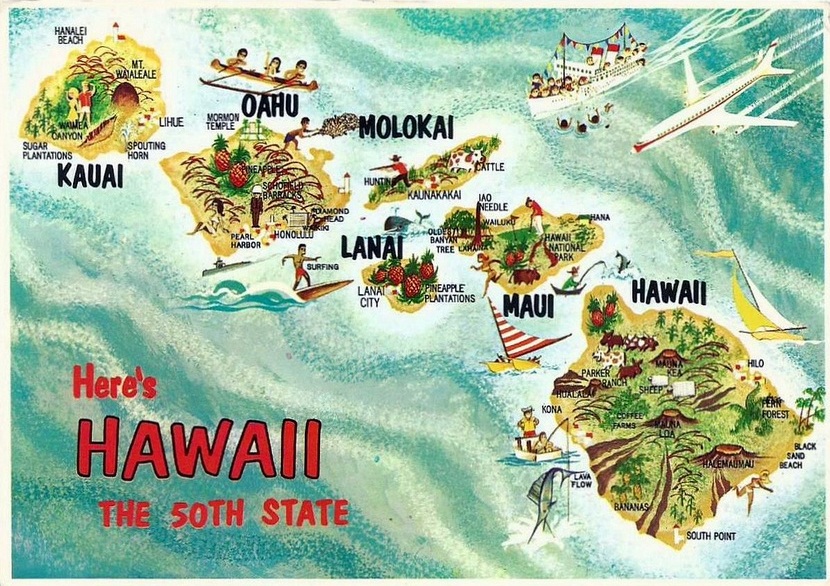
The history of Hawaii is a complex narrative of sovereignty, strategic positioning, and global commerce, centered on a collection of islands that serves as a bridge between the United States and the vast expanse of the Pacific Ocean. While many visitors today view the islands as a paradise for relaxation, the physical landmarks of Oahu and the surrounding islands tell a much more intricate story of how and why the American government sought to incorporate this independent kingdom into its territory. The acquisition of Hawaii was not a single event but a gradual process driven by military necessity, agricultural wealth, and the shifting tides of 19th-century imperialism.
The Strategic Sovereignty of Pearl Harbor and the Pacific
Long before the tourist crowds arrived at Waikiki, the deep-water lagoons of the islands caught the attention of global powers. The most significant of these natural features is Pearl Harbor. To understand why the United States took Hawaii, one must first understand the geographic value of this landmark. Situated at the crossroads of the Pacific, the islands offered the perfect refueling station for ships traveling from San Francisco to China and Japan.
The Geopolitical Value of Oahu
The United States viewed Oahu as the “Gibraltar of the Pacific.” In an era where naval power dictated the strength of a nation, owning a secure harbor in the middle of the ocean was of paramount importance. Pearl Harbor, known to the Native Hawaiians as Wai Momi, was identified early on by American naval strategists as the finest natural harbor in the region. By securing this location, the American military could project power across the hemisphere and protect trade routes that were becoming increasingly vital to the national economy.
The desire for a permanent naval presence was codified in several diplomatic agreements, but none were as influential as the Reciprocity Treaty of 1875. This agreement allowed Hawaiian sugar to enter the United States tax-free, in exchange for a promise that Hawaii would not lease its lands or harbors to any other foreign power, such as Great Britain or France. When the treaty was renewed in 1887, the American government successfully lobbied for the exclusive right to use Pearl Harbor as a coaling and repair station.
Maritime Expansion and the Spanish-American War
The definitive push for annexation came during the Spanish-American War in 1898. As the United States fought to secure territories like the Philippines and Guam from Spain, the strategic necessity of Hawaii became undeniable. President William McKinley argued that the islands were essential for the movement of troops and supplies to the western theater of the war. Despite significant domestic opposition and protests from the Hawaiian people, the strategic landmarks of the islands—namely the docks and logistical hubs of Honolulu—were deemed too valuable to remain under an independent flag.
Iolani Palace and the Overthrow of the Monarchy
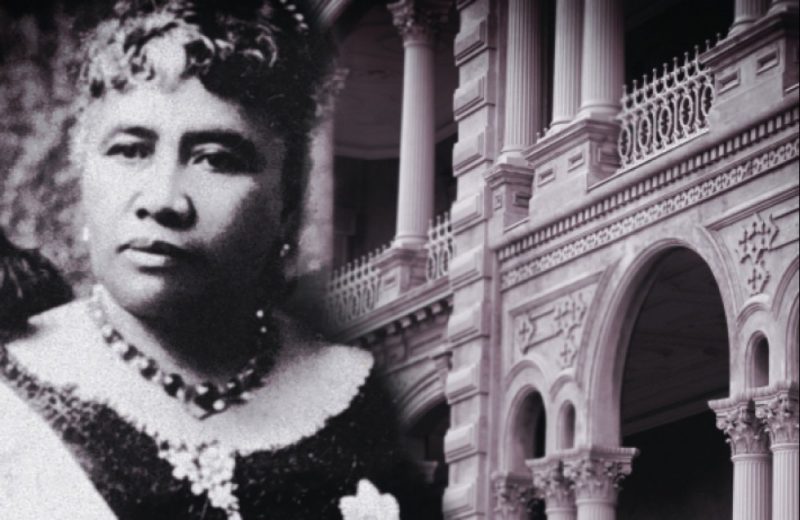
If Pearl Harbor represents the military motivations for the acquisition, Iolani Palace stands as the landmark of political transition. Located in the heart of Honolulu, it is the only royal palace on American soil and serves as a poignant reminder of the sovereign nation that existed before 1893. The palace was the residence of the last two monarchs of the Kingdom of Hawaii: King Kalakaua and his sister, Queen Liliuokalani.
Queen Liliuokalani and the Fight for Hawaiian Independence
In 1891, Queen Liliuokalani ascended the throne with the goal of restoring power to the monarchy and the native people. At the time, the political landscape was dominated by the “Bayonet Constitution,” which had been forced upon her brother by a group of armed American and European businessmen. This constitution stripped the monarch of most authority and disenfranchised many Native Hawaiians and Asian immigrants by tying voting rights to property ownership.
When the Queen attempted to promulgate a new constitution that would restore rights to her subjects, a group of businessmen and lawyers, calling themselves the Committee of Safety, organized a coup. This group, led by Sanford Dole, sought to overthrow the Queen and seek annexation by the United States to ensure that their sugar profits would remain protected from changing tariffs and royal interference.
The Role of American Intervention
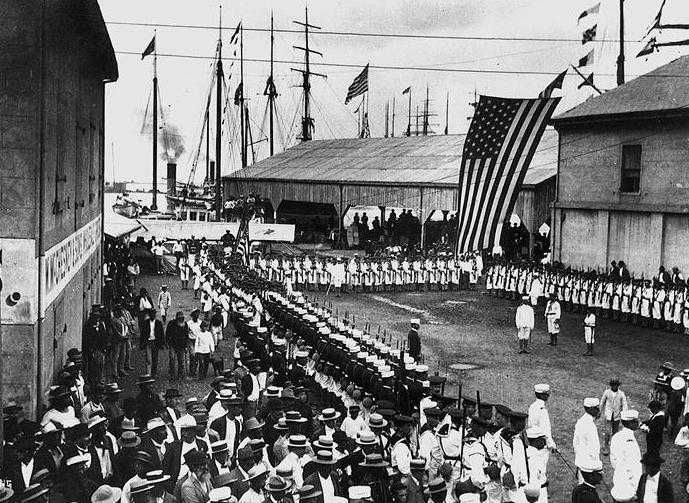
The overthrow was not merely a local insurrection. The United States Minister to Hawaii, John L Stevens, ordered the landing of U.S. Marines from the USS Boston to support the Committee of Safety. Positioned across from Iolani Palace, these troops provided the necessary intimidation to force Queen Liliuokalani to yield her authority. She did so under protest, believing that the United States government, once informed of the facts, would undo the actions of its representatives and restore her to the throne.
While President Grover Cleveland initially condemned the overthrow and called for the restoration of the monarchy after the Blount Report found the intervention illegal, he was unable to persuade Congress or the provisional government in Hawaii to comply. The palace eventually became the headquarters for the newly formed Republic of Hawaii until the islands were formally annexed.
The Economic Influence of the Sugar Industry and Landmarks of Trade
Beyond the strategic harbors and royal chambers, the landscape of Hawaii was fundamentally reshaped by the sugar industry. For much of the 19th century, the economy of the islands was driven by vast plantations that required massive amounts of land, water, and labor. This economic engine was controlled by a small group of corporations known as The Big Five.
The Big Five and the Development of Honolulu
The companies comprising The Big Five—Castle & Cooke, Alexander & Baldwin, C Brewer & Co, Theo H Davies & Co, and American Factors—exerted immense influence over the islands. Their headquarters in downtown Honolulu became landmarks of American-style corporate power. These entities realized that their financial stability depended on the elimination of trade barriers between Hawaii and the American mainland. If Hawaii were a territory of the United States, the sugar planters would be entitled to the same subsidies and tariff protections as planters in Louisiana or Florida.
The landmarks of this era include the extensive irrigation systems that diverted water from the lush windward sides of the islands to the arid leeward plains where sugar flourished. These feats of engineering permanently altered the natural environment and displaced traditional Hawaiian agriculture, further consolidating power in the hands of the sugar barons.
Agricultural Infrastructure and the Shift in Power
The shift from a subsistence-based society to a plantation-based economy necessitated a massive influx of labor. This led to the creation of plantation towns, many of which still exist today as historic landmarks. Workers from China, Japan, Portugal, and the Philippines were brought in to work the fields, creating a multi-ethnic society that would eventually outnumber the Native Hawaiian population. This demographic shift was often cited by proponents of annexation as a reason why the United States should take control: to “stabilize” the region and ensure that it remained under the influence of Western cultural and political norms.
The Aloha Tower, though built slightly later in 1926, stands as a monument to the era of maritime trade and the economic prosperity that the sugar industry brought to the territory’s elite. For decades, it was the tallest building in Hawaii, greeting the massive steamships that carried the sugar out and brought the tourists in.
Preserving History: Modern Landmarks and the Legacy of Annexation
Today, the story of why the United States took Hawaii is preserved through various landmarks that serve as educational sites for residents and visitors alike. These locations offer a nuanced view of the past, acknowledging both the benefits of integration and the profound loss experienced by the Hawaiian people.
Bishop Museum and the Documentation of Cultural Heritage
The Bishop Museum, founded in memory of Princess Bernice Pauahi Bishop, the last descendant of the Kamehameha Dynasty, is a critical landmark for understanding the pre-annexation era. It houses the world’s largest collection of Hawaiian artifacts and documents. The museum provides a space where the history of the Kingdom of Hawaii is kept alive, offering context to the political and social structures that were dismantled during the American takeover.
By visiting the Bishop Museum, one can see the royal regalia, feather cloaks, and historical records that emphasize Hawaii was a recognized sovereign state with its own international treaties and diplomatic standing long before it became a part of the United States.
Washington Place and the Site of Historical Transition
Another vital landmark is Washington Place. Built by the father-in-law of Queen Liliuokalani, this elegant mansion served as her private residence and the place where she was eventually arrested during the counter-revolution of 1895. Later, it became the official residence of the Governor of Hawaii.
The transition of Washington Place from a royal residence to a seat of American territorial and state power mirrors the broader transition of the islands. It is a site of deep emotional resonance, particularly for those who advocate for Hawaiian sovereignty. Every year, ceremonies are held at such landmarks to honor the memory of the monarchy and to reflect on the events of 1893 and 1898.
The natural landmarks of the islands also play a role in this historical narrative. Sites like Nuuanu Pali look back even further to the unification of the islands under Kamehameha I. The steep cliffs where the final battle for Oahu took place serve as a reminder that Hawaii has always been a land where geography and power are inextricably linked.
From the volcanic peak of Diamond Head to the memorial at Pearl Harbor, the physical environment of Hawaii is a living record of its annexation. The United States took Hawaii because it was a jewel of the Pacific—a strategic military asset, a lucrative agricultural hub, and a symbolic gateway to the East. While the methods of its acquisition remain a subject of debate and historical reflection, the landmarks that remain continue to tell the story of a kingdom, a coup, and the creation of the 50th state. Understanding these sites is essential for anyone wishing to grasp the true history of the United States in the Pacific Ocean.
LifeOutOfTheBox is a participant in the Amazon Services LLC Associates Program, an affiliate advertising program designed to provide a means for sites to earn advertising fees by advertising and linking to Amazon.com. Amazon, the Amazon logo, AmazonSupply, and the AmazonSupply logo are trademarks of Amazon.com, Inc. or its affiliates. As an Amazon Associate we earn affiliate commissions from qualifying purchases.