
The allure of the unknown, the whispers of engineering marvels that defy logic, often capture the imagination. Among these whispered tales, the “Louisiana Loop Bridge” has surfaced, sparking curiosity and debate among those fascinated by unique infrastructure and the mysteries that can shroud even the most tangible of human creations. This article delves into the reality behind this enigmatic structure, exploring its potential origins, the reasons for its mystique, and what it signifies in the broader context of architectural and geographical exploration.
The Enigma of the Louisiana Loop Bridge
The very name, “Louisiana Loop Bridge,” evokes a sense of intrigue. It suggests a bridge that doesn’t follow conventional linear paths, a structure that perhaps curves or loops back on itself in a manner that seems counterintuitive to its purpose of spanning a gap. This inherent strangeness is what fuels its legend. In a state like Louisiana, known for its intricate network of waterways, bayous, and unique geological formations, the idea of an unusual bridge is not entirely far-fetched. However, the specific concept of a “loop bridge” in this context requires careful examination.

The initial fascination with such a bridge likely stems from a combination of factors: a genuine interest in innovative engineering, a fascination with the natural landscape of Louisiana, and perhaps a dash of urban legend or misinterpretation. Bridges are designed for a fundamental purpose: to connect two points efficiently and safely. A structure that loops would, on the surface, seem to contradict this principle by adding unnecessary distance and complexity. This apparent paradox is precisely what makes the idea so captivating and prompts the question of its existence.
Deconstructing the “Loop” Concept
To understand if the Louisiana Loop Bridge could be real, we must first dissect what “loop bridge” might entail.
Potential Interpretations of a “Loop Bridge”
-
A True Topological Loop: The most literal interpretation is a bridge that forms a continuous loop, a circuit that starts and ends at the same point without ever reaching a distinct opposite bank. This would be an exceptionally rare and likely impractical design for traditional transportation purposes. Such a structure might exist as an artistic installation, a very specific pedestrian path with an aesthetic purpose, or perhaps a segment of a larger, more complex interchange system where multiple roads converge and diverge in a circular fashion. However, a standalone bridge forming a complete loop for vehicular traffic is highly improbable due to efficiency concerns.
-
A Series of Interconnecting Loops: More plausibly, a “loop bridge” could refer to a complex interchange where bridges and roadways form a series of interconnected loops, ramps, and overpasses, creating a visually striking and intricate network. Many large highway interchanges feature sweeping curves and circular elements designed to manage traffic flow efficiently, and from certain vantage points, these might appear as a form of “loop.” These are common in urban areas and major transportation hubs around the world, and Louisiana certainly has its share of such infrastructure.
-
A Misnomer or Local Legend: It is also possible that the term “Louisiana Loop Bridge” is a misnomer, a local nickname for a bridge that has a distinctive curve or unusual design, or it could be an apocryphal tale. Legends about hidden places, secret structures, or unusual natural phenomena are common in many regions, and Louisiana with its rich folklore and mysterious landscapes, is fertile ground for such stories.
Engineering and Practicality
From an engineering perspective, constructing a bridge that forms a complete, continuous loop without reaching a destination would be a significant undertaking with questionable practical benefits for standard transportation. Bridges are fundamentally about overcoming obstacles, such as rivers, valleys, or roads, to connect two distinct locations. A true loop would add considerable length and cost for no clear gain in connectivity.
However, if we consider the interpretation of a complex interchange system, then the concept becomes much more grounded. Modern traffic engineering often employs multi-level, curved ramps and overpasses to facilitate the smooth merging and diverging of traffic streams, particularly where multiple major highways intersect. These systems, while complex, are designed to maximize traffic flow and safety. Structures like the I-10/I-49 interchange near Lafayette or similar complex junctions in the New Orleans metropolitan area could, from a distance or in certain photographic representations, be perceived as forming “loops.”
Searching for Evidence: Where Might It Be?
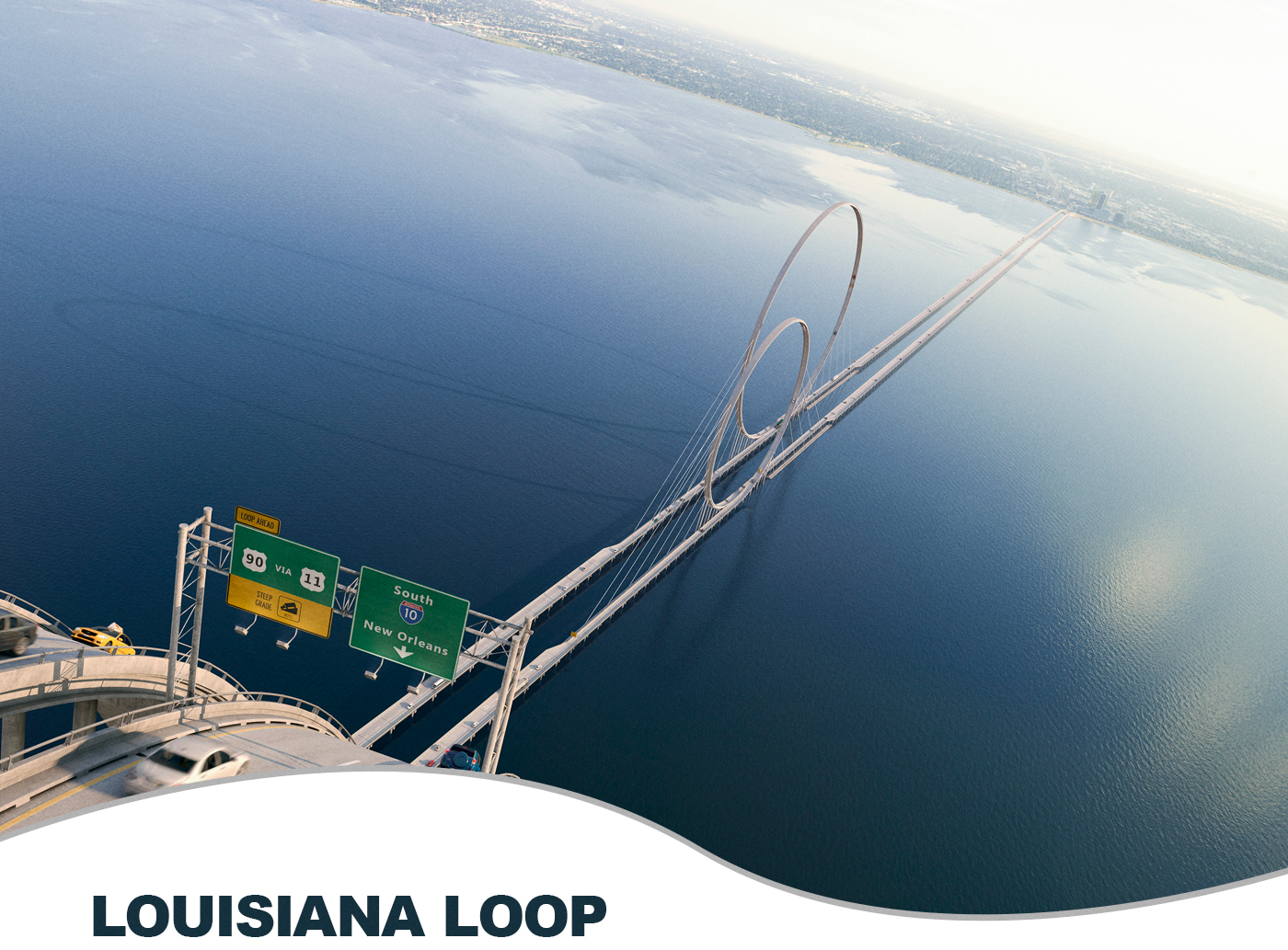
Given the lack of widely recognized engineering projects explicitly named the “Louisiana Loop Bridge,” the search for its reality leads us down several avenues.
Potential Locations and Infrastructure
If such a bridge or a structure resembling one exists, it’s most likely to be found in areas with high traffic volume and complex transportation needs.
-
Major Urban Centers: Cities like New Orleans, Baton Rouge, and Shreveport have extensive highway systems and often feature intricate interchanges designed to manage dense traffic. These are prime candidates for housing complex overpasses that might be colloquially referred to as a “loop.” For instance, the elevated sections of highways in New Orleans can create visually complex patterns.
-
Areas with Unique Geography: Louisiana’s distinctive geography, with its numerous rivers, bayous, and marshes, necessitates a vast network of bridges. Some of these might incorporate curves or specific designs to navigate the terrain, leading to an unusual appearance. While unlikely to form a perfect loop, bridges built to accommodate these challenging landscapes could possess a unique aesthetic.
-
Industrial or Specialized Sites: It’s conceivable that a specialized industrial complex, a port, or a unique transportation hub might feature a looping bridge for internal logistics or specific operational needs. However, these would likely be privately owned and not widely known or accessible to the public.
The Role of Misinformation and Folklore
The digital age, while providing access to vast amounts of information, also facilitates the spread of rumors and misinformation. A compelling idea, such as a “loop bridge,” can quickly gain traction online, even if it lacks factual basis. Photographs can be taken out of context, descriptions can be exaggerated, and urban legends can evolve.
The term might also be a misinterpretation of a bridge with a significant curve or a series of connecting ramps that create a circular effect. For example, some aerial photographs of complex highway systems can appear abstract and geometric, leading to imaginative interpretations. Without specific coordinates or official documentation, the “Louisiana Loop Bridge” remains in the realm of conjecture.
The Reality vs. The Legend
The absence of any officially documented or widely recognized structure fitting the description of a “Louisiana Loop Bridge” leads to a primary conclusion: the concept as a singular, named entity is likely apocryphal. There is no famous bridge in Louisiana that is universally known by this name and fits the literal description of a complete loop.
However, this does not diminish the fascination. The idea of such a bridge speaks to our desire for wonder and the unexpected in the built environment. It prompts us to look closer at the infrastructure around us and question the boundaries of design.

What the “Loop Bridge” Symbolizes
The legend of the Louisiana Loop Bridge, even if not a physical reality, serves a purpose. It represents:
- The Human Drive for Innovation: The desire to create structures that are not just functional but also awe-inspiring. While a true loop bridge might be impractical, the idea of it pushes our imagination about what is possible.
- The Mystery of Place: Louisiana is a state rich in mystique and unique landscapes, from the swamps of the Atchafalaya Basin to the historic streets of New Orleans. Legends about unusual structures fit neatly into this narrative of the unexpected.
- The Power of Storytelling: How a simple concept, even if unverified, can capture public imagination and inspire exploration, even if that exploration leads to the realization that the legend is just that – a legend.
While you won’t find a bridge that literally loops back on itself as a standalone structure in Louisiana, the spirit of the question encourages us to appreciate the complex and sometimes visually striking realities of modern highway engineering, particularly the intricate interchanges that manage the flow of traffic across this fascinating state. The true marvel might not be a singular “loop bridge” but the vast, interconnected network of infrastructure that keeps the state moving.
LifeOutOfTheBox is a participant in the Amazon Services LLC Associates Program, an affiliate advertising program designed to provide a means for sites to earn advertising fees by advertising and linking to Amazon.com. Amazon, the Amazon logo, AmazonSupply, and the AmazonSupply logo are trademarks of Amazon.com, Inc. or its affiliates. As an Amazon Associate we earn affiliate commissions from qualifying purchases.