
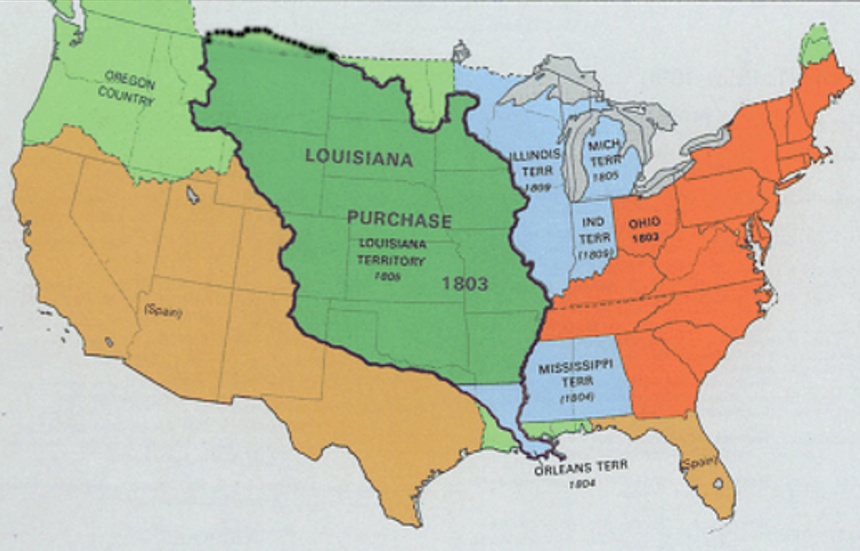
The decision by Napoleon Bonaparte to sell the vast Louisiana Territory to the United States in 1803 remains one of history’s most significant and, at first glance, perplexing transactions. For the ambitious French emperor, who harbored dreams of a grand French empire in the Americas, relinquishing such an expansive and resource-rich dominion seemed counterintuitive. However, a confluence of strategic imperatives, pressing financial needs, and evolving geopolitical realities on the European continent compelled Napoleon to make this monumental sale. The purchase, totaling approximately 828,000 square miles, effectively doubled the size of the young United States, paving the way for westward expansion and fundamentally reshaping the course of North American history. To understand Napoleon’s motives, one must delve into the complex tapestry of his empire-building ambitions, the immediate threats he faced, and the economic pressures that dictated his grand strategy.

The Strategic Landscape of Early 19th Century Europe
Napoleon’s reign was characterized by a relentless pursuit of French dominance in Europe. His grand designs were constantly challenged by coalitions of rival powers, most notably Great Britain, Austria, Prussia, and Russia. The ongoing conflicts demanded immense resources – manpower, matériel, and financial backing – to sustain his campaigns and maintain his grip on conquered territories. The Louisiana Territory, while a potential future asset, represented a distant and vulnerable possession that required significant investment in defense and administration, resources that were desperately needed closer to home.
The Shadow of War and the Cost of Empire
The Napoleonic Wars were a defining feature of this era. Napoleon’s armies were engaged in constant military operations, from the Iberian Peninsula to the plains of Poland. The financial strain of these wars was immense. The French treasury was perpetually in need of funds to equip troops, build ships, and pay subsidies to allied states. Napoleon’s imperial ambitions, while fueled by military success, were also a significant drain on his resources. Maintaining control over far-flung colonies like Saint-Domingue (modern-day Haiti) was proving to be an expensive and ultimately futile endeavor, further diverting attention and capital from the North American mainland.
The Haitian Revolution’s Impact
A critical factor influencing Napoleon’s decision was the success of the Haitian Revolution, which began in 1791 and culminated in the declaration of independence in 1804. Napoleon had dispatched a massive expeditionary force under his brother-in-law, Charles Leclerc, in 1802, aiming to re-establish French authority and slavery in Saint-Domingue. The campaign was a catastrophic failure. The French army was decimated by yellow fever and fierce resistance from the formerly enslaved population led by figures like Toussaint Louverture and later Jean-Jacques Dessalines. The heavy losses in men and materiel, coupled with the strategic defeat in Saint-Domingue, signaled the unviability of French colonial ambitions in the Caribbean and, by extension, North America. Napoleon realized that without a secure base in the Caribbean, the Louisiana Territory would be extremely difficult to defend and develop as a loyal French colony. The loss of Saint-Domingue made the prospect of holding onto Louisiana even more untenable.
The Geopolitical Calculus: Fear of British Ascendancy

Beyond the immediate financial and military concerns, Napoleon was acutely aware of the prevailing geopolitical balance of power. The ascendant British Empire, with its formidable navy, posed a constant threat to French colonial possessions. Napoleon feared that if France retained the Louisiana Territory, it would inevitably fall into British hands during the ongoing conflicts. Great Britain was already a powerful presence in North America, with established colonies and significant naval capabilities. The prospect of Britain gaining control of such a vast and strategically important territory was a prospect Napoleon found unacceptable. Selling it to a neutral and relatively weaker United States offered a way to deny it to his arch-rival and, in a way, to create a buffer state that would complicate British ambitions.
The United States as a Pragmatic Buyer
From Napoleon’s perspective, the United States represented a far more palatable option than the British. The young republic, though growing in power, was not a direct military threat to France in the same way Britain was. The transaction offered a swift infusion of cash for Napoleon’s war chest while simultaneously preventing his primary adversary from acquiring a crucial strategic asset. President Thomas Jefferson and his administration were keen to acquire New Orleans and the surrounding territory to secure the vital Mississippi River for American trade and expansion. The opportunity to acquire the entire Louisiana Territory was far beyond their initial expectations, but they recognized its immense strategic and economic value. The negotiations, led by James Monroe and Robert Livingston, were conducted with a sense of urgency by both sides, though the American negotiators were initially uncertain if Napoleon would even agree to sell the entire territory.
Financial Pressures and Imperial Reorientation
The primary driver for Napoleon’s decision, however, was the dire need for immediate financial resources. The ongoing wars demanded an unprecedented level of expenditure. The sale of the Louisiana Territory provided a substantial windfall, estimated at $15 million (equivalent to approximately $300 million today), which was crucial for funding Napoleon’s military campaigns and consolidating his power in Europe. This immediate financial injection was far more valuable to him than the potential, long-term economic benefits of possessing the Louisiana Territory.
Shifting Focus to European Hegemony
With his dreams of a French empire in the Americas fading, particularly after the costly failure in Saint-Domingue, Napoleon began to reorient his strategic focus entirely towards Europe. His ambition was to establish French hegemony across the continent, and this required concentrating his resources and attention on the ongoing wars and diplomatic maneuvering against the established European powers. The Louisiana Territory, with its vast distances and tenuous connection to France, was no longer a viable or strategic component of this refined imperial vision. It became a burden, a potential liability that could be leveraged for immediate gain.
The Legacy of the Sale
The sale of the Louisiana Territory was a masterstroke of pragmatic statesmanship, albeit one driven by necessity. Napoleon, the ambitious conqueror, was forced to abandon a significant portion of his colonial aspirations due to the harsh realities of warfare and finance. He recognized that holding onto Louisiana would weaken his position in Europe and potentially cede an invaluable asset to his greatest nemesis. For the United States, the purchase was a transformative event, a “golden opportunity” as President Jefferson termed it, that secured its future as a continental power and laid the groundwork for its eventual rise to global prominence. The story of the Louisiana Purchase is a potent reminder that even the most ambitious imperial visions are often shaped by the immediate pressures of war, economics, and the shifting tides of international relations. It underscores how strategic decisions are rarely made in a vacuum but are rather the product of complex, often conflicting, considerations. The vast expanse of land that once represented a potential French empire in the New World became the bedrock upon which a new nation would build its destiny, a destiny fundamentally altered by Napoleon’s pragmatic choice.
LifeOutOfTheBox is a participant in the Amazon Services LLC Associates Program, an affiliate advertising program designed to provide a means for sites to earn advertising fees by advertising and linking to Amazon.com. Amazon, the Amazon logo, AmazonSupply, and the AmazonSupply logo are trademarks of Amazon.com, Inc. or its affiliates. As an Amazon Associate we earn affiliate commissions from qualifying purchases.