
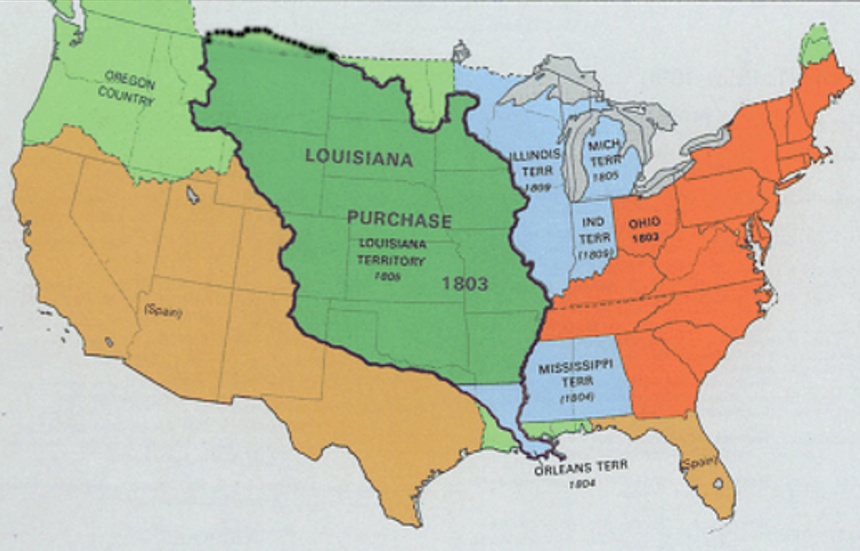
The sale of the Louisiana Territory by France to the United States in 1803 stands as one of history’s most pivotal real estate transactions. For a mere $15 million, a sum that today equates to roughly $340 million, the United States doubled its size, gaining control over a vast expanse stretching from the Mississippi River to the Rocky Mountains. This monumental acquisition reshaped the geopolitical landscape of North America and laid the foundation for America’s westward expansion. Yet, the question remains: why would Napoleon Bonaparte, the ambitious and expansionist First Consul of France, divest such a massive, potentially resource-rich territory? The answer is a complex tapestry woven from imperial ambition, military setbacks, dire financial constraints, and strategic geopolitical calculations, all against the backdrop of an impending war with Great Britain.

Understanding Napoleon choices requires delving into the intricate web of European power politics, colonial aspirations, and the unexpected turn of events in a small, yet strategically vital, Caribbean colony. This decision, seemingly abrupt, was in fact the culmination of several converging pressures that forced Napoleon to abandon a grand vision for a renewed French empire in the Americas. For travelers, history enthusiasts, and those fascinated by the pivotal moments that shaped modern nations, the story of the Louisiana Purchase offers a compelling journey into the heart of early 19th-century global dynamics. It’s a narrative rich with intrigue, sacrifice, and the dramatic interplay of personalities and events that forever altered the map of the world. From the bustling port of New Orleans, a city renowned for its vibrant culture, music, and food, to the far reaches of the American plains, the echoes of this historic transaction resonate, inviting us to explore the historical threads that connect diverse regions and peoples.
A Grand Imperial Vision Crumbles: The French Presence in North America
To grasp the motivations behind Napoleon’s decision, one must first understand the context of French colonial ambitions in the late 18th and early 19th centuries. For centuries, France had maintained a significant, albeit often contested, presence in North America. The vast Louisiana Territory, initially claimed by Robert Cavelier de La Salle in 1682, stretched from the Gulf of Mexico northward, encompassing the fertile Mississippi River basin. This territory was seen as crucial for supplying French Caribbean sugar colonies and establishing a robust presence against rival powers like Great Britain and Spain. However, the Seven Years’ War (or French and Indian War) in the mid-18th century resulted in a devastating loss for France, costing it nearly all its mainland North American possessions, including Canada and the eastern part of Louisiana. The western portion of Louisiana, including the vital port of New Orleans, was ceded to Spain in 1762 as compensation for its alliance during the war.

The Dream of a Revitalized Empire
By 1800, under Napoleon Bonaparte’s leadership, France had emerged from the turmoil of its Revolution with renewed imperial ambitions. Napoleon envisioned a vast transatlantic empire, with France at its heart, supported by the rich sugar islands of the Caribbean and supplied by the agricultural bounty of the Louisiana Territory. The jewel in this crown was Saint-Domingue, present-day Haiti, the wealthiest sugar colony in the world. Its immense profitability was fueled by the brutal system of enslaved labor, producing vast quantities of sugar and coffee that enriched the French treasury. Louisiana was intended to serve as the breadbasket for Saint-Domingue, providing food and timber, thus making the Caribbean colonies self-sufficient and independent of foreign suppliers like the United States.
In a secret treaty signed in 1800, the Treaty of San Ildefonso, Napoleon successfully persuaded Spain to retrocede the Louisiana Territory back to France. This transfer ignited alarm in the United States, particularly for President Thomas Jefferson. The prospect of a powerful and expansionist France controlling the strategic port of New Orleans and the entire Mississippi River basin posed an existential threat to American trade and westward expansion. American farmers in the Ohio Valley depended entirely on the Mississippi River and the port of New Orleans to transport their goods to market. Jefferson, a staunch Francophile, reluctantly considered an alliance with Great Britain if France did not guarantee American navigation rights and access to New Orleans. This moment underscores how intertwined European power struggles were with the nascent American nation, offering a unique historical context for understanding the complexities of early international relations.
The Costly Nightmare of Saint-Domingue
Napoleon’s grand vision for an American empire hinged entirely on control over Saint-Domingue. However, the colony was in the throes of a brutal and protracted slave revolt, led by the brilliant former slave general, Toussaint Louverture. The Haitian Revolution, which began in 1791, had already seen enslaved people successfully fight for their freedom and establish de facto control over much of the island. Napoleon dispatched his brother-in-law, General Charles Leclerc, with a massive expeditionary force of around 30,000 veteran troops, with the explicit orders to restore French authority and reintroduce slavery. This was meant to be the first step in reasserting French dominance in the Caribbean before consolidating control over Louisiana.
The campaign in Saint-Domingue proved to be an unmitigated disaster for France. Despite initial successes, including the capture of Toussaint Louverture, the French forces were decimated not by battle alone, but by yellow fever and other tropical diseases. Tens of thousands of French soldiers perished, including General Leclerc himself. The fierce resistance of the Haitian revolutionaries, combined with the devastating toll of disease, shattered Napoleon’s ambition for a sugar empire. Without Saint-Domingue as its economic engine and strategic base, the vast agricultural lands of Louisiana lost their primary purpose and economic viability in Napoleon’s grand scheme. The failure in Haiti was a brutal awakening for Napoleon, demonstrating the immense cost and futility of trying to maintain a distant, disease-ridden colony against a determined population. This struggle highlights the resilience of the human spirit in the face of oppression and offers a profound lesson on the limitations of military might when confronted with a people fighting for their fundamental freedom, a story that resonates deeply with travelers interested in cultural history and movements for liberation worldwide.
Financial Straits and Geopolitical Chess: Europe’s Shadow Over Louisiana
The catastrophic losses in Saint-Domingue were not the only factor compelling Napoleon to reconsider his American strategy. European politics, ever turbulent, played an even more decisive role in forcing his hand. By early 1803, the fragile Peace of Amiens, which had briefly halted hostilities between France and Great Britain, was rapidly unraveling. Napoleon knew that a renewed and massive war with his arch-rival was imminent, and he needed every resource available to prepare for it.
Preparing for War: The Looming Conflict with Great Britain
Napoleon was a pragmatic leader and a military genius. He understood that a land war in Europe against a formidable coalition, potentially including Great Britain, Austria, and Russia, would be incredibly expensive. France needed funds desperately to equip its armies, build its navy, and finance its military campaigns. The Louisiana Territory, though vast, was a distant, undefendable asset. It generated little direct revenue for France at the time and would be a massive drain on resources to protect, especially from the superior British navy. In the event of war, Great Britain could easily seize New Orleans and the entire territory, depriving France of any potential future gains without a single penny of compensation.
Therefore, selling the territory offered a brilliant solution to several pressing problems. First, it would provide an immediate influx of cash, precisely what Napoleon needed to finance his upcoming wars in Europe. This money would be crucial for his campaigns that would eventually lead to victories at Ulm, Austerlitz, and Jena, fundamentally altering the political map of the continent. Second, by selling the territory, Napoleon would remove a potential strategic liability that he could neither defend nor profitably exploit given the circumstances. It was a clear-eyed decision, prioritizing immediate and tangible gains for his European ambitions over a distant and increasingly problematic colonial dream. For those interested in the grand strategies of historical figures, this provides a fascinating case study in crisis management and resource allocation during a period of immense global upheaval.
The Strategic Imperative: Strengthening the United States
Beyond the financial and defensive considerations, Napoleon harbored another crucial strategic objective: to strengthen the United States as a counterweight to Great Britain. He famously remarked that he “desired to place a barrier” against the maritime dominance of the British by “strengthening forever the power of the United States.” A strong, expanding United States would inevitably become a rival to Great Britain in North America, potentially diverting British resources and attention away from Europe.
By providing the United States with such a vast territory, Napoleon effectively guaranteed its future growth and prosperity, turning a former colony into a formidable power that would eventually challenge British influence across the globe. This was a long-term strategic gambit, designed to serve French interests by creating a powerful adversary for its primary foe. It was an audacious move, demonstrating Napoleon’s keen understanding of geopolitics and his willingness to sacrifice one ambition to achieve another, more immediate and pressing goal. This fascinating aspect of the Louisiana Purchase showcases how distant diplomatic maneuvers can have profound, lasting impacts on global power dynamics, a testament to the interconnectedness of historical events across continents.
The Historic Transaction: A Legacy of Opportunity
The actual negotiation and sale of the Louisiana Territory unfolded with remarkable speed and an element of surprise for all parties involved. American envoys had initially been dispatched to Paris with a much more modest goal: to purchase New Orleans and possibly West Florida to secure navigation rights on the Mississippi River for American farmers. The idea of acquiring the entire vast territory was beyond their wildest expectations.
The American Delegation’s Surprise
President Thomas Jefferson had sent Robert Livingston, the U.S. Minister to France, to negotiate with Napoleon’s government. Livingston was later joined by James Monroe as a special envoy with instructions to offer up to $10 million for New Orleans and West Florida. To their astonishment, Napoleon’s foreign minister, Charles Maurice de Talleyrand-Périgord, abruptly offered to sell the entire Louisiana Territory.
This sudden shift came directly from Napoleon, who, having weighed his options and faced with the dire situation in Saint-Domingue and the impending war, made the snap decision to divest. Livingston and Monroe were caught completely off guard, realizing the immense implications of such an offer. They had no specific instructions to purchase the entire territory, and the cost far exceeded their authorized budget. However, recognizing the unprecedented opportunity, they decided to proceed, understanding that such a chance might never come again. This moment encapsulates the dynamic nature of international diplomacy, where unforeseen opportunities can suddenly emerge, forever altering the course of history.
A Bargain for the Ages
The negotiations were swift. Within weeks, the American envoys agreed to a price of $15 million for the entire territory. This amounted to approximately three cents per acre for 828,000 square miles, an incredible bargain that defied belief even at the time. The treaty for the Louisiana Purchase was signed on April 30, 1803, in Paris.
Upon hearing the news, President Jefferson was elated but also faced a constitutional dilemma. The United States Constitution did not explicitly grant the President the power to acquire new territory in this manner. Despite his strict constructionist views, Jefferson ultimately put aside his constitutional reservations, recognizing the extraordinary strategic and economic benefits for the young nation. He argued that the opportunity was too vital to pass up, an empire for liberty. The Senate quickly ratified the treaty, and the acquisition was complete. The scale of the purchase was immense, effectively doubling the size of the United States and opening up vast new lands for exploration, settlement, and resource extraction, a testament to the vision of a burgeoning nation. For those who enjoy exploring the growth and development of nations, the Louisiana Purchase offers a tangible starting point for understanding American identity and expansion.
Lasting Echoes: The Louisiana Purchase’s Enduring Impact
The sale of the Louisiana Territory was far more than a simple land transaction; it was a watershed moment with profound and lasting consequences that shaped the trajectory of the United States and reverberated across the globe. For France, it marked the end of its significant colonial ambitions in North America, allowing Napoleon to focus entirely on his European campaigns. The funds received were indeed critical for his subsequent military endeavors, demonstrating the immediate tactical brilliance of the move.
For the United States, the impact was transformative. The Louisiana Purchase removed the threat of a powerful foreign presence on its western border, secured vital trade routes along the Mississippi River, and provided an unimaginable expanse of fertile land and natural resources. It fueled the concept of Manifest Destiny, the belief in America’s divine right to expand westward, and set the stage for generations of pioneers, explorers, and settlers. The acquisition led directly to the famous Lewis and Clark Expedition, which charted much of the unknown territory, documenting its geography, flora, fauna, and indigenous populations, opening up routes for future settlement and trade.
The long-term effects of the Louisiana Purchase can still be seen today. The states that were eventually carved out of the territory, including Louisiana, Missouri, Arkansas, Iowa, Oklahoma, Kansas, Nebraska, and parts of Minnesota, Colorado, Montana, North Dakota, South Dakota, and Wyoming, represent a vast agricultural heartland and a rich tapestry of American culture. Cities like New Orleans, with its unique blend of French, Spanish, African, and American influences, continue to attract millions of tourists, drawn by its vibrant history, architectural landmarks, and unparalleled culinary scene. Travelers visiting these regions can immerse themselves in the rich historical narratives that trace back to this momentous sale, from the Creole plantations of Louisiana to the frontier museums of the Great Plains. The cultural landscape, diverse cuisines, and even the legal traditions in some areas, particularly in Louisiana, bear the indelible mark of French influence, making it a compelling destination for those seeking unique travel experiences and deep dives into local culture.
In conclusion, Napoleon’s decision to sell the Louisiana Territory was not a casual one but a calculated strategic retreat born from a confluence of factors: the devastating failure to re-establish control over Saint-Domingue, the urgent need for funds to finance an impending war with Great Britain, and the desire to create a powerful rival to his greatest foe. What began as a desperate measure for Napoleon became an extraordinary stroke of luck for the United States, irrevocably altering its destiny and establishing it as a continental power. The echoes of this historic moment continue to shape the geography, demography, and cultural identity of a nation, inviting us to reflect on how pivotal decisions, even those made in distant lands, can forever change the course of human history and inspire new avenues for travel and exploration.
LifeOutOfTheBox is a participant in the Amazon Services LLC Associates Program, an affiliate advertising program designed to provide a means for sites to earn advertising fees by advertising and linking to Amazon.com. Amazon, the Amazon logo, AmazonSupply, and the AmazonSupply logo are trademarks of Amazon.com, Inc. or its affiliates. As an Amazon Associate we earn affiliate commissions from qualifying purchases.