
Navigating the New York State Thruway via Interstate 90 (I-90) is a quintessential experience for many travelers journeying through the Empire State. Whether you’re embarking on a cross-country adventure, visiting family in Buffalo, or exploring the scenic beauty of the Adirondack Mountains, understanding the toll structure on this vital artery is crucial for budgeting your trip and ensuring a smooth passage. This guide delves into the intricacies of I-90 tolls in New York, offering insights into how they are calculated, common routes, and payment methods.
The New York State Thruway is a vast network of controlled-access highways spanning over 570 miles across the state, with a significant portion comprising I-90. Its extensive reach connects major cities like New York City, Albany, and Buffalo, making it a primary corridor for both commercial and leisure travel. The tolling system on the Thruway, and by extension I-90 within its jurisdiction, is designed to fund maintenance, operations, and capital improvements.
Understanding the New York State Thruway Toll System
The New York State Thruway Authority operates under a zone-based toll system for a significant portion of its cashless tolling routes, including most of I-90. This system differs from traditional toll plazas where you pay a set amount at each booth. Instead, tolls are calculated based on the entry and exit points of your travel along the Thruway.
Cashless Tolling and its Impact
In recent years, the New York State Thruway has transitioned to a fully cashless tolling system. This means there are no more toll booths to stop at. Instead, overhead gantries equipped with advanced technology capture your vehicle’s passage.
- Tire-Recycling Systems (TRS) and E-ZPass: The primary methods for toll collection are through the E-ZPass electronic toll collection system and Tire-Recycling Systems (TRS), which use license plate readers.
- E-ZPass: Subscribers to E-ZPass benefit from discounted toll rates and the convenience of automatic payment. Your transponder communicates with the gantries, and the toll is deducted directly from your linked account.
- Toll Bills: For vehicles without an E-ZPass transponder, license plate information is captured, and a toll bill is mailed to the registered owner of the vehicle. These bills are typically sent to the address on file with the Department of Motor Vehicles. It is essential to keep your address updated with the DMV to ensure you receive your bills promptly. Unpaid tolls can accrue late fees and penalties.
The cashless tolling system aims to improve traffic flow, reduce congestion, and enhance safety by eliminating the need for vehicles to slow down or stop at toll booths.
Toll Calculation: Entry and Exit Points
The core principle of the New York State Thruway toll calculation for I-90 is based on the distance traveled between your point of entry and exit on the Thruway system.
- Zone-Based System: The Thruway is divided into various toll zones. When you enter the Thruway at an interchange, your entry point is recorded. When you exit the Thruway at another interchange, your exit point is recorded. The system then calculates the toll based on the specific zone or zones you traversed.
- Factors Influencing Toll Costs:
- Distance: The longer the distance you travel on the Thruway, the higher the toll will generally be.
- Vehicle Class: Tolls are also determined by the type and size of your vehicle. Passenger cars (Class 1) pay the lowest rates, while larger vehicles such as trucks, buses, and vehicles with trailers (Classes 2-5) incur higher tolls due to their greater impact on road infrastructure.
- Toll Discounts: As mentioned, E-ZPass users receive a discount compared to those who pay by toll bill. This discount is a significant incentive for frequent travelers.
- Specific Sections: While I-90 is largely under the Thruway Authority’s jurisdiction, there are sections where tolling mechanisms might differ, though the overwhelming majority of I-90 in New York is part of the Thruway cashless system.
Sample Tolls and Common Routes on I-90 in New York
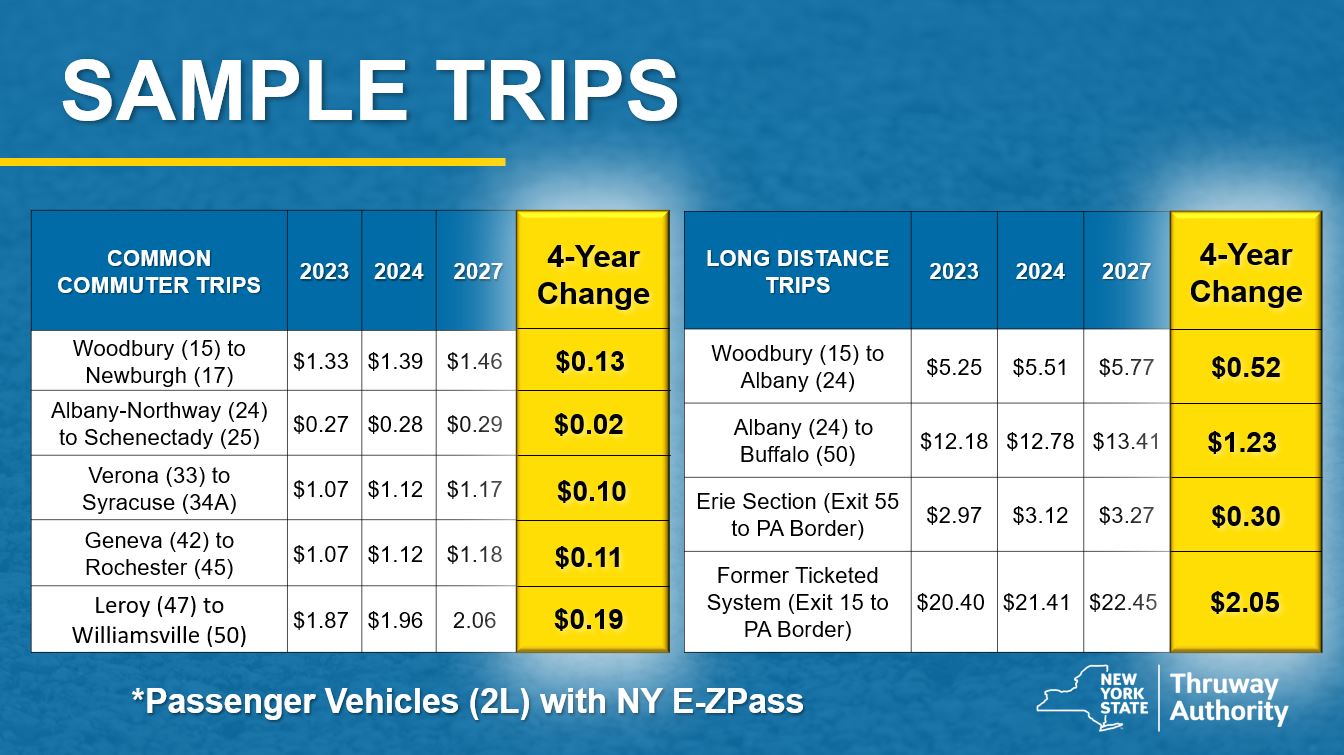
To provide a practical understanding, let’s consider some common travel scenarios along I-90 in New York. It’s important to note that toll rates are subject to change, and the New York State Thruway Authority publishes official toll schedules on its website. The figures provided here are illustrative and based on typical passenger car (Class 1) rates.
Western New York: Buffalo to Syracuse
A common stretch of I-90 for travelers in Western New York is the route between Buffalo and Syracuse. This section covers a significant portion of the state and includes several interchanges.
- Entry Example: Entering I-90 West near Buffalo (e.g., from the I-190).
- Exit Example: Exiting I-90 East near Syracuse (e.g., to access I-81 or local roads).
- Estimated Toll: For a passenger vehicle traveling this full distance using an E-ZPass, the toll could range from approximately $8 to $12. If paying by toll bill, the cost would be higher, potentially around $10 to $15.
This estimate accounts for traversing multiple tolling zones between these two major metropolitan areas. The exact amount depends on the specific entry and exit ramps used.
Central New York: Syracuse to Albany
Continuing eastward on I-90, the journey from Syracuse to Albany covers another substantial segment of the Thruway. This route passes through the Finger Lakes region and central New York landscapes.
- Entry Example: Entering I-90 East near Syracuse.
- Exit Example: Exiting I-90 East near Albany.
- Estimated Toll: For a passenger vehicle using E-ZPass, the toll for this segment could be in the range of $12 to $18. The toll bill rate might be around $15 to $22.
This section is characterized by a higher number of tolling points as it moves through more varied terrain and more populated areas.
Full Cross-State Journey: Buffalo to Albany
Combining the above segments gives an idea of the cost for a significant portion of a cross-state trip.
- Total Estimated Toll: A full journey between Buffalo and Albany on I-90 for a passenger car with E-ZPass might cost between $20 and $30. For toll bill payments, expect this to be higher, possibly $25 to $40 or more.
These are approximations, and for precise figures, it is always recommended to consult the official New York State Thruway toll rate schedule or use their online toll calculator.
Tips for Managing I-90 Tolls
Planning ahead and understanding how tolls work can save you money and hassle when traveling on I-90 in New York.
Get an E-ZPass
The most significant way to save money on New York State Thruway tolls, including I-90, is by obtaining an E-ZPass transponder.
- Discounted Rates: E-ZPass users consistently pay less per toll than those who pay by toll bill. The savings can add up considerably, especially for frequent travelers.
- Convenience: E-ZPass offers a seamless travel experience. You don’t need to worry about carrying cash or receiving toll bills in the mail.
- Account Management: You can manage your E-ZPass account online, view transaction history, and set up automatic payments.
Utilize the Toll Calculator
The New York State Thruway Authority provides an online toll calculator on its official website. This tool is invaluable for trip planning.
- Precise Estimates: Enter your intended entry and exit points, and the calculator will provide an accurate estimate of the toll cost for your specific journey.
- Vehicle Class Input: You can specify your vehicle class to get the most accurate toll amount.
- Budgeting: Use this tool to factor toll costs into your travel budget, ensuring you’re not caught by surprise.
Understand Toll Bill Procedures
If you receive a toll bill, it’s essential to act promptly.
- Payment Deadlines: Pay your toll bill by the due date to avoid late fees and penalties.
- Address Updates: If you move, ensure your address is updated with the New York State DMV and the E-ZPass Customer Service Center if you have an account.
- Disputing Tolls: If you believe you have received an incorrect toll bill, contact the New York State Thruway Authority’s customer service immediately to resolve the issue.
Consider Alternative Routes (for cost savings)
While I-90 is a direct and efficient route, for travelers on a very tight budget, exploring alternative routes that use non-tolled roads might be an option for shorter segments. However, this often comes at the cost of increased travel time, potential for more traffic, and less scenic or direct pathways. For most travelers, the convenience and speed of I-90 make the toll costs a worthwhile investment for reaching destinations like Niagara Falls or the historic sites around Schenectady.

The Future of Tolling on I-90
The New York State Thruway Authority continually evaluates its tolling policies and infrastructure to ensure efficient operation and adequate funding for maintenance and improvements. The move to cashless tolling is a significant step in modernizing the system. Future enhancements might include advanced traffic management systems, improved payment technologies, and potential adjustments to toll rates based on economic factors and infrastructure needs.
For travelers planning a journey on I-90 in New York, a clear understanding of the toll system, leveraging E-ZPass, and utilizing available planning tools will lead to a more predictable and cost-effective travel experience across this vital transportation corridor.
LifeOutOfTheBox is a participant in the Amazon Services LLC Associates Program, an affiliate advertising program designed to provide a means for sites to earn advertising fees by advertising and linking to Amazon.com. Amazon, the Amazon logo, AmazonSupply, and the AmazonSupply logo are trademarks of Amazon.com, Inc. or its affiliates. As an Amazon Associate we earn affiliate commissions from qualifying purchases.