
The history of how the United States acquired Texas is a complex narrative woven with threads of exploration, revolution, and international negotiation. It’s a story that involves ambitious expansion, shifting borders, and the eventual incorporation of a vast territory into the American union. Understanding this process is crucial for appreciating the geopolitical landscape of North America and the unique cultural identity of the state itself.
The Genesis of Texas: From Spanish Frontier to Mexican Province
The story of Texas begins long before it became a part of the United States. Initially, the territory was claimed by Spain as part of its vast colonial empire in the Americas. For centuries, Texas remained a sparsely populated frontier, a buffer zone between the more established Spanish settlements and the interior of North America. Spanish explorers like Alonso Álvarez de Pineda and later Álvar Núñez Cabeza de Vaca traversed its lands, but sustained European settlement was slow to take root. The Spanish established a network of missions and presidios, hoping to solidify their claim and convert indigenous populations, but these efforts met with limited success against the formidable challenges of the frontier and resistance from native tribes like the Comanche.
By the early 19th century, Spain’s grip on its colonies was weakening. In 1821, Mexico gained its independence from Spain, and Texas became a part of the newly formed Mexican nation. However, Mexico faced its own internal struggles and a pressing need to populate and develop its northern territories. To achieve this, the Mexican government adopted a policy of encouraging immigration, particularly from the United States.
The Empresario System and American Immigration
Under the empresario system, the Mexican government granted large tracts of land to individuals, known as empresarios, who were tasked with recruiting and settling colonists. The most prominent of these was Stephen F. Austin, often hailed as the “Father of Texas.” Austin successfully brought over 300 families from the United States to settle in the fertile lands between the Brazos and Colorado rivers. These early settlers, primarily from the Southern United States, brought with them their traditions, their language, and, significantly, their institution of slavery, which was already a contentious issue in Mexico.
As more Americans settled in Texas, cultural and political tensions began to rise. The settlers, accustomed to a more democratic and individualistic society, chafed under the centralist policies of the Mexican government. Disagreements over issues such as slavery, tariffs, and the right to bear arms, coupled with Mexico’s perceived instability and growing authoritarianism under leaders like Antonio López de Santa Anna, sowed the seeds of rebellion. The vast distance from the capital in Mexico City and the differing cultural norms further exacerbated these frictions.
The Texas Revolution and Independence
The growing discontent culminated in the Texas Revolution, which officially began in 1835. Key events that fueled the conflict included the Mexican government’s attempts to assert greater control over Texas, including disarming its citizens and imposing new laws that were deeply unpopular with the American settlers. The spark that ignited the revolution is often traced to the Battle of Gonzales, where Texian militia famously defied a Mexican order to surrender a cannon, raising a flag with the slogan “Come and Take It.”
The revolution was marked by both brutal conflict and moments of significant bravery. The Alamo, a mission in San Antonio, became a powerful symbol of Texian resistance. Though the small Texian garrison was ultimately overwhelmed and massacred by Santa Anna’s superior forces in March 1836, the heroic stand at the Alamo galvanized Texian morale and drew more volunteers to the cause. The subsequent victory at the Battle of San Jacinto in April 1836, where Sam Houston’s Texian army decisively defeated Santa Anna’s forces, secured Texas’s independence. The captured Santa Anna was forced to sign treaties recognizing Texas’s sovereignty.
The Republic of Texas
Following its declaration of independence on March 2, 1836, Texas established itself as the Republic of Texas. The new nation, however, faced considerable challenges. It struggled with financial instability, ongoing border disputes with Mexico, and the threat of renewed invasion. The Republic of Texas sought international recognition, which it eventually received from several countries, including the United States, France, and Great Britain. The issue of slavery remained a significant point of contention, both internally and externally, as Mexico had abolished it.
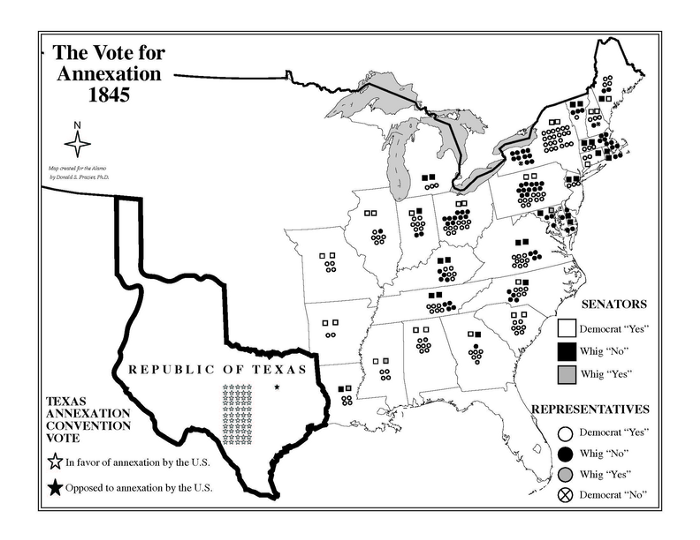
The question of annexation by the United States became a central theme during the Republic of Texas’s existence. Many Texans, particularly those with American origins, favored joining the United States. However, annexation was a complex issue for the United States. The primary obstacle was the debate over slavery. Admitting Texas as a slave state would upset the delicate balance of power between free and slave states in the U.S. Congress, a conflict that would eventually erupt into the American Civil War. Furthermore, Mexico continued to view Texas as a rebellious province and warned that annexation would be considered an act of war.
The Road to Annexation
The idea of Texas joining the United States gained momentum throughout the 1830s and 1840s. Proponents argued for the strategic advantages of incorporating Texas, including its vast territory and its role as a buffer against potential foreign influence. The concept of “Manifest Destiny,” the belief that the United States was divinely ordained to expand its dominion and spread democracy across the North American continent, also played a significant role in shaping public opinion and political discourse.
The election of James K. Polk as President of the United States in 1844 proved to be a pivotal moment. Polk was a strong advocate for territorial expansion and made the annexation of Texas a cornerstone of his platform. Despite initial resistance and complex diplomatic maneuvers, including a treaty that was rejected by the U.S. Senate, Congress eventually passed a joint resolution for annexation. This was achieved through a simple majority vote, bypassing the need for a two-thirds majority required for a treaty.

Annexation and the Mexican-American War
In December 1845, Texas officially became the 28th state of the United States. This act, however, was not accepted by Mexico. Mexico viewed the annexation as a violation of its sovereignty and territorial integrity. Diplomatic relations between the United States and Mexico deteriorated rapidly. Disputes over the southern boundary of Texas – Mexico claimed the Nueces River, while Texas and the United States claimed the Rio Grande – provided a casus belli.
In 1846, skirmishes broke out between U.S. and Mexican troops along the disputed border. President Polk used these incidents to justify a declaration of war, leading to the Mexican-American War. The war was largely a resounding success for the United States, with American forces achieving decisive victories across Mexico. The war concluded with the signing of the Treaty of Guadalupe Hidalgo in February 1848.
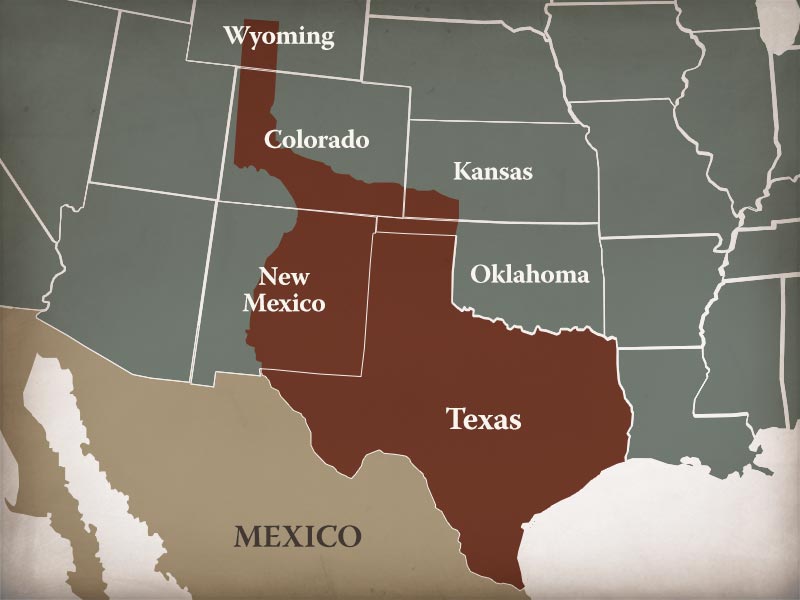
The Treaty of Guadalupe Hidalgo officially ended the Mexican-American War. In exchange for a payment of $15 million and the assumption of certain claims against the Mexican government, Mexico ceded a vast territory to the United States, a region known as the Mexican Cession. This cession included present-day California, Nevada, Utah, most of Arizona and New Mexico, and parts of Colorado and Wyoming. Crucially, the treaty also recognized the Rio Grande as the southern boundary of Texas, firmly establishing its territorial claims and resolving the border dispute that had been a major catalyst for the war. Thus, through a combination of Texian independence, a strategic push for annexation, and ultimately, war with Mexico, the United States acquired the vast and historically significant territory that is Texas.
LifeOutOfTheBox is a participant in the Amazon Services LLC Associates Program, an affiliate advertising program designed to provide a means for sites to earn advertising fees by advertising and linking to Amazon.com. Amazon, the Amazon logo, AmazonSupply, and the AmazonSupply logo are trademarks of Amazon.com, Inc. or its affiliates. As an Amazon Associate we earn affiliate commissions from qualifying purchases.