
Navigating the intricacies of healthcare can be a daunting prospect, especially when it involves a significant life transition like accessing Medicare. For residents of Texas, understanding the application process is crucial to ensuring seamless coverage and peace of mind. This comprehensive guide will demystify Medicare enrollment in the Lone Star State, offering insights into eligibility, enrollment periods, and the specific steps required to secure your benefits.
Understanding Medicare Eligibility in Texas
Medicare is a federal health insurance program primarily for individuals aged 65 or older. However, eligibility extends beyond age to include younger individuals with certain disabilities and those with End-Stage Renal Disease (ESRD).
Age-Based Eligibility
The most common path to Medicare eligibility is reaching the age of 65. If you are a U.S. citizen or have been a legal resident for at least five years, and you or your spouse has worked and paid Medicare taxes for at least 10 years (40 quarters), you are likely eligible for premium-free Part A. Part B, which covers medically necessary services, has a monthly premium, but it is also available to most individuals 65 and older.
Disability Eligibility
Individuals under 65 who have a qualifying disability may also be eligible for Medicare. This typically applies to those who have been receiving Social Security disability benefits for 24 months. The waiting period can be waived for individuals with Amyotrophic Lateral Sclerosis (ALS), also known as Lou Gehrig’s disease, and those with End-Stage Renal Disease (ESRD).
End-Stage Renal Disease (ESRD) and Other Conditions
ESRD, a permanent kidney failure requiring dialysis or a kidney transplant, makes individuals of any age eligible for Medicare, usually starting four months before dialysis begins. Certain other specific medical conditions can also qualify individuals for Medicare coverage even if they are under 65.
Medicare Enrollment Periods: Timing is Key
Understanding the different enrollment periods is paramount to avoiding coverage gaps and potential penalties. Texas residents, like all Americans, adhere to these federal guidelines.
Initial Enrollment Period (IEP)
Your Initial Enrollment Period is a seven-month window that begins three months before the month you turn 65, includes the month you turn 65, and ends three months after the month you turn 65. For example, if your 65th birthday is in July, your IEP runs from April 1st to October 31st. This is the ideal time to enroll in Parts A and B to avoid late enrollment penalties. If you are already receiving Social Security or Railroad Retirement Board benefits when you turn 65, you will automatically be enrolled in Part A and Part B.
General Enrollment Period (GEP)
If you miss your IEP and are not automatically enrolled, you can enroll during the General Enrollment Period, which runs from January 1st to March 31st each year. Coverage under Part B, if enrolled during the GEP, will begin on July 1st of that year. However, you may face a late enrollment penalty for Part B, which is added to your monthly premium for as long as you have Part B.
Special Enrollment Period (SEP)
Life circumstances can sometimes grant you a Special Enrollment Period outside of the standard enrollment windows. Common qualifying events include:
- Loss of employer coverage: If you or your spouse lose health insurance from an employer (including COBRA coverage) after age 65, you may qualify for an SEP.
- Relocation: Moving out of a Medicare Advantage plan’s service area can trigger an SEP.
- Changes in employment status: Certain changes in employment can also lead to an SEP.
- End of Medicaid coverage: If you lose Medicaid coverage and were not enrolled in Medicare Part B when first eligible, you might be eligible for an SEP.
It’s crucial to be aware of the specific timelines for SEPs, as they can vary depending on the qualifying event. Generally, you have a limited time frame, often 6 or 8 months, after the qualifying event to enroll.
Medicare Advantage Open Enrollment Period
If you are enrolled in a Medicare Advantage plan (Part C), you have an Open Enrollment Period from January 1st to March 31st each year. During this time, you can switch to another Medicare Advantage plan or drop your Medicare Advantage plan and return to Original Medicare (Parts A and B).
Annual Election Period (AEP)
Also known as the Fall Open Enrollment Period, the AEP runs from October 15th to December 7th annually. This is the time when anyone with Medicare can make changes to their coverage. You can switch from Original Medicare to a Medicare Advantage plan, switch from one Medicare Advantage plan to another, switch from a Medicare Advantage plan back to Original Medicare, or enroll in a Medicare Part D prescription drug plan or switch to a different one. Any changes you make during the AEP will take effect on January 1st of the following year.
How to Apply for Medicare in Texas: Step-by-Step
Applying for Medicare in Texas involves several straightforward steps, whether you are applying online, by phone, or in person.
Step 1: Determine Your Eligibility and Enrollment Period
Before initiating the application, confirm your eligibility based on age, disability, or specific medical conditions. Simultaneously, identify which enrollment period applies to your situation. This foundational step ensures you are applying at the correct time and are aware of potential financial implications like late enrollment penalties.
Step 2: Gather Necessary Information
To complete your application efficiently, have the following information readily available:

- Social Security Number (SSN): Your own and your spouse’s if applicable.
- Proof of U.S. Citizenship or Lawful Presence: Birth certificate, passport, or Certificate of Naturalization.
- Work History: Information about your or your spouse’s work history, including employer names and dates of employment if you are applying based on work credits for premium-free Part A.
- Dates of Employment: If applicable for premium-free Part A.
- Current Health Insurance Information: Details about any employer-sponsored or other health insurance you currently have.
- If you are under 65 and applying due to disability: Proof of disability, such as a letter from the Social Security Administration or the Railroad Retirement Board.
- If you have End-Stage Renal Disease (ESRD): Information about your condition and treatment.
Step 3: Choose Your Application Method
Texas residents can apply for Medicare through the following channels:
Online Application (Recommended for most)
The most convenient and often quickest method is to apply online through the Social Security Administration’s website (ssa.gov). The online application allows you to:
- Apply for Medicare, Social Security retirement, or disability benefits.
- Check the status of your application.
- Manage your Social Security benefits.
The online portal is available 24/7, allowing you to complete the process at your own pace. It guides you through each step and provides clear instructions.
By Phone
You can also apply for Medicare by calling the Social Security Administration directly at 1-800-772-1213. They can assist you with your application over the phone. The best times to call are typically early in the morning or on Tuesdays, Wednesdays, and Thursdays to avoid longer wait times.
In Person
If you prefer face-to-face assistance or have complex questions, you can visit your local Social Security office. You can find the nearest office by using the Social Security Office Locator tool on the ssa.gov website. It’s advisable to call ahead to schedule an appointment to minimize your wait time.
Step 4: Select Your Medicare Coverage
Once your eligibility is confirmed and you’ve applied for Medicare Parts A and B, you’ll need to decide on how you want to receive your coverage.
Original Medicare (Parts A & B)
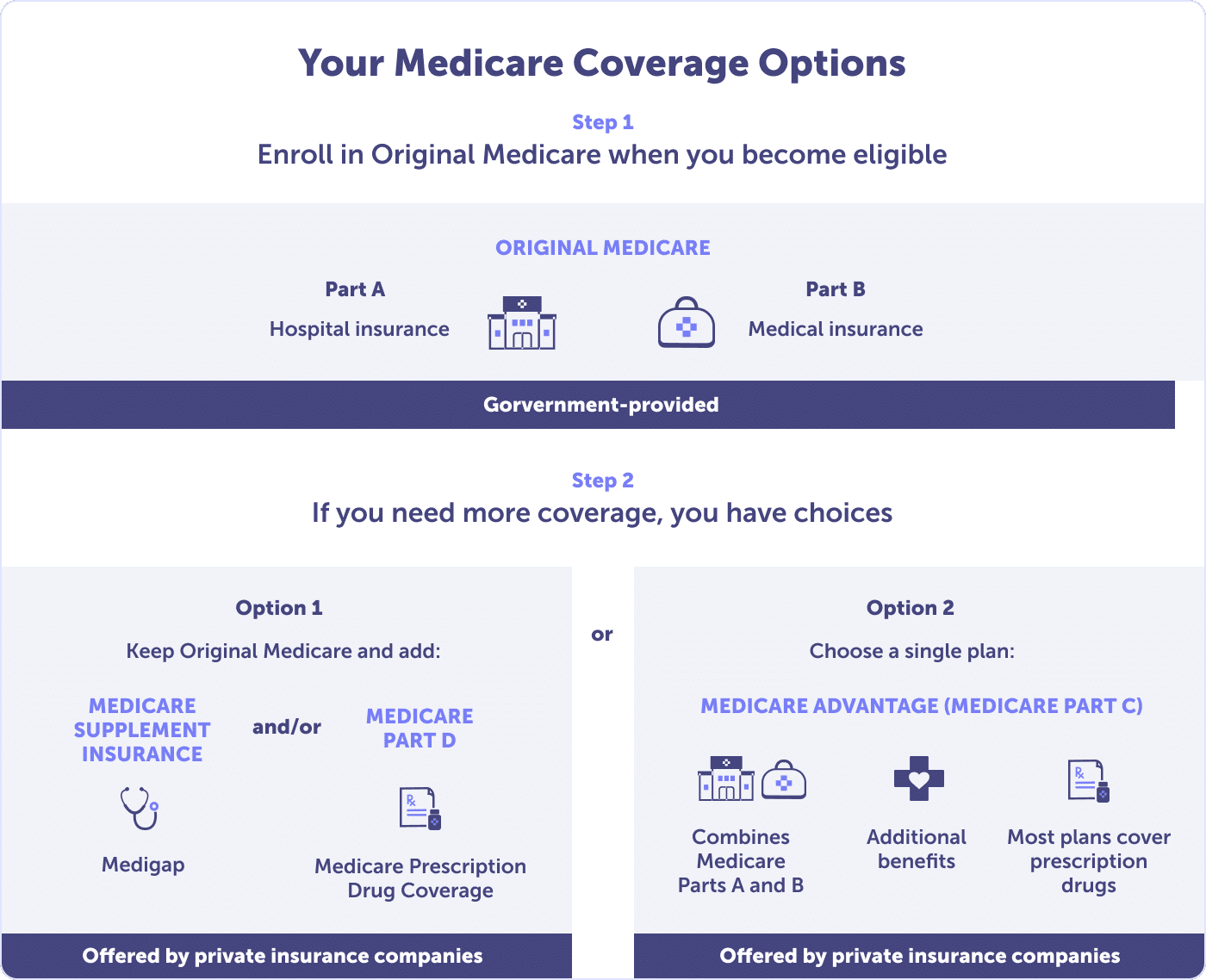
Original Medicare provides coverage for hospital stays (Part A) and medically necessary doctor visits and outpatient services (Part B). You have the freedom to choose any doctor or hospital that accepts Medicare. You can also supplement Original Medicare with a Medigap policy (also known as Medicare Supplement Insurance) to help cover out-of-pocket costs like deductibles, copayments, and coinsurance. Medigap policies are sold by private insurance companies.
Medicare Advantage Plans (Part C)
Medicare Advantage plans are an alternative way to get your Medicare benefits. These plans are offered by private companies approved by Medicare. They bundle Part A, Part B, and often Part D (prescription drug coverage) into one plan. Medicare Advantage plans often include extra benefits not covered by Original Medicare, such as dental, vision, and hearing care. Popular providers in Texas include Humana, Blue Cross Blue Shield of Texas, and Aetna. You generally must use doctors, hospitals, and other providers within the plan’s network. These plans have their own set of rules, copayments, and may require referrals to see specialists.
Medicare Prescription Drug Plans (Part D)
If you choose Original Medicare and do not enroll in a Medicare Advantage plan that includes drug coverage, you will need to consider a standalone Medicare Prescription Drug Plan (Part D). These plans help cover the cost of prescription drugs. Part D plans are also offered by private insurance companies and vary in terms of monthly premiums, deductibles, copayments, and the formulary (list of covered drugs). It is important to choose a plan that covers your specific medications.
Step 5: Review Your Enrollment Confirmation
After submitting your application, you will receive a confirmation from the Social Security Administration. Keep this document for your records. Your Medicare card will typically arrive by mail within a few weeks to a month. It will indicate your Medicare Number, which is unique to you, and will not include your Social Security Number for privacy reasons.
Additional Considerations for Texas Residents
While the core application process is federal, Texas residents may benefit from understanding state-specific resources and programs that can complement their Medicare coverage.
Texas Medicare Savings Programs
The state of Texas offers Medicare Savings Programs (MSPs) designed to help low-income individuals pay for their Medicare premiums, deductibles, and copayments. These programs are administered by the Texas Health and Human Services Commission. Eligibility for MSPs is based on income and assets. If you qualify for certain MSPs, you may also automatically qualify for Extra Help with Medicare prescription drug costs.
SHIP Program Assistance
The State Health Insurance Assistance Program (SHIP) is a national program with local counselors available in Texas to provide free, unbiased information about Medicare, Medicare Advantage, Medigap, and Part D plans. These SHIP counselors can help you understand your options, compare plans, and assist with enrollment. You can typically find your local Texas SHIP counselor through the state’s Department of Aging and Disability Services or by searching online for “Texas SHIP.”

Navigating Medicare Advantage and Part D Plan Selection
Choosing between Original Medicare with a Medigap and Part D plan, or a Medicare Advantage plan, requires careful consideration of your healthcare needs and budget.
- Consider your health: If you have chronic conditions or anticipate needing significant medical care, a Medicare Advantage plan might offer predictable costs. If you value flexibility and want to see any doctor without referrals, Original Medicare plus a Medigap plan might be a better fit.
- Prescription drug needs: Carefully review the drug formularies of Part D or Medicare Advantage plans to ensure your medications are covered at an affordable cost.
- Budget: Compare monthly premiums, deductibles, copayments, and coinsurance for all available options. Remember that while Medicare Advantage plans may have lower monthly premiums, out-of-pocket costs can be higher if you use a lot of healthcare services.
- Provider networks: If opting for a Medicare Advantage plan, verify that your preferred doctors and hospitals are within the plan’s network.
By taking a proactive approach and understanding the nuances of Medicare enrollment in Texas, residents can confidently navigate the process and secure the healthcare coverage they need. Resources like the Social Security Administration, Medicare.gov, and state-specific programs are invaluable tools in this journey.
LifeOutOfTheBox is a participant in the Amazon Services LLC Associates Program, an affiliate advertising program designed to provide a means for sites to earn advertising fees by advertising and linking to Amazon.com. Amazon, the Amazon logo, AmazonSupply, and the AmazonSupply logo are trademarks of Amazon.com, Inc. or its affiliates. As an Amazon Associate we earn affiliate commissions from qualifying purchases.