
Navigating the complexities of child custody in Texas can be an emotionally taxing endeavor. When one parent seeks sole managing conservatorship, often referred to as “full custody,” it signifies a desire for primary decision-making authority and physical possession of the child. This legal framework, while designed to protect the best interests of the child, requires a meticulous approach to legal proceedings. Understanding the Texas Family Code, the role of the court, and the evidence required is paramount for any parent embarking on this journey. This guide outlines the essential steps and considerations for filing for full custody in the Lone Star State.

Understanding Texas Custody Laws
In Texas, the court’s primary concern when determining custody is always the “best interest of the child.” This principle guides every decision made by a judge regarding conservatorship, possession, and access. Texas law does not inherently favor mothers or fathers; instead, it focuses on what environment and arrangement will best promote the child’s physical, emotional, and psychological well-being.
Conservatorship: Not Exactly “Custody”
Texas uses the term “conservatorship” rather than “custody.” There are two main types of conservatorship:
- Joint Managing Conservatorship (JMC): This is the preferred arrangement in Texas. In JMC, both parents share rights and responsibilities for their child. While one parent may have the right to designate the child’s primary residence, both parents actively participate in the child’s upbringing.
- Sole Managing Conservatorship (SMC): This is what most people refer to when they say “full custody.” In SMC, one parent is granted the exclusive right to make major decisions concerning the child, such as medical care, education, and religious upbringing. The other parent is typically designated as a Possessory Conservator, with specific visitation rights.
When is Sole Managing Conservatorship Granted?
A court will only grant Sole Managing Conservatorship if it finds that JMC would not be in the best interest of the child. This is usually due to specific circumstances, such as:
- Family violence or a history of family violence.
- Substance abuse by one parent.
- Abandonment of the child.
- Criminal conduct by one parent that endangers the child.
- Significant geographic distance that makes joint decision-making impractical.
- One parent consistently failing to co-parent effectively.
Initiating the Custody Case
The process of seeking Sole Managing Conservatorship begins with filing a lawsuit with the appropriate court.
Filing the Original Petition in Suit Affecting the Parent-Child Relationship
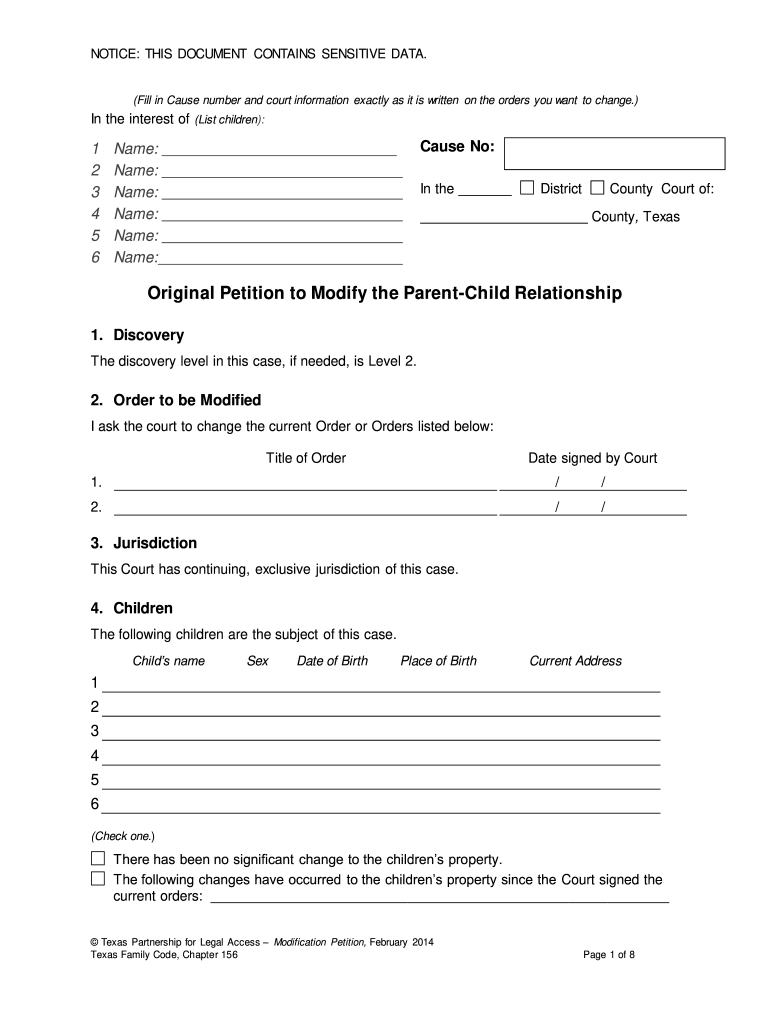
The formal legal document to start a custody case in Texas is called an “Original Petition in Suit Affecting the Parent-Child Relationship” (SAPCR). This petition must be filed in the district court of the county where the child has resided for at least six months. If the child has lived in Texas for less than six months, the suit may be filed in the county where the child has lived the longest.
The petition needs to include:
- Information about the parties: Names, addresses, and dates of birth of both parents and the child(ren).
- Jurisdiction: A statement explaining why the Texas court has jurisdiction over the case.
- Relief sought: A clear statement requesting Sole Managing Conservatorship for one parent and specifying the desired terms for possession and access for the other parent. This is where you explicitly state the request for “full custody.”
- Grounds for SMC: If seeking Sole Managing Conservatorship, the petition must outline the specific reasons why this arrangement is in the child’s best interest and why JMC would be detrimental.
Serving the Other Parent
After filing the petition, the other parent must be formally notified of the lawsuit. This is called “service.” Service is typically performed by a sheriff, constable, or a private process server. The server will hand-deliver a copy of the filed petition and a citation (a legal document informing the parent of the lawsuit and their obligation to respond). Proper service is crucial for the court to have authority over the case.
Temporary Orders
In many custody cases, particularly those involving significant conflict or urgent circumstances, either parent can request temporary orders from the court. These orders provide guidelines for conservatorship, possession, and child support while the case is pending.
- Temporary Orders Hearing: The court will schedule a hearing to consider temporary orders. Both parents will have an opportunity to present their arguments and evidence to the judge.
- Purpose of Temporary Orders: Temporary orders ensure stability for the child during the litigation process. They might establish a temporary possession schedule, temporary child support payments, and temporary restrictions on the parents’ actions (e.g., preventing relocation out of state).
Building Your Case for Sole Managing Conservatorship
Successfully obtaining Sole Managing Conservatorship requires presenting compelling evidence to the court that demonstrates why this arrangement is in the child’s best interest.
Demonstrating the Child’s Best Interest
The court will consider various factors when determining the child’s best interest, including:
- The child’s physical and emotional needs: This includes providing a stable home environment, adequate food, shelter, and healthcare.
- Any danger to the child’s physical or emotional well-being: This is a critical factor when seeking SMC. Evidence of abuse, neglect, substance abuse, or criminal activity by the other parent will be highly influential.
- The parental abilities of each parent: This assesses each parent’s capacity to provide guidance, discipline, education, and emotional support.
- The stability of the home environment offered by each parent: A consistent and predictable environment is generally favored.
- The acts or omissions of a parent which may indicate that the parent is not acting in the best interest of the child: This can encompass a wide range of behaviors, from neglecting responsibilities to actively undermining the other parent’s relationship with the child.
- Any excuse for a parent’s failure to support the child: If a parent has not provided financial or emotional support, the court will investigate the reasons.
Gathering Evidence
The evidence you present is critical. This can include:
- Testimony: Your own testimony, as well as the testimony of witnesses who can speak to your parenting abilities and the other parent’s shortcomings. Witnesses can include teachers, counselors, family members, or friends.
- Documentation:
- School records: Grades, attendance, and any reports from teachers or school counselors.
- Medical records: Documentation of the child’s health and any specific medical needs.
- Communication logs: Emails, texts, or voicemails that demonstrate efforts to co-parent or, conversely, the other parent’s unresponsiveness or problematic communication.
- Police reports or court records: If there has been any history of domestic violence, substance abuse, or criminal activity.
- Photographs or videos: Evidence of an unsafe or unstable environment.
- Financial records: To support or refute child support claims.
- Expert testimony: In complex cases, the court may appoint an amicus attorney or a custody evaluator to investigate the situation and provide recommendations to the court. An amicus attorney is appointed to represent the best interests of the child. A custody evaluator is a professional (often a psychologist or social worker) who conducts in-depth assessments of the family and provides a report with recommendations.
The Role of the Amicus Attorney and Custody Evaluator
- Amicus Attorney: This attorney’s sole focus is the child’s well-being. They will meet with the child, parents, and other relevant individuals, review evidence, and make recommendations to the court. They do not represent either parent.
- Custody Evaluator: This professional conducts a thorough investigation, which may include interviews with parents and children, home visits, psychological testing, and review of collateral information. Their detailed report helps the judge make an informed decision.
The Final Orders and Beyond
The conclusion of a custody case results in a court order that outlines the rights and responsibilities of each parent.
The Final Decree of Divorce or SAPCR
If the case is part of a divorce, the custody orders will be incorporated into the Final Decree of Divorce. If it’s a standalone custody case (e.g., for unmarried parents), it will be a Final Decree of SAPCR. This document is legally binding and dictates conservatorship, possession schedules, child support, and other crucial aspects of the parent-child relationship.
Modifying Custody Orders
Circumstances can change, and Texas law allows for the modification of custody orders. To modify an order, a parent must demonstrate a “material and substantial change in circumstances” since the last order was entered, and that the requested modification is in the child’s best interest. For example, if the parent who was granted Sole Managing Conservatorship moves to another state, or if the other parent develops a serious substance abuse problem, a modification might be sought.
Enforcement of Orders
If one parent fails to comply with the terms of the court order (e.g., denies visitation, fails to pay child support), the other parent can take legal action to enforce the order. Enforcement actions can include contempt of court proceedings, which can result in fines, jail time, or other penalties.
Conclusion
Seeking Sole Managing Conservatorship in Texas is a serious undertaking that requires a thorough understanding of the legal process and a commitment to presenting a strong case. It is highly advisable to seek legal counsel from an experienced Texas family law attorney. An attorney can guide you through the intricacies of filing, evidence gathering, and court appearances, ensuring that your rights and, most importantly, your child’s best interests are fully protected throughout this challenging journey. The goal is to establish a legal framework that supports a healthy and stable upbringing for the child, even amidst parental separation.
LifeOutOfTheBox is a participant in the Amazon Services LLC Associates Program, an affiliate advertising program designed to provide a means for sites to earn advertising fees by advertising and linking to Amazon.com. Amazon, the Amazon logo, AmazonSupply, and the AmazonSupply logo are trademarks of Amazon.com, Inc. or its affiliates. As an Amazon Associate we earn affiliate commissions from qualifying purchases.