
Navigating the complexities of vehicle ownership in Texas can sometimes present unique challenges, particularly when dealing with vehicles that lack a traditional title. This is where the concept of a “bonded title” becomes invaluable. A bonded title, also known as a mechanic’s lien, bonded title, or salvage title, serves as a legal document proving ownership of a vehicle when the usual title is lost, stolen, or otherwise unavailable. For Texans seeking to register and drive a vehicle without a clear title, understanding the bonded title process is paramount. This guide will delve into the steps required to obtain a bonded title in Texas, ensuring you can legally own and operate your vehicle.

Understanding the Bonded Title
A bonded title is essentially a form of insurance for the state and potential future buyers. When you apply for a bonded title, you are acquiring a surety bond that protects the previous legal owner and any other parties who might have a claim to the vehicle from financial loss. The surety bond acts as a financial guarantee. If a rightful claimant to the vehicle appears after a bonded title has been issued, the surety company that issued the bond will compensate them, up to the bond’s limit. This process is designed to provide a legal pathway to vehicle ownership for individuals who would otherwise be unable to prove their title, often in cases of abandoned vehicles, lost or damaged titles, or vehicles acquired through certain auctions.
When is a Bonded Title Necessary?
There are several common scenarios in Texas that necessitate pursuing a bonded title:
- Lost or Stolen Title: This is perhaps the most frequent reason. If the original title was lost during a move, misplaced, or unfortunately stolen, and you cannot obtain a duplicate from the previous owner or the issuing state, a bonded title is the solution.
- Inherited Vehicles: If you inherit a vehicle and the deceased owner’s title cannot be located or is incomplete, a bonded title can help establish your ownership.
- Abandoned Vehicles: Vehicles that have been legally repossessed, towed, or declared abandoned, and for which the previous owner’s title is unobtainable, often require a bonded title for the new owner to gain legal possession.
- Vehicles Purchased Without a Title: In some instances, individuals may purchase a vehicle from a private seller or at an auction where the title was not properly transferred or was missing.
- Vehicles with Salvage Branding: While not always requiring a bonded title, if a salvage-branded vehicle has been rebuilt and inspected, and the original title documentation is insufficient, a bonded title might be part of the process to obtain a rebuilt title.
It is crucial to understand that a bonded title is not a “clean” title. It carries a branding that indicates it was issued through a surety bond. This branding will typically remain on the title, even after a certain period has passed.
The Role of the Surety Bond
The surety bond is the cornerstone of the bonded title process. It’s a three-party agreement:
- The Principal: This is you, the applicant for the bonded title.
- The Surety Company: This is the insurance company that issues the bond and guarantees your obligation.
- The Obligee: This is the state of Texas, represented by the Texas Department of Motor Vehicles (TxDMV), which is protected by the bond.
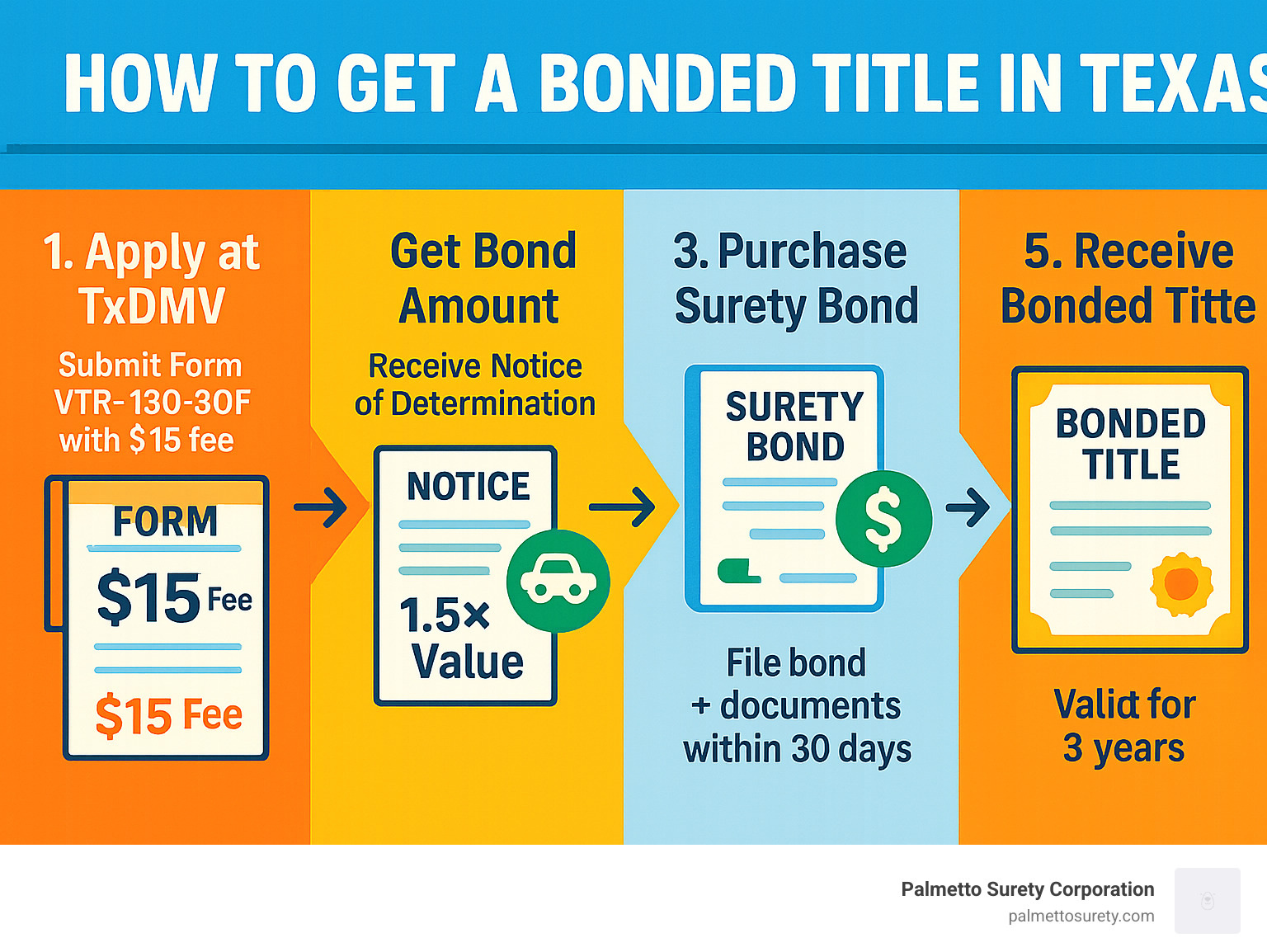
The bond’s value is typically 1.5 times the fair market value of the vehicle. This ensures that there are sufficient funds to compensate any legitimate claimant who might come forward. The bond is usually valid for a period of three years. If no claims are made against the bond within this period, the bond is released, and you can then apply for a standard Texas title.
Steps to Obtain a Bonded Title in Texas
The process of obtaining a bonded title in Texas involves several distinct stages, requiring meticulous attention to detail and proper documentation.
Step 1: Gather Necessary Documentation
Before you can even apply for a bond, you need to compile a comprehensive set of documents to prove your claim to the vehicle and demonstrate why a traditional title is unavailable. While the exact requirements can vary slightly, common documents include:
- Proof of Ownership (or Lack Thereof): This could be a bill of sale, canceled checks, a purchase agreement, or any other documentation that shows how you acquired the vehicle. If the vehicle was abandoned, you might need tow receipts or a lienholder’s release.
- Verification of Vehicle Information: This includes the Vehicle Identification Number (VIN), make, model, and year of the vehicle. You may need to have the VIN physically inspected.
- Previous Title Information (if available): Even if you don’t have the original title, any scraps of information about the previous owner or title number can be helpful.
- Affidavits: You will likely need to complete several affidavits, such as a “Statement of Location,” “Affidavit of Non-Receipt of Title,” and potentially an “Affidavit for Bonded Title.” These statements attest to the circumstances under which you acquired the vehicle and why you cannot produce a title.
- Law Enforcement Inspection Certificate: In many cases, you will need to have the vehicle inspected by a law enforcement officer to verify the VIN and confirm the vehicle has not been reported stolen. This results in a completed “Vehicle Identification Number Inspection Certificate.”
- DMV Forms: Obtain the required forms from the Texas Department of Motor Vehicles (TxDMV). The primary form is typically the “Application for Texas Title and/or Registration” (Form 130-U).
Step 2: Obtain a Vehicle Valuation
The Texas Department of Motor Vehicles (TxDMV) requires an estimate of the vehicle’s fair market value to determine the bond amount. This valuation can often be obtained through:
- Kelley Blue Book (KBB): A common source for vehicle valuations.
- NADA Guides: Another reputable guide for vehicle appraisals.
- Independent Appraisals: In some cases, a professional appraisal may be necessary.
The valuation should be recent and accurately reflect the vehicle’s condition. Remember, the bond amount will be 1.5 times this determined value.

Step 3: Purchase a Surety Bond
Once you have the estimated vehicle value and a clear understanding of the required documentation, you can proceed to purchase a surety bond. You will need to contact a licensed surety bond provider in Texas. These providers are typically insurance agencies that specialize in surety bonds.
You will need to provide them with the vehicle’s details, its estimated value, and the required bond form, which is often the “Application for Texas Bonded Title“. The surety company will assess your application, and upon approval, you will pay a premium for the bond. This premium is a percentage of the total bond amount and is non-refundable. You will receive the original surety bond document, which is essential for your application.
Step 4: Submit Your Application to the County Tax Assessor-Collector
With all your documentation in order, including the completed application forms, the surety bond, the law enforcement inspection certificate, and any other supporting documents, you are ready to submit your application. You will take these documents to the County Tax Assessor-Collector’s office in your county of residence.
The county office will review your submission to ensure it is complete and meets all the state’s requirements. If everything is in order, they will process your application and forward it to the Texas Department of Motor Vehicles (TxDMV) for final approval.
Step 5: Receive Your Bonded Title
After the TxDMV reviews and approves your application, they will issue a bonded title for the vehicle. This title will be branded as “Bonded.” You will then be able to use this bonded title to register the vehicle with the county tax office and obtain license plates.
Post-Bonded Title Ownership and Considerations
Obtaining a bonded title is a significant step, but it’s not the absolute end of the process. There are ongoing considerations and responsibilities.
The Three-Year Waiting Period
The surety bond for a bonded title in Texas is typically valid for three years from the date of issuance. During this period, the bond protects any previous owner or lienholder who may have a legal claim to the vehicle. It is crucial to maintain continuous insurance on the vehicle and keep it in good repair.
If, during these three years, a valid claim is filed against the bond, the surety company will investigate. If the claim is deemed legitimate, the surety company will compensate the claimant, up to the limit of the bond. In such a situation, you, as the bonded title holder, may be held responsible for any amounts paid out by the surety company if your actions or representations were fraudulent.
Obtaining a Clean Title After Three Years
Once the three-year period has expired without any claims being filed against the surety bond, you can then apply for a standard, clean Texas title. The process typically involves:
- Submitting Proof of Bond Expiration: You will need to provide documentation from the surety company confirming that the bond has expired and that no claims were filed.
- Completing New Title Application Forms: You will likely need to fill out another “Application for Texas Title and/or Registration” (Form 130-U) and pay the associated title and registration fees.
- County Tax Assessor-Collector Review: The county tax office will review your application and the bond expiration proof.
- Issuance of a Clean Title: Upon approval, the TxDMV will issue a new title that is no longer branded as “Bonded.”
This clean title then becomes your official proof of ownership, free from the encumbrance of the surety bond.
Potential Challenges and Tips
While the bonded title process is designed to be accessible, there can be hurdles.
- Accurate Valuation: Ensuring an accurate and accepted vehicle valuation is critical. Disagreements with the TxDMV on value can delay the process.
- Completeness of Documentation: Missing or incomplete paperwork is the most common reason for application rejection or delays. Double-check every form and requirement.
- Navigating Bureaucracy: Government processes can sometimes be slow. Patience and persistent follow-up are key.
- Cost: While not prohibitively expensive, the cost of the surety bond premium, inspection fees, and application fees does add up. Factor these into your budget.
- Resale Value: It’s important to note that vehicles with a bonded title history may have a lower resale value compared to vehicles with a clean title, even after obtaining a clean title following the bond period. Buyers may be hesitant due to the previous title status.
Conclusion
Obtaining a bonded title in Texas is a vital procedure for individuals who possess vehicles without standard title documentation. By diligently following the steps outlined—gathering comprehensive proof, securing a surety bond, and submitting a complete application—you can navigate this process successfully. The three-year waiting period and the eventual transition to a clean title provide a structured pathway to legitimate ownership. While it requires patience and attention to detail, the bonded title system ensures that legal ownership can be established, allowing more vehicles to be legally registered and enjoyed on Texas roads.
LifeOutOfTheBox is a participant in the Amazon Services LLC Associates Program, an affiliate advertising program designed to provide a means for sites to earn advertising fees by advertising and linking to Amazon.com. Amazon, the Amazon logo, AmazonSupply, and the AmazonSupply logo are trademarks of Amazon.com, Inc. or its affiliates. As an Amazon Associate we earn affiliate commissions from qualifying purchases.