
Navigating the path to earning your GED® (General Educational Development) credential in Texas is a significant step towards enhanced educational and career opportunities. The GED program offers an alternative to a traditional high school diploma, validating your knowledge and skills across four core subject areas: Reasoning Through Language Arts, Mathematical Reasoning, Science, and Social Studies. Texas offers a structured and accessible process for individuals seeking to achieve this important milestone. This guide will walk you through the essential steps, requirements, and resources available to help you successfully obtain your GED in the Lone Star State.

Understanding the GED Requirements in Texas
To be eligible for the GED test in Texas, candidates must meet specific criteria. These requirements are designed to ensure that individuals are prepared for the rigor of the exams and are pursuing the credential for valid educational or career advancement purposes. Understanding these prerequisites is the crucial first step in your GED journey.
Age Requirements
The primary age requirement for taking the GED test in Texas is that you must be at least 16 years old. However, there are different provisions depending on your age.
- 18 Years or Older: If you are 18 years or older, you can take the GED tests without any further age-related restrictions, provided you are no longer enrolled in high school.
- 16 or 17 Years Old: If you are 16 or 17 years old, you will need to provide specific documentation to prove you are officially withdrawn from high school. This typically involves submitting a GED authorization form signed by your school principal, superintendent, or a designee. This form confirms that you are not currently attending high school and are eligible to pursue the GED.
Residency Requirements
While Texas does not have a strict residency requirement in terms of a minimum duration of living in the state, you will need to establish that you are a resident of Texas to take the GED tests within the state’s testing centers and for the credential to be issued by the Texas Education Agency. Proof of residency might be requested during the registration process or at the testing center on the day of your exam. Accepted forms of identification and proof of residency often include a valid Texas driver’s license, a Texas identification card, or other official documents that clearly indicate your Texas address.
Identification Requirements
On the day of your GED test, you will need to present valid, government-issued photo identification. This is a standard security measure to verify your identity. Acceptable forms of ID typically include:
- A valid driver’s license or state-issued ID card.
- A U.S. passport.
- A foreign passport.
- A U.S. military ID.
- A national identity card.
Ensure your identification is current and not expired, as it will be checked before you are permitted to take the exam.
Prior High School Completion
A fundamental requirement for taking the GED tests is that you must not have completed a high school program or an equivalent credential, such as a high school equivalency certificate from another state or country. If you have previously graduated from high school, you are not eligible to take the GED tests.
Preparing for the GED Tests in Texas
Once you meet the eligibility requirements, the next crucial phase is preparing for the four GED subject tests. Effective preparation significantly increases your chances of passing each exam on your first attempt. Texas offers a variety of resources to support your learning journey, from structured courses to self-study materials.
Official GED Preparation Resources
The GED Testing Service, in partnership with Pearson, provides official study materials and practice tests designed to align directly with the GED assessment. These resources are invaluable for understanding the test format, question types, and content areas.
- GED Ready® Practice Tests: These are official practice tests that simulate the actual GED exam experience. They are designed to assess your readiness for the official tests and provide targeted feedback on areas where you may need further study. Passing a GED Ready™ practice test can give you the confidence to schedule your official GED exam.
- The Official GED Study Guide: This comprehensive guide offers detailed explanations of the content covered in each subject area, along with practice questions and tips for test-taking strategies.
Adult Education Programs in Texas
Texas boasts a robust network of adult education and literacy programs, many of which are funded by the state and offer free or low-cost GED preparation classes. These programs are often hosted by community colleges, school districts, libraries, and non-profit organizations across the state.
- Community Colleges: Most community colleges in Texas offer GED preparation courses as part of their continuing education or workforce development programs. These classes provide structured instruction, qualified instructors, and a supportive learning environment.
- School Districts: Many local school districts operate adult education centers that provide GED classes. These programs are often tailored to the specific needs of the local community.
- Non-Profit Organizations: Various non-profit organizations and community centers across Texas are dedicated to providing educational opportunities for adults, including GED preparation services.
These programs often offer flexible scheduling, including day, evening, and weekend classes, to accommodate working adults and those with other commitments. They can be an excellent way to receive personalized instruction, ask questions, and study with peers.
Self-Study Options
For individuals who prefer a more independent approach to learning, self-study is a viable option. This can involve using GED preparation books purchased from bookstores or online retailers, utilizing online learning platforms, or accessing resources through your local public library. While self-study requires a high degree of self-discipline and motivation, it can be an effective method for those who are comfortable with independent learning.
Registering for and Taking the GED Tests
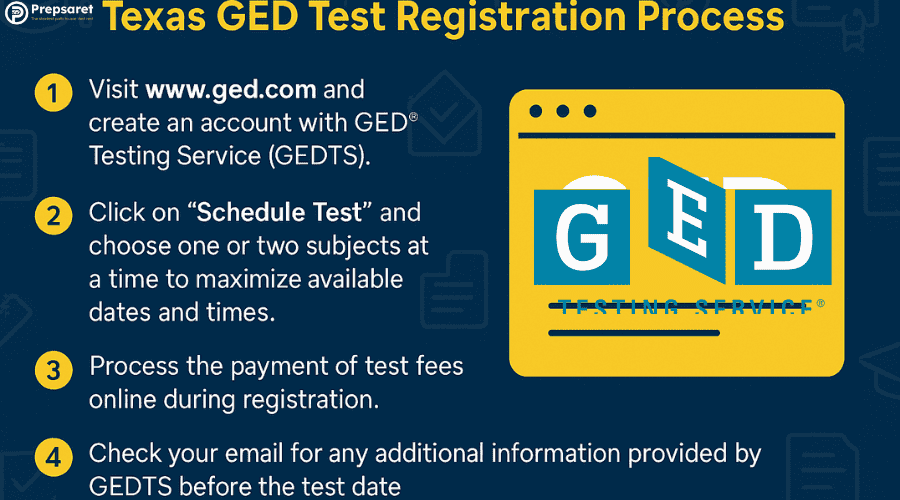
The GED testing process in Texas is managed by Pearson VUE, the official GED testing provider. Registration and scheduling are handled online through the official GED website.
Creating a GED Account
The first step in the registration process is to create a MyGED™ account on the official GED website. This account will be your central hub for all GED-related activities, including:
- Registering for the tests.
- Scheduling your exams.
- Accessing your scores.
- Finding preparation resources.
- Managing your testing history.
Ensure you use accurate personal information when creating your account, as this will be used on your GED transcript and certificate.
Scheduling Your Tests
Once you have created your MyGED™ account, you can schedule your exams. You can choose to take all four tests at once or schedule them individually, depending on your preparation level and preference.
- Test Order: You can take the tests in any order you choose. Many candidates find it beneficial to start with subjects they feel more confident in to build momentum.
- Test Centers: When scheduling, you will be prompted to select a GED testing center in Texas. Pearson VUE operates numerous authorized testing locations throughout the state, including in major cities like Houston, Dallas, San Antonio, and Austin, as well as in smaller towns and rural areas.
- Fees: There are fees associated with taking the GED tests. These fees cover the cost of the exams, scoring, and the issuance of your credential. Fee waivers or assistance programs may be available through some adult education providers, so it’s worth inquiring about these possibilities.
The GED Testing Experience
On the day of your test, arrive at the designated testing center early to allow time for check-in. You will need to present your valid photo identification. The tests are computer-based and are administered in a secure testing environment.
- Test Format: Each subject test has a specific time limit and consists of multiple-choice questions, extended response prompts (for Language Arts and Social Studies), and constructed-response items. The Mathematical Reasoning test includes both multiple-choice and gridded-response questions.
- Scoring: Scores are reported on a scale of 100 to 200. A passing score is 145 or higher on each of the four subject tests. A scaled score between 145-164 indicates a “High School Level” proficiency. Scores between 165-174 indicate “College Ready” proficiency. Scores from 175-200 indicate “College Ready + Credit” proficiency, which may earn you college credit for specific courses.
After You Pass: Receiving Your GED Credential
Successfully passing all four GED subject tests is a significant achievement. Upon meeting all requirements, the Texas Education Agency will issue your official GED credential.
Obtaining Your GED Transcript and Certificate
Your GED transcript and certificate serve as official documentation of your accomplishment. These documents are vital for future educational pursuits, employment applications, and other life opportunities.
- Accessing Records: You can typically access your GED scores and order official transcripts and duplicate certificates through your MyGED™ account on the GED website. There may be a fee associated with ordering duplicate documents.
- Verification: Employers and educational institutions can often verify the authenticity of your GED credential online through official channels.

Utilizing Your GED for Future Opportunities
Earning your GED in Texas opens doors to a wide range of possibilities:
- Higher Education: Your GED credential is an acceptable substitute for a high school diploma when applying to colleges and universities in Texas and across the country. Many community colleges and four-year institutions offer pathways for GED recipients.
- Career Advancement: Many employers require a high school diploma or equivalent for job applications. A GED can qualify you for a broader range of employment opportunities and promotions.
- Vocational Training: GED graduates are eligible for enrollment in vocational training programs and apprenticeships, which can lead to skilled trades and in-demand careers.
The journey to obtaining your GED in Texas is a rewarding one. By understanding the requirements, preparing effectively, and utilizing the available resources, you can successfully achieve this important educational goal and unlock a brighter future.
LifeOutOfTheBox is a participant in the Amazon Services LLC Associates Program, an affiliate advertising program designed to provide a means for sites to earn advertising fees by advertising and linking to Amazon.com. Amazon, the Amazon logo, AmazonSupply, and the AmazonSupply logo are trademarks of Amazon.com, Inc. or its affiliates. As an Amazon Associate we earn affiliate commissions from qualifying purchases.