
Navigating the roads of Alabama requires adherence to various state regulations, and among the less commonly understood, yet critically important, are the laws governing vehicle window tint. Whether you’re a long-time resident or a visitor exploring the state’s diverse landscapes, understanding legal tint limits is crucial to ensure compliance, avoid fines, and maintain the safety standards set by the Alabama Department of Public Safety. These regulations are designed to balance privacy and comfort with visibility and road safety for all drivers and law enforcement officers. Illegal window tint can lead to serious consequences, not just for the driver but potentially for the vehicle’s registration and insurance.
The impetus behind tint laws stems from multiple concerns. Excessively dark tint can impair a driver’s ability to see clearly, especially at night or in adverse weather conditions, increasing the risk of accidents. It also poses a safety concern for law enforcement during traffic stops, as officers need to be able to see into a vehicle for their own security. Furthermore, uniform tint laws ensure that vehicles operating on public roads meet a certain standard, contributing to overall road safety and order. For travelers, knowing these specifics before embarking on a journey through the “Heart of Dixie” can prevent unexpected roadside stops and costly citations. This guide will delve into the intricacies of Alabama’s window tint laws, providing a comprehensive overview for drivers seeking to remain compliant.
Understanding Alabama’s Window Tint Laws: An Overview
Alabama’s tint laws are codified under Title 32, Chapter 5B of the Alabama Code, specifically addressing “Motor Vehicle Window Tinting.” The core of these regulations revolves around Visible Light Transmission (VLT), which is the percentage of visible light that passes through the window film. A lower VLT percentage indicates a darker tint, allowing less light to pass through. Conversely, a higher VLT means a lighter tint. Alabama has specific VLT percentages mandated for different windows on a vehicle, distinguishing between front side windows, rear side windows, the rear window, and the windshield.
These laws apply to all passenger vehicles, including cars, vans, and light trucks registered or operating within Alabama. It’s important to note that even if your vehicle is registered in another state, you are expected to comply with Alabama’s tint laws while driving within its borders. This is a common pitfall for interstate travelers who may have legal tint in their home state but find it non-compliant when crossing state lines. Therefore, understanding the nuances of VLT percentages is paramount for anyone driving through or residing in Alabama to avoid potential legal issues and maintain road safety for everyone. The state’s regulations are designed to be clear-cut, but their specific application often requires careful attention to detail.
Specific VLT Requirements for Different Windows
The distinct VLT requirements for each window are the cornerstone of Alabama’s window tint law. These variations acknowledge the different roles each window plays in driver visibility and safety.
Front Side Windows
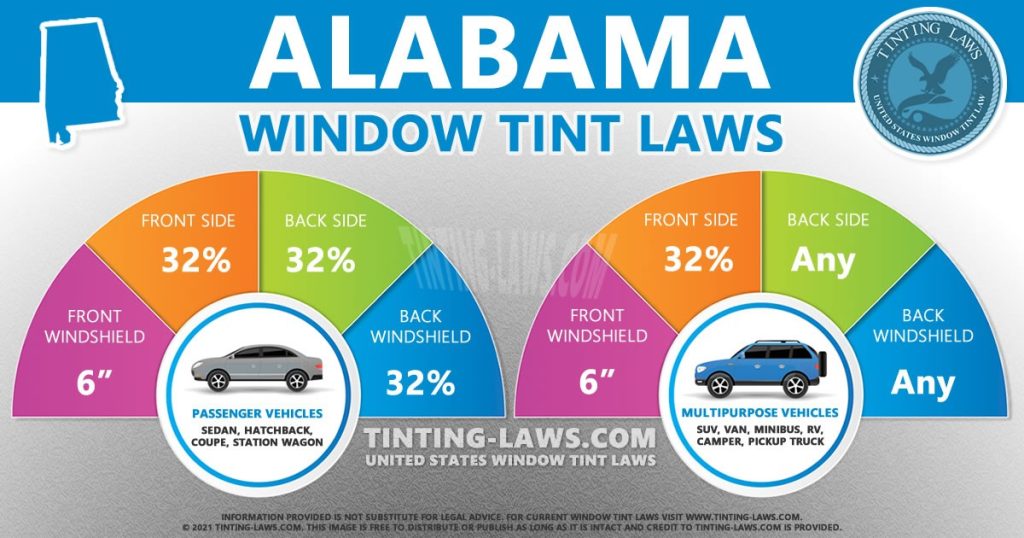
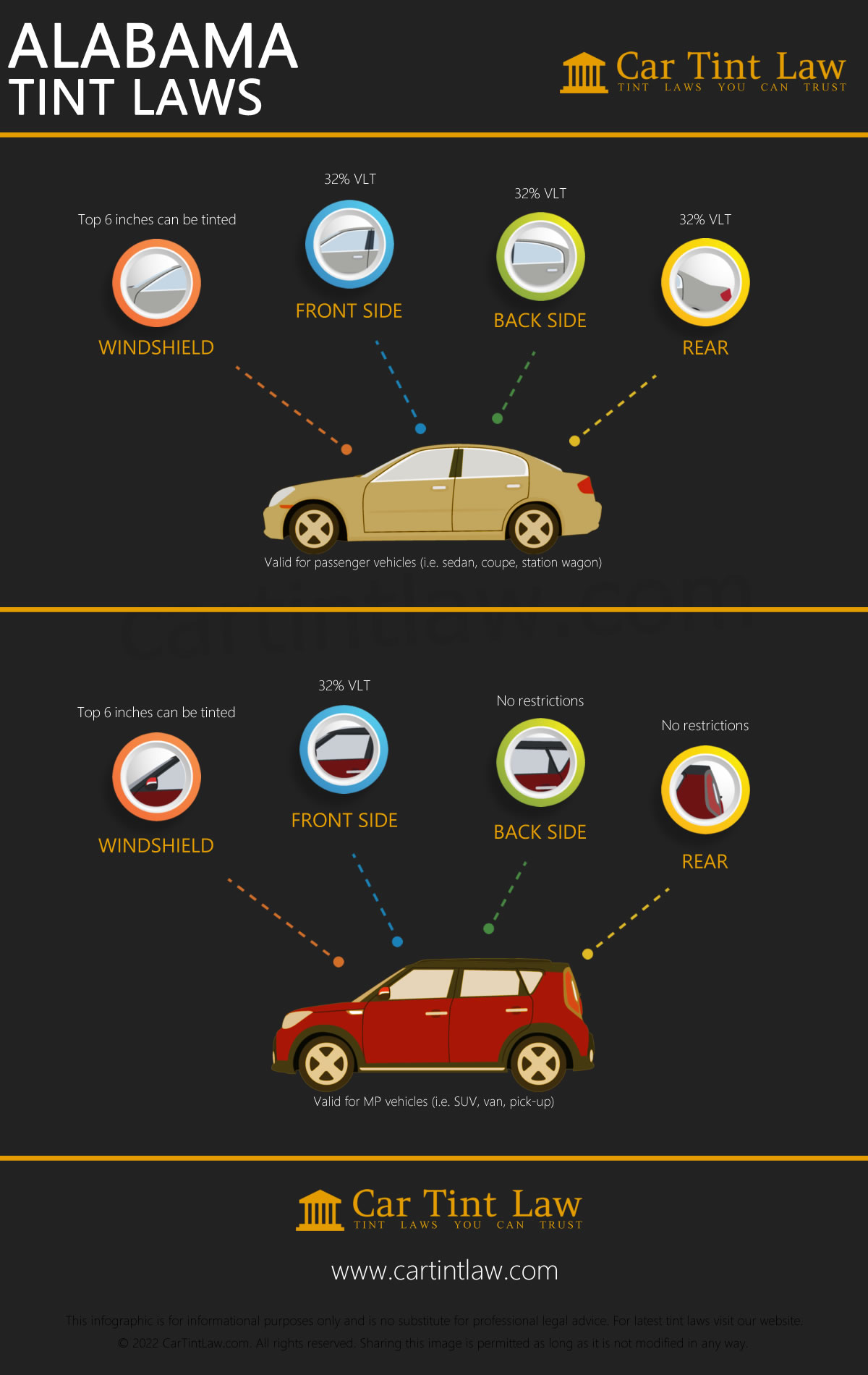
For the front side windows—those immediately to the left and right of the driver—Alabama mandates a minimum VLT of 32%. This means that the tint film, combined with the factory glass, must allow at least 32% of visible light to pass through. The reason for this specific percentage is to ensure that the driver has adequate visibility, particularly when making turns, checking mirrors, or interacting with pedestrians and other vehicles. It also allows law enforcement officers a reasonable degree of visibility into the vehicle’s interior for safety purposes during traffic stops. Drivers should be aware that many factory-tinted windows already have a certain VLT, and adding aftermarket film could push the total VLT below the legal limit.
Back Side Windows and Rear Window
The regulations for the back side windows (all windows behind the driver’s seat) and the rear window are more lenient. Alabama law permits any darkness for these windows, meaning there is no specific VLT limit for the windows behind the driver. This allowance often caters to passengers’ comfort, particularly for families with children, or for those transporting sensitive cargo, offering enhanced privacy and UV protection. While there’s no darkness limit, other restrictions, such as reflectivity, still apply to these windows. Furthermore, if the rear window is tinted, the vehicle must be equipped with working dual side mirrors to ensure the driver has an unobstructed view of the rear of the vehicle.
Windshield Tinting
The windshield, crucial for primary forward visibility, has the strictest tinting regulations. Alabama law permits tinting only on the uppermost portion of the windshield, specifically above the AS-1 line or the top five inches of the windshield, whichever is less. This strip of tint is primarily for reducing sun glare and improving driver comfort, but it must not extend into the critical viewing area. Below this permissible strip, the windshield must remain clear of any aftermarket tinting that reduces its VLT. This ensures that the driver’s forward visibility is completely unimpaired, preventing any potential hazards due to reduced light transmission or glare from the film itself. Factory-installed clear or lightly tinted windshields are typically compliant, but any addition of aftermarket film below the AS-1 line is strictly prohibited.
Key Regulations and Exemptions to Be Aware Of
Beyond the VLT percentages, Alabama’s window tint laws include other important provisions and potential exemptions that drivers should understand. These aspects further contribute to the safety and uniformity of vehicles on the state’s roads.
Reflectivity and Color Restrictions
One significant aspect of Alabama’s tint laws pertains to the reflectivity and color of the window film. The law strictly prohibits window film that is highly reflective or mirrored. The intent behind this is to prevent the tint from creating dangerous glare for other drivers, which could impair their vision and potentially lead to accidents. Specifically, the reflectivity of the tint must not be greater than 20%. This ensures that sunlight or headlights bouncing off a tinted window do not become a hazard.
In terms of color, Alabama law generally allows a wide range of tint colors, provided they meet the VLT and reflectivity requirements. However, certain colors are explicitly prohibited due to their potential to interfere with driver visibility or law enforcement identification. Films that are red, amber, or yellow in color are not permitted. These colors are typically reserved for emergency vehicle lighting or traffic signals, and their use on vehicle windows could cause confusion or misinterpretation on the road. It’s always advisable to choose neutral-colored tints (like charcoal, gray, or bronze) that comply with both VLT and reflectivity limits to avoid any issues.
Medical Exemptions
Alabama law provides for certain medical exemptions to the standard window tint regulations. Individuals who suffer from a medical condition that requires protection from the sun’s harmful rays may be eligible for a darker window tint than typically allowed. Conditions such as porphyria, lupus, or severe photosensitivity could qualify for such an exemption.
To obtain a medical exemption, a driver must possess a valid physician’s statement or prescription from a licensed physician in Alabama or a bordering state. This document must clearly state the medical necessity for the darker tint and be kept in the vehicle at all times. While a medical exemption allows for darker front side windows, it typically does not permit tinting the windshield below the AS-1 line. It’s crucial for individuals with such exemptions to ensure their documentation is current and readily available, as law enforcement officers may request it during a traffic stop. Without proper documentation, even a medically necessary darker tint would be considered illegal.
Manufacturer’s Label Requirement
For any aftermarket window film installed on a vehicle, Alabama law requires that a label or sticker indicating compliance with state regulations be affixed to the lower right-hand corner of each tinted window. This label serves as proof that the tint meets the state’s VLT and reflectivity standards and was professionally installed by a reputable dealer. Many legitimate tint installers will automatically provide and affix these labels.
The absence of such a label can be a red flag for law enforcement, even if the tint itself appears to be compliant. It can lead to a traffic stop and an inspection of the tint’s VLT, potentially resulting in a citation if no valid proof of compliance is present. Therefore, when having tint installed, always ensure that the installer provides and properly affixes the required certification labels. This simple step can save drivers considerable hassle and potential fines down the road.
Consequences of Non-Compliance and Enforcement
Disregarding Alabama’s window tint laws carries distinct penalties and procedures for enforcement, which drivers should be fully aware of. Non-compliance can lead to more than just a simple warning; it can result in financial costs and inconvenience.
Penalties for Illegal Tint
If a vehicle is found to have illegal window tint in Alabama, the owner or driver can face a traffic citation. This is typically considered a non-moving violation, but it still comes with a fine. The exact amount of the fine can vary by jurisdiction within Alabama, but it generally ranges from around $50 to $100 for a first offense. In addition to the fine, the driver may also incur court costs.
More significantly, the citation usually comes with an order to correct the violation. This means the illegal tint must be removed or replaced with compliant tint within a specified timeframe, often 30 days. Failure to correct the violation and provide proof to the court or law enforcement agency could lead to further fines, more severe penalties, or even a vehicle inspection hold. Repeat offenses can result in higher fines and potentially more stringent corrective actions. It’s important to understand that ignorance of the law is not an acceptable defense, and drivers are responsible for ensuring their vehicle’s compliance.
Enforcement and Inspection
Law enforcement officers in Alabama are equipped to enforce window tint laws. During a routine traffic stop for another violation, or if an officer suspects illegal tint, they can use a specialized device called a tint meter to measure the VLT percentage of the window on the spot. These handheld devices provide an accurate reading of how much light is passing through the film and glass, allowing the officer to determine if the tint is above or below the legal limit.
If the tint meter indicates a violation, the officer will issue a citation. Drivers should be prepared for this possibility if their tint is borderline or visibly dark. In some cases, officers might also visually assess the reflectivity or color of the tint. Drivers with medical exemptions must present their valid physician’s statement upon request to avoid a citation. Proactive measures, such as knowing your tint’s VLT or ensuring professional, compliant installation with proper labeling, are the best defense against enforcement actions.

Tips for Travelers and Residents Regarding Window Tint
Ensuring your vehicle complies with Alabama’s window tint laws is straightforward with a few proactive steps. Whether you’re planning a road trip or living in the state, these tips can help you avoid unnecessary hassle.
Firstly, if you are unsure about your current window tint’s legality, consider visiting a reputable auto accessory store or a tint installation specialist in Alabama. Many such establishments have tint meters and can provide an accurate reading of your VLT percentage. This allows you to assess your compliance before it becomes an issue with law enforcement.
Secondly, if you need new tint installed, always choose a certified and reputable installer. These professionals are familiar with Alabama’s specific regulations and use high-quality films that meet legal standards. They will also ensure that the required manufacturer’s labels are properly affixed to your windows, which is a crucial part of legal compliance. Insist on receiving a receipt and documentation detailing the VLT percentage of the film installed.
For travelers driving through Alabama from other states, it’s particularly important to research Alabama’s laws beforehand. If your home state allows darker tint on front side windows, you might be at risk of a citation in Alabama. If frequent travel to Alabama is part of your routine, it may be prudent to ensure your vehicle’s tint meets the more restrictive of the states you frequent.
Finally, always keep any relevant documentation, such as medical exemption certificates or installation compliance paperwork, readily accessible in your vehicle. This can expedite traffic stops and provide immediate proof of legality, should an officer question your window tint. By taking these preventative measures, drivers can confidently navigate the roads of Alabama, enjoying the privacy and comfort of tinted windows without fear of legal repercussions.
LifeOutOfTheBox is a participant in the Amazon Services LLC Associates Program, an affiliate advertising program designed to provide a means for sites to earn advertising fees by advertising and linking to Amazon.com. Amazon, the Amazon logo, AmazonSupply, and the AmazonSupply logo are trademarks of Amazon.com, Inc. or its affiliates. As an Amazon Associate we earn affiliate commissions from qualifying purchases.