
The Historical Tapestry of America’s Last Frontier
The vast, untamed expanse of Alaska stands as a monumental landmark, not just in its physical grandeur, but in the layered history that forged its identity. Its journey to becoming a part of the United States is a captivating narrative of discovery, geopolitical strategy, and the enduring spirit of self-determination. Far from being a mere geographical outpost, Alaska represents the pinnacle of America’s westward expansion and a testament to the nation’s diverse heritage. Understanding its statehood date is to unlock a critical chapter in American history, revealing the processes and aspirations that shaped the Union.
From Russian America to US Territory
The story of modern Alaska begins long before its statehood, rooted in its tenure as Russian America. For over a century, Russian explorers and fur traders established outposts across this resource-rich land, primarily focused on the lucrative fur trade. Settlements like Sitka served as the administrative and economic hub of this distant colony. However, by the mid-19th century, Russia found its American holdings increasingly difficult to manage and defend, especially after its defeat in the Crimean War. This vulnerability, coupled with economic motivations, led to the historic decision to sell Alaska to the United States.
On March 30, 1867, Secretary of State William H. Seward negotiated the Alaska Purchase for a sum of $7.2 million, or approximately two cents an acre. Initially derided by some as “Seward’s Folly” or “Seward’s Icebox,” this acquisition was a visionary move that would ultimately transform the geopolitical landscape of North America. Upon purchase, Alaska was largely administered as a district, lacking a formal government structure. It took decades for the federal government to establish proper governance, reflecting the era’s focus on reconstruction after the Civil War and expansion into the western contiguous states. By 1912, recognizing its growing population and economic potential, Alaska was officially organized as a United States territory, a crucial step on its eventual path to statehood. This shift from distant colony to organized territory marked a significant landmark in its political evolution, laying the groundwork for greater self-determination.
The Gold Rush and Early Development
The late 19th and early 20th centuries brought transformative events to Alaska that catalyzed its development and amplified calls for greater political autonomy. The discovery of gold in the Klondike region of Canada in 1896, and subsequent finds within Alaska itself, triggered an unprecedented influx of prospectors and settlers. The Klondike Gold Rush transformed remote outposts into booming towns, injecting capital and population into the rugged territory. Cities like Juneau, Fairbanks, and Nome grew rapidly, driven by the allure of mineral wealth.
Beyond gold, other natural resources, particularly fishing and later petroleum, began to underscore Alaska’s immense economic value. The establishment of canneries, mining operations, and early transportation networks—including railroads and steamship lines—began to knit together the vast territory, creating a rudimentary infrastructure where little had existed before. These developments, while often exploitative of natural resources and challenging for the Indigenous populations, simultaneously fostered a sense of community among the non-native settlers and solidified the territory’s economic importance to the United States. The growth spurred by these industries provided compelling arguments for statehood, as residents increasingly desired a greater say in the governance of their burgeoning economy and society, pushing for local control over federal oversight. The very landscape, once seen as barren, was now understood as a treasure trove, a landmark of American resourcefulness.
The Path to Statehood: A Long and Winding Road
Alaska’s journey to statehood was anything but straightforward, marked by decades of political advocacy and overcoming significant hurdles. For many Alaskans, the territorial status felt like a colonial arrangement, where decisions affecting their lives and resources were made thousands of miles away in Washington D.C. This prolonged struggle for self-governance makes its eventual admission a landmark event in American political history.
Arguments For and Against Statehood
The debate over Alaska’s statehood was characterized by fervent arguments from both proponents and opponents. Advocates for statehood passionately argued that full political rights and representation were a fundamental democratic entitlement. They believed that statehood would allow Alaskans to elect their own governor, send voting members to Congress, and manage their own vast natural resources, rather than having them dictated by federal agencies. Proponents also argued that statehood would stimulate economic development by attracting investment and giving Alaska a stronger voice in national policy that directly impacted its unique industries like fishing, mining, and, eventually, oil. The strategic importance of Alaska, particularly during and after World War II as a vital defense outpost facing Russia and Japan, also bolstered the argument for granting it full partnership in the Union.
Conversely, significant opposition existed, primarily from interests in the contiguous United States and some Alaskans who feared the financial burdens of self-governance. Critics often cited Alaska’s sparse population, vast distances, and perceived economic dependence on federal subsidies as reasons it was not ready for statehood. Concerns were raised about whether the territory could afford to fund its own state government and infrastructure without crippling taxes on its small population. Powerful lobbying groups, particularly those with existing resource extraction interests, also resisted statehood, fearing that local control would lead to increased regulations or taxes on their operations. These debates underscored the complex balance between democratic ideals and practical considerations, making the eventual triumph of the statehood movement a significant historical landmark.
Key Figures and Political Milestones
The momentum for Alaska statehood was largely driven by dedicated individuals and strategic political organizing. Among the most influential figures was Ernest Gruening, who served as territorial governor from 1939 to 1953. A staunch advocate for statehood, Gruening tirelessly campaigned, wrote articles, and lobbied Congress to recognize Alaska’s readiness for self-governance. Another pivotal figure was Bob Bartlett, Alaska’s non-voting delegate to Congress, who skillfully navigated the legislative landscape in Washington D.C. for years, building alliances and keeping the statehood issue alive.

The formal political process gained significant traction with the establishment of the Alaska Statehood Committee in the 1940s, which coordinated efforts across the territory. A landmark event was the Alaska Constitutional Convention, held at the University of Alaska in Fairbanks from November 1955 to February 1956. During this convention, 55 elected delegates drafted the Alaska Constitution, a progressive and innovative document that would later be praised for its foresight. This act of self-governance, even before federal approval, demonstrated Alaska’s maturity and commitment to responsible statehood. The constitution was ratified by Alaskan voters in April 1956, sending a clear message to Congress that the people of Alaska were ready for their place in the Union. These milestones, each a landmark in political self-determination, paved the way for the ultimate federal recognition.
January 3, 1959: A Defining Moment
The culmination of decades of advocacy, political maneuvering, and a robust display of democratic will arrived in the waning days of the 1950s. This date marks not only a pivotal moment for Alaska but also a significant expansion of the United States itself, adding its largest state by area to the national tapestry.
President Eisenhower’s Proclamation
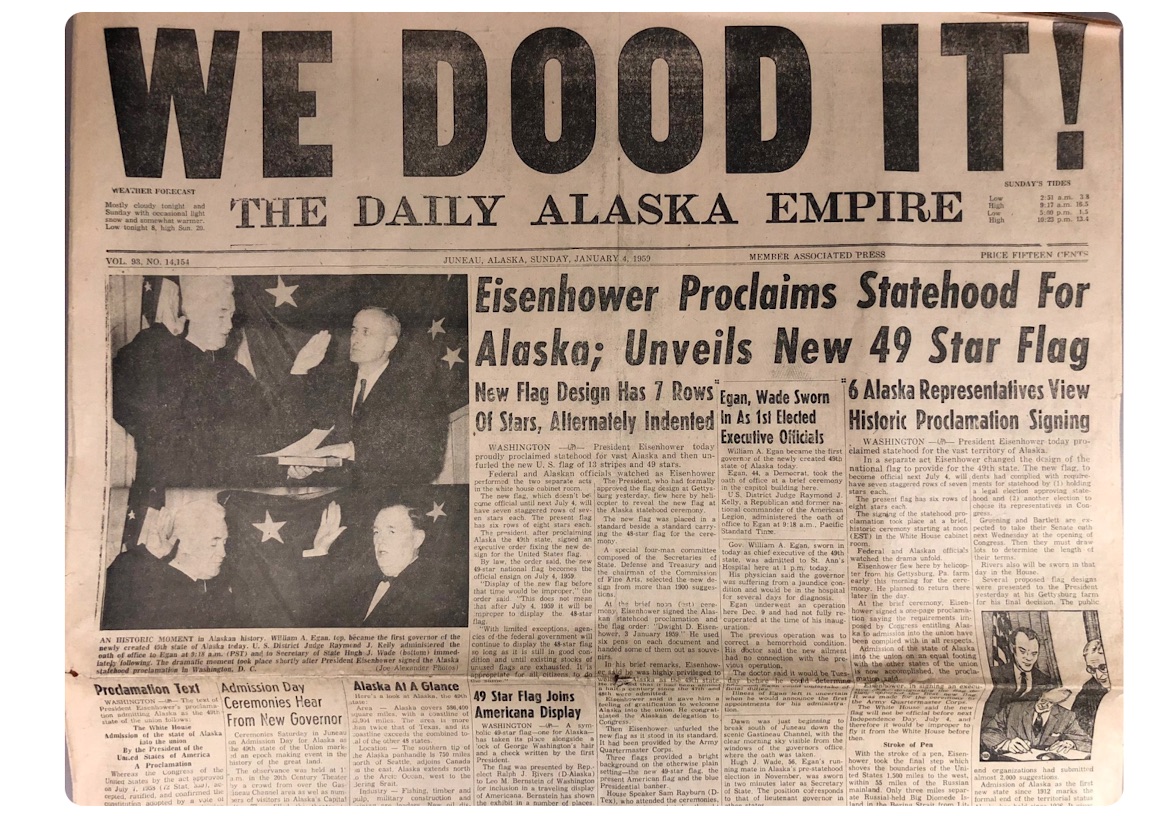
On January 3, 1959, President Dwight D. Eisenhower signed the official proclamation declaring Alaska the 49th state of the United States. This formal act brought an end to over 90 years of territorial status and fulfilled the long-held aspirations of Alaskans for full representation and self-governance. It’s important to clarify the title’s question here: Alaska became the 49th state, not the 50th. The 50th state, Hawaii, would follow approximately seven months later on August 21, 1959. However, Alaska’s admission was a monumental achievement, dramatically altering the geographic and strategic scope of the American nation. The bill granting Alaska statehood had been passed by Congress in June 1958 and signed into law by President Eisenhower then, but the official proclamation was held until the newly elected state officials could be sworn in. This period ensured a smooth transition from territorial administration to a fully functioning state government, a testament to careful planning.
The significance of this proclamation extended beyond mere legal formality. It symbolized the expansion of American democratic principles to its farthest reaches, embracing a land that was once a remote Russian outpost. The sheer size of Alaska—more than twice the size of Texas—meant that the United States instantly grew by almost one-fifth its land area. This expansion solidified the nation’s presence in the Arctic and Pacific regions, profoundly impacting its strategic standing in the Cold War era. The formal admission was a landmark moment, not just for Alaskans, but for the entire nation, signaling an era of new frontiers and possibilities.
Immediate Impacts and Celebrations
The news of statehood was met with widespread jubilation across Alaska. Communities erupted in celebrations, parades, and fireworks, marking the end of a long struggle. The transition was swift: new state officials, including Governor William A. Egan and its first two senators, Ernest Gruening and Bob Bartlett, and its lone representative, Ralph J. Rivers, immediately took their seats. For the first time, Alaskans had a direct, voting voice in the federal government, a fundamental shift from their previous territorial status.
Perhaps one of the most visible and immediate impacts of Alaska’s statehood was the change to the United States flag. With 49 stars, the new flag design, incorporating a single row of seven stars added to the existing field, debuted on July 4, 1959. This new national emblem visually represented the expanded Union, and its debut was met with patriotic fervor across the nation. Economically, statehood opened new avenues for development and investment. The ability to manage its own resources led to more aggressive exploration and development, notably in the nascent oil industry which would dramatically transform Alaska’s economic fortunes in the coming decades. The period immediately following statehood was one of optimism and growth, laying the foundation for modern Alaska. The act of statehood was a landmark in the truest sense, reshaping both the territory and the nation.
Alaska’s Enduring Legacy as a Landmark State
Beyond the historical date, Alaska’s statehood has left an indelible mark on its landscape, culture, and national identity. It transitioned from a federal ward to a powerful, sovereign state, influencing national policy and representing a unique segment of the American experience. This legacy continues to shape Alaska as a living landmark of exploration, resilience, and unparalleled natural beauty.
Economic and Cultural Transformation
Statehood provided Alaska with the autonomy to leverage its immense natural resources, leading to significant economic and cultural transformations. The most profound economic shift came with the discovery of vast oil reserves at Prudhoe Bay in 1968. This find, coupled with state control over resource management, spurred the construction of the Trans-Alaska Pipeline System in the 1970s, an engineering marvel that revolutionized Alaska’s economy. Oil revenues transformed the state, funding infrastructure projects, supporting education, and famously establishing the Alaska Permanent Fund, which provides an annual dividend to residents. Cities like Anchorage flourished, becoming vital economic and cultural centers.
Culturally, statehood brought increased recognition and preservation efforts for Alaska’s diverse Indigenous populations, including the Athabascan, Yup’ik, Inupiaq, Aleut, and Tlingit peoples. The Alaska Native Claims Settlement Act (ANCSA) of 1971, enacted twelve years after statehood, was a direct consequence of Alaska being a state with land to allocate and sovereignty to protect. ANCSA granted 44 million acres of land and nearly a billion dollars to Alaska Native Corporations, creating a unique model for Indigenous land ownership and economic development. This represented a crucial step towards respecting and integrating Alaska’s original inhabitants into the state’s modern framework.

A Symbol of the American Spirit
Today, Alaska stands as a monumental landmark in the national imagination—a symbol of the enduring American spirit of exploration, resilience, and reverence for nature. Its vast wilderness, including iconic national parks like Denali National Park and Glacier Bay National Park, represents the last true frontier within the United States. Its towering mountains, extensive glaciers, and rich wildlife draw visitors from around the globe, seeking experiences that connect them with unspoiled nature and the rugged pioneering spirit.
Alaska’s unique geographical position also makes it a critical geopolitical landmark. Its proximity to Russia across the Bering Strait and its strategic location in the Arctic mean it continues to play a vital role in national defense and international relations. From the historical landmark of the Alaska Purchase to its admission as the 49th state on January 3, 1959, Alaska’s story is one of profound significance. It is a state defined by its grandeur, its unique blend of cultures, and a history that continues to shape its identity as a truly remarkable and irreplaceable part of the American Union, an enduring landmark for all to explore and appreciate.
LifeOutOfTheBox is a participant in the Amazon Services LLC Associates Program, an affiliate advertising program designed to provide a means for sites to earn advertising fees by advertising and linking to Amazon.com. Amazon, the Amazon logo, AmazonSupply, and the AmazonSupply logo are trademarks of Amazon.com, Inc. or its affiliates. As an Amazon Associate we earn affiliate commissions from qualifying purchases.