
A Momentous Milestone: Dwight D. Eisenhower and Alaska’s Statehood
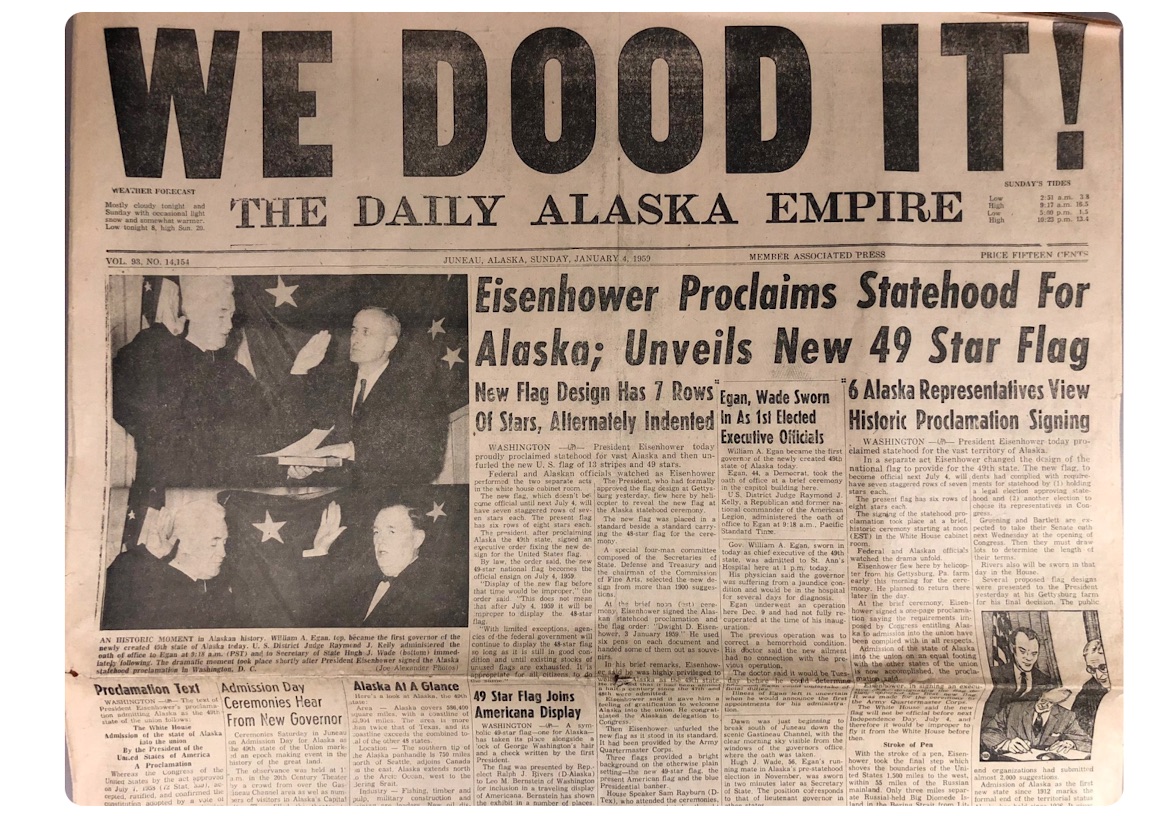
On a pivotal day in American history, January 3, 1959, Alaska officially became the 49th state of the United States of America. The president who signed the proclamation admitting the vast northern territory into the Union was Dwight D. Eisenhower. As the 34th President of the United States, Eisenhower’s tenure saw significant national and international developments, and the incorporation of Alaska stood as a testament to the nation’s westward expansion and growing strategic interests.
The journey to statehood for Alaska was a protracted one, spanning decades of advocacy, political maneuvering, and a deep-seated desire for self-determination among its residents. Eisenhower’s signing of the Alaska Statehood Act on July 7, 1958, followed by the official proclamation months later, marked the culmination of this arduous process. At a time when the Cold War was intensifying, Alaska’s strategic location, bordering the Soviet Union across the Bering Strait, added another layer of urgency and importance to its integration as a full member of the United States. This historical event forever altered the geographical and political landscape of the nation, adding a magnificent, untamed frontier that stands as a landmark of unparalleled natural beauty and historical resilience.
The Long Road to Statehood: A Historical Landmark
The narrative of Alaska’s statehood is a rich tapestry woven with threads of exploration, commerce, geopolitical strategy, and the unwavering spirit of its people. Understanding the historical context leading up to 1959 is crucial to appreciating Alaska’s unique position as a historical and natural landmark.
From Russian America to US Territory
The story begins long before Eisenhower’s presidency. For over a century, Alaska was known as Russian America, a fur-rich outpost of the Russian Empire. However, facing financial difficulties and concerns about potential British expansion, Russia opted to sell its North American holdings. On March 30, 1867, U.S. Secretary of State William H. Seward negotiated the Alaska Purchase for $7.2 million, a sum often derided at the time as “Seward’s Folly” or “Seward’s Icebox.”
Initially administered by the military and later as a civil district, Alaska’s vastness and remote location meant it often languished in neglect. It wasn’t until the Gold Rushes of the late 19th and early 20th centuries, particularly the Klondike Gold Rush, that Alaska’s population swelled and its strategic and economic potential began to be recognized. This influx of people, driven by the promise of mineral wealth, ignited the first serious calls for greater self-governance and representation. In 1912, Alaska was formally organized as an incorporated territory, a significant step but still far from full statehood.
Key Figures and Political Momentum
The momentum for statehood gathered pace in the mid-20th century. Visionary leaders and dedicated citizens tirelessly championed the cause, advocating for the rights and responsibilities that came with being a full member of the United States. Among the most prominent figures was Ernest Gruening, a former territorial governor who became Alaska’s first U.S. Senator. His unwavering advocacy and deep understanding of Alaska’s needs were instrumental. Another key player was E.L. “Bob” Bartlett, Alaska’s delegate to Congress, who worked tirelessly in Washington D.C. to sway political opinion.
A crucial strategic move was the convening of the Alaska Constitutional Convention in Fairbanks from 1955 to 1956. Here, delegates drafted the Alaska Constitution, a forward-thinking document designed to impress Congress with Alaskans’ readiness for self-governance. They also employed the “Tennessee Plan,” a strategy previously used by Tennessee to gain statehood, wherein Alaska elected its congressional delegation and sent them to Washington to demand seats even before statehood was granted. This bold move, coupled with growing national recognition of Alaska’s strategic value, finally led to the passage of the Alaska Statehood Act and President Eisenhower’s momentous signature.

Alaska’s Identity: A Landmark of Untamed Nature and Rich Culture
Alaska’s journey to statehood is not merely a political story; it is inextricably linked to its unparalleled identity as a land of breathtaking natural landmarks and vibrant cultural heritage. Even today, the state evokes images of the “Last Frontier,” a place where wilderness reigns supreme and human history is etched into a dramatic landscape.
Geographical Grandeur and Natural Landmarks
Covering over 663,000 square miles, Alaska is the largest state in the U.S., twice the size of Texas. Its sheer scale and diverse ecosystems make it a natural landmark of global significance. From the towering peaks of the Alaska Range, home to Denali (formerly Mount McKinley), North America’s highest mountain, to the intricate fjords and glaciers of the Inside Passage, Alaska offers a mosaic of natural wonders.
Iconic natural landmarks like the expansive Denali National Park and Preserve, the dynamic Glacier Bay National Park, and the accessible Mendenhall Glacier near Juneau draw millions of visitors annually. These protected areas not only showcase the state’s incredible biodiversity, from grizzly bears and moose to bald eagles and whales, but also preserve vital ecosystems that are increasingly threatened elsewhere. The Arctic tundra, boreal forests, and thousands of miles of coastline all contribute to Alaska’s status as a premier destination for experiencing untouched nature.
Cultural Heritage and Historical Significance
Beyond its natural beauty, Alaska is a living landmark of human resilience and cultural diversity. For thousands of years, indigenous peoples such as the Inupiat, Yupik, Athabascan, Tlingit, Haida, and Tsimshian have thrived in this challenging environment, developing rich traditions, languages, and art forms that continue to shape the state’s identity. Their ancient villages, intricate totem poles, and vibrant cultural centers are invaluable historical landmarks, offering insights into their enduring connection to the land.
The influx of prospectors during the Gold Rushes also left an indelible mark, creating boomtowns like Skagway that today serve as fascinating historical sites, preserving the rough-and-tumble spirit of the era. Later, World War II brought significant military development to Alaska, particularly during the Aleutian Campaign, when Japanese forces occupied islands in the Aleutian chain. The remnants of military installations and battlefields serve as poignant reminders of Alaska’s critical role in national defense. These layers of history, from ancient indigenous cultures to modern geopolitical events, solidify Alaska’s status as a multifaceted landmark.

The Legacy of Statehood: A Modern Landmark
The statehood proclamation signed by President Eisenhower fundamentally transformed Alaska’s future, allowing it to become a modern landmark of economic vitality, environmental stewardship, and strategic importance. With statehood, Alaskans gained full control over their destiny, including the right to manage vast tracts of land and natural resources.
The discovery of massive oil reserves at Prudhoe Bay in 1968, and the subsequent construction of the Trans-Alaska Pipeline System, cemented Alaska’s role as a crucial energy provider for the nation. This monumental engineering feat, stretching over 800 miles, is itself a modern marvel and a landmark of human ingenuity in a challenging environment. Revenue generated from oil has funded public services and established the Alaska Permanent Fund, providing direct dividends to residents and supporting future generations.
Today, Alaska continues to evolve, balancing economic development with a profound commitment to conservation. It remains a strategic outpost, vital for national security and a hub for Arctic research as climate change reshapes the globe. As a state, Alaska is not just a collection of historical sites or natural wonders; it is a dynamic, living landmark that encapsulates the American spirit of exploration, resilience, and the enduring quest to understand and coexist with the wild. Its story, from being purchased as a “folly” to becoming a cornerstone of the United States, is a powerful testament to its unique and invaluable place in the world.
LifeOutOfTheBox is a participant in the Amazon Services LLC Associates Program, an affiliate advertising program designed to provide a means for sites to earn advertising fees by advertising and linking to Amazon.com. Amazon, the Amazon logo, AmazonSupply, and the AmazonSupply logo are trademarks of Amazon.com, Inc. or its affiliates. As an Amazon Associate we earn affiliate commissions from qualifying purchases.