
The Boston Massacre, a name steeped in historical weight, marks a pivotal moment in the lead-up to the American Revolutionary War. More than just a street brawl that escalated into tragedy, it became a symbol of British oppression and colonial resistance, dramatically altering the course of American history. Understanding this event, now memorialized as a significant landmark in Boston, requires delving into the deep-seated tensions that characterized colonial America in the late 1760s. It was a culmination of political, economic, and social frustrations that ignited on a cold winter’s evening, leaving an indelible mark on the collective consciousness of the fledgling nation.
A Crucible of Colonial Tensions
Growing Unrest in Boston
The years following the French and Indian War (or Seven Years’ War) saw a significant shift in the relationship between Great Britain and its American colonies. Despite Britain’s victory, the war had left the empire deeply in debt. To alleviate this financial burden, Parliament began enacting a series of acts designed to raise revenue from the colonies. These included the Sugar Act (1764), the Stamp Act (1765), and the Townshend Acts (1767), which imposed duties on imported goods like glass, lead, paints, paper, and tea.
For the colonists, particularly in politically charged cities like Boston, these acts were a direct violation of their rights as Englishmen, sparking the rallying cry of “no taxation without representation.” They argued that since they had no elected representatives in Parliament, that body had no right to levy taxes upon them. Resistance was widespread, manifesting in boycotts of British goods, protests, and the formation of groups like the Sons of Liberty.
To enforce these increasingly unpopular laws and quell the growing unrest, British troops, derogatorily nicknamed “Redcoats,” were deployed to Boston in 1768. The presence of these soldiers intensified the already palpable friction. Colonists resented the quartering of troops in their homes and public buildings, viewing them as an occupying force. Economically, soldiers competed with local laborers for jobs during their off-duty hours. Culturally and religiously, the Protestant colonists often viewed the Anglican British soldiers with suspicion. Incidents of harassment, minor scuffles, and verbal confrontations between soldiers and townspeople became commonplace, creating an explosive atmosphere where a minor spark could ignite a conflagration.
The Fatal Encounter on King Street
The Evening of March 5, 1770
The stage for the tragedy was set on the cold, snowy evening of March 5, 1770. It began innocuously enough with a lone British sentry, Private Hugh White, stationed outside the Custom House on King Street (now known as State Street). An argument erupted between Private White and a young wigmaker’s apprentice, Edward Garrick, who claimed a British officer had not paid his master. The verbal exchange quickly drew a crowd of colonists who began to heckle and harass the sentry, pelting him with snowballs, ice, and other debris.
The situation rapidly escalated. The sound of church bells began to ring, a signal that usually meant fire, drawing more citizens into the street, swelling the agitated crowd around Private White. Fearing for his safety and outnumbered, Private White called for reinforcements. In response, Captain Thomas Preston arrived on the scene with a small detachment of eight soldiers, marching with fixed bayonets to protect the sentry and the Custom House. They formed a semi-circle in front of the building, facing the increasingly hostile mob.
Shots Fired
The scene became chaotic. The crowd, estimated to be several hundred strong, pressed closer, shouting insults, taunts of “Fire! Fire!” and dares. They continued to throw objects at the soldiers, who were reportedly hit by snowballs, oyster shells, and chunks of ice and wood. Accounts differ on the precise sequence of events. Many colonists later testified that Captain Preston never gave an order to fire. However, amidst the confusion and clamor, one of the soldiers, Private Hugh Montgomery, was reportedly struck by a thrown object and discharged his musket.
This single shot was the catalyst. Whether in panic, self-defense, or believing a command had finally been given, other soldiers in the detachment also began to fire into the crowd. The smoke cleared to reveal a horrifying sight: five colonists lay dead or dying on the cobblestone street. The first to fall was Crispus Attucks, a runaway slave of African and Native American descent, often recognized as the first casualty of the American Revolution. Others killed were James Caldwell, a sailor; Patrick Carr, an Irish immigrant; Samuel Gray, a rope maker; and Samuel Maverick, a seventeen-year-old apprentice. Six more colonists were wounded. The “massacre” instantly transformed the escalating tensions into a bloody reality, deeply shocking the colony and reverberating across the Atlantic.

Propaganda, Trials, and Public Opinion
The Power of Imagery
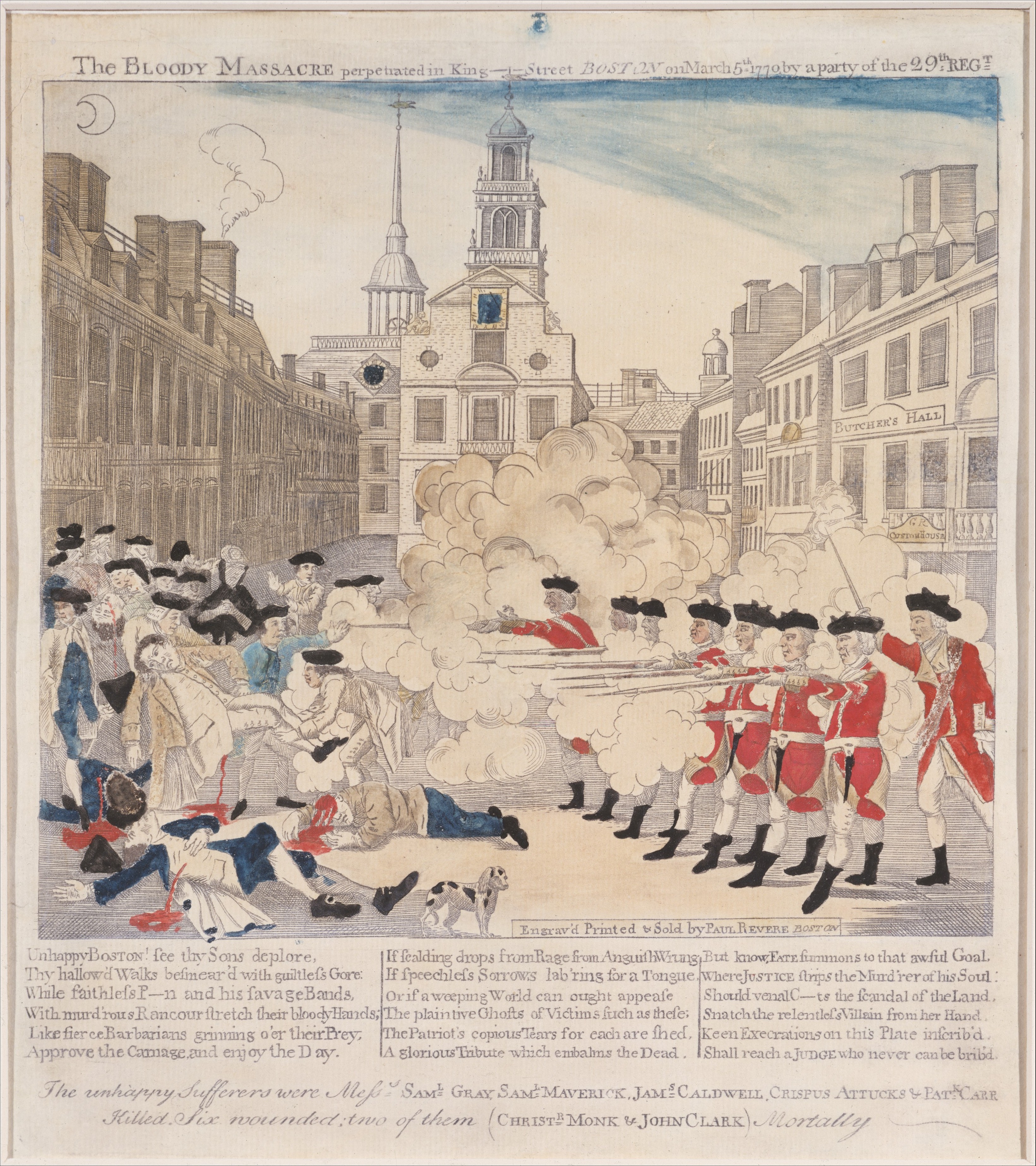
In the immediate aftermath, the Sons of Liberty and other patriot groups seized upon the event as a powerful tool for propaganda. The term “Boston Massacre” itself was a deliberate choice, intended to emphasize the brutality of the British soldiers and frame the incident as an unprovoked slaughter of innocent civilians. The most enduring piece of propaganda was an engraving by silversmith and patriot Paul Revere, titled “The Bloody Massacre in King Street.”
Revere’s depiction was highly influential yet wildly inaccurate. It showed British soldiers, under the command of a seemingly callous officer, firing an organized volley into a defenseless crowd. The engraving omitted the unruly mob, the thrown projectiles, and the general chaos that characterized the event, presenting a clear narrative of British tyranny. Despite its factual liberties, the print was widely circulated, fueling anti-British sentiment across the colonies and galvanizing public opinion against imperial rule. It served as a powerful visual testament to the perceived injustices inflicted upon the colonists.
The Quest for Justice
In an extraordinary turn of events, Captain Preston and his eight soldiers were arrested and charged with murder. Fearing a complete breakdown of law and order and believing in the fundamental right to a fair trial, two prominent patriots and lawyers, John Adams and Josiah Quincy II, agreed to defend the British soldiers. Their decision was courageous and deeply unpopular, earning them scorn from many colonists, but they upheld the principles of justice and due process, even for their adversaries.
The trials, held in Boston in late 1770, were meticulously documented. John Adams famously argued that facts were “stubborn things,” and presented evidence suggesting the soldiers had fired in self-defense or under extreme provocation. After extensive testimony, Captain Preston was acquitted, as there was insufficient evidence to prove he had given the order to fire. Six of the eight soldiers were also acquitted. Two soldiers, Hugh Montgomery and Matthew Kilroy, were found guilty of manslaughter. Their punishment was a branding on the thumb, a relatively lenient sentence that reflected the complexities and uncertainties of the event. While the legal outcomes were seen as fair by some, the court of public opinion had already rendered its verdict, solidified by Paul Revere’s iconic, inflammatory image.
A Pivotal Landmark in American History
Fueling the American Revolution
Although the immediate political tensions in Boston subsided somewhat after the trials and the temporary withdrawal of British troops, the Boston Massacre remained a potent symbol. It transcended being merely a local incident; it became a powerful narrative in the ongoing struggle for colonial rights and self-governance. For many colonists, it was undeniable proof of British tyranny and the lengths to which the Crown would go to suppress dissent.
The incident deepened the ideological divide between the American colonies and Great Britain, contributing significantly to the growing sense of an “American” identity distinct from that of the mother country. It served as a rallying cry for patriots like Samuel Adams and the Sons of Liberty, who used its memory to continually remind colonists of the dangers of standing armies and unchecked imperial power. Every anniversary of the Boston Massacre was commemorated with speeches and publications, reigniting the flame of revolutionary fervor and directly influencing events like the Boston Tea Party just a few years later. It solidified the determination of many colonists to resist oppressive policies and ultimately paved the way for the Declaration of Independence and the subsequent American Revolutionary War. The “massacre” became etched into the national memory as a foundational moment of American liberty and defiance.

The Boston Massacre Site Today
Today, the site of the Boston Massacre is a powerful historical landmark, an essential stop on Boston’s famous Freedom Trail. Located in downtown Boston, directly in front of the historic Old State House, a cobblestone circle marks the precise spot where the tragic event unfolded. The Old State House itself is a landmark of immense significance, having served as the seat of colonial government and the focal point of much of the revolutionary agitation.
Visiting the site offers a tangible connection to this pivotal moment in history. Standing on the cobblestones, visitors can imagine the tension, the shouts, and the fatal shots that echoed through King Street over 250 years ago. The site serves not only as a memorial to the five men who died but also as a reminder of the complex forces that lead to revolution. It highlights the importance of civil liberties, the dangers of political extremism, and the enduring quest for justice. As a landmark, it provides invaluable educational insight, encouraging reflection on the sacrifices made for the freedoms enjoyed today and underscoring how a single, tragic event can forever alter the course of a nation.
LifeOutOfTheBox is a participant in the Amazon Services LLC Associates Program, an affiliate advertising program designed to provide a means for sites to earn advertising fees by advertising and linking to Amazon.com. Amazon, the Amazon logo, AmazonSupply, and the AmazonSupply logo are trademarks of Amazon.com, Inc. or its affiliates. As an Amazon Associate we earn affiliate commissions from qualifying purchases.