
The story of how the United States acquired California is a complex narrative woven through geopolitical ambitions, military conflict, and demographic shifts, ultimately culminating in one of the most significant territorial expansions in American history. This acquisition was not a simple transaction but rather the result of decades of growing American interest in the Pacific and a direct consequence of the Mexican-American War. Understanding this pivotal period sheds light on the origins of modern California and its profound historical landmarks.
The Spanish and Mexican Eras: A Distant Frontier
Before becoming a jewel in the American crown, California existed for centuries as a sparsely populated, remote outpost of colonial empires. From the late 18th century, the region known as Alta California was under the dominion of Spain. Spanish colonization efforts were primarily driven by a desire to secure their northern frontiers against potential Russian and British incursions, rather than economic exploitation of the kind seen in central Mexico or South America.

Mission System and Presidios
The Spanish established a network of missions, presidios (military garrisons), and pueblos (civilian towns) along the California coast. Landmark institutions like the Mission San Diego de Alcalá and the Presidio of Monterey served as centers for religious conversion, agricultural production, and military control. These sites, now cherished historical landmarks, were integral to the Spanish strategy of assimilation and territorial claim. Native Californian populations were profoundly impacted, often forced into labor and subjected to cultural and religious changes that irrevocably altered their traditional ways of life.
Mexican Independence and Shifting Allegiances
In 1821, Mexico gained independence from Spain, and Alta California became a northern province of the new Mexican Republic. This transition brought significant changes, most notably the secularization of the mission lands. The vast agricultural estates of the missions were broken up and distributed among Mexican citizens, creating large ranchos and a class of wealthy Californio landowners. Key landmarks like the Pío Pico House in Whittier stand today as a testament to the brief but influential era of Mexican California governors and landowners.
Despite its vast territory, Mexican California remained sparsely populated by non-indigenous peoples, with political and economic power concentrated in a few coastal settlements like Los Angeles, Monterey, and San Francisco. This remote character, coupled with growing internal instability within Mexico City, made the region vulnerable to external pressures, particularly from the rapidly expanding United States.
American Expansionism and Manifest Destiny
By the mid-19th century, the concept of Manifest Destiny had taken firm root in American political thought. This belief asserted that the United States was destined to expand its dominion across the North American continent, from the Atlantic to the Pacific. California, with its strategic Pacific coastline and potential for trade with Asia, became a primary target for American expansionists.
Influx of American Settlers
Even while under Mexican rule, American traders and settlers began to trickle into California. Many were drawn by the prospect of land, the fur trade, and the allure of the largely undeveloped frontier. Figures like Jedediah Smith and John C. Frémont led expeditions that mapped vast swathes of the American West, increasing American familiarity and interest in California’s resources and strategic value. These early American residents, often settling in areas like the Sacramento Valley, maintained a distinct cultural identity and frequently chafed under Mexican administration, setting the stage for conflict.
Diplomatic Overtures and Tensions
The United States government, under President James K. Polk, made repeated attempts to purchase California from Mexico. However, Mexico, still smarting from the loss of Texas, consistently refused to sell any more of its northern territories. The strained diplomatic relations, coupled with border disputes in Texas and the growing presence of American settlers in California, created an explosive situation that would soon erupt into open warfare.
The Bear Flag Revolt and the Mexican-American War
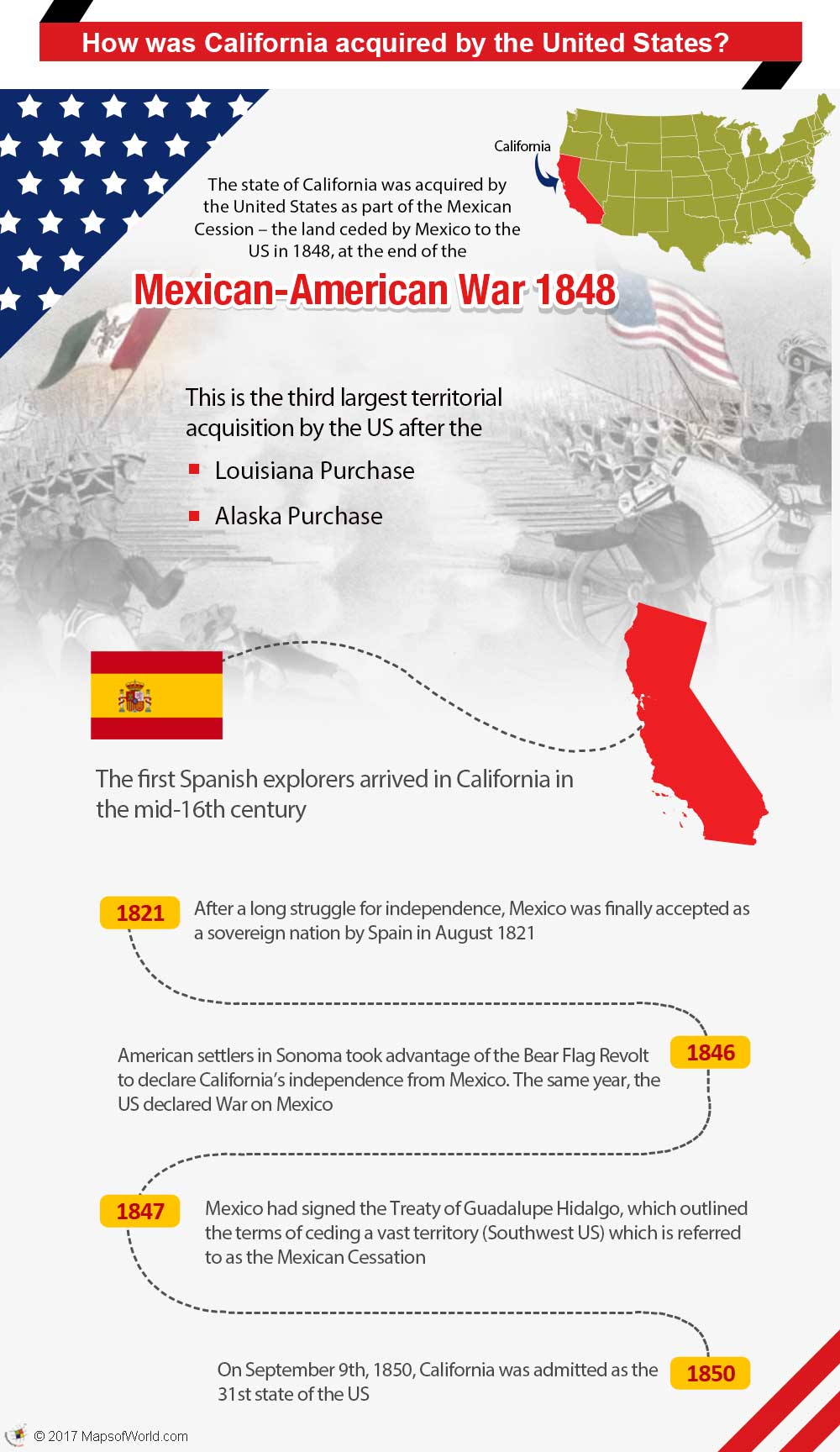
The formal acquisition of California by the United States was a direct consequence of the Mexican-American War, which began in May 1846. Even before official war was declared, events were already unfolding in California that signaled the end of Mexican rule.
The Bear Flag Revolt
In June 1846, a group of American settlers, led by figures such as William B. Ide and supported indirectly by U.S. Army Captain John C. Frémont, launched the Bear Flag Revolt in Sonoma. They captured the Mexican garrison commander, Mariano Guadalupe Vallejo, and declared California an independent republic. They raised a hastily designed “Bear Flag,” featuring a star, a grizzly bear, and the words “California Republic.” The historic Sonoma Plaza and the Mission San Francisco Solano are key landmarks in understanding this brief but symbolic assertion of independence. The revolt was short-lived, as the United States Navy, under Commodore John D. Sloat, officially claimed Monterey for the U.S. just weeks later, effectively absorbing the “Bear Flaggers” into the larger American war effort.
Naval and Land Campaigns
The war in California involved both naval and land campaigns. Commodore Sloat seized Monterey and San Francisco in July 1846, raising the American flag over these crucial ports. Soon after, Commodore Robert F. Stockton arrived and took command, working in conjunction with Frémont’s California Battalion. American forces successfully occupied Los Angeles in August, only to face a determined Californio resistance led by figures like José María Flores. The Californios temporarily regained control of Los Angeles and other southern areas, leading to further engagements.
The decisive battles in California included the Battle of San Pasqual in December 1846, where a contingent of U.S. Army dragoons suffered heavy casualties against Californio lancers, and the Battles of Rio San Gabriel and La Mesa in January 1847, which ultimately secured American control of Los Angeles and effectively ended the organized resistance in California. The Treaty of Cahuenga, signed on January 13, 1847, formally ended hostilities in California, preceding the broader peace treaty.
The Treaty of Guadalupe Hidalgo and Statehood
The conclusion of the Mexican-American War resulted in the vast territorial expansion for the United States as defined by the Treaty of Guadalupe Hidalgo, signed on February 2, 1848.
Terms of the Treaty
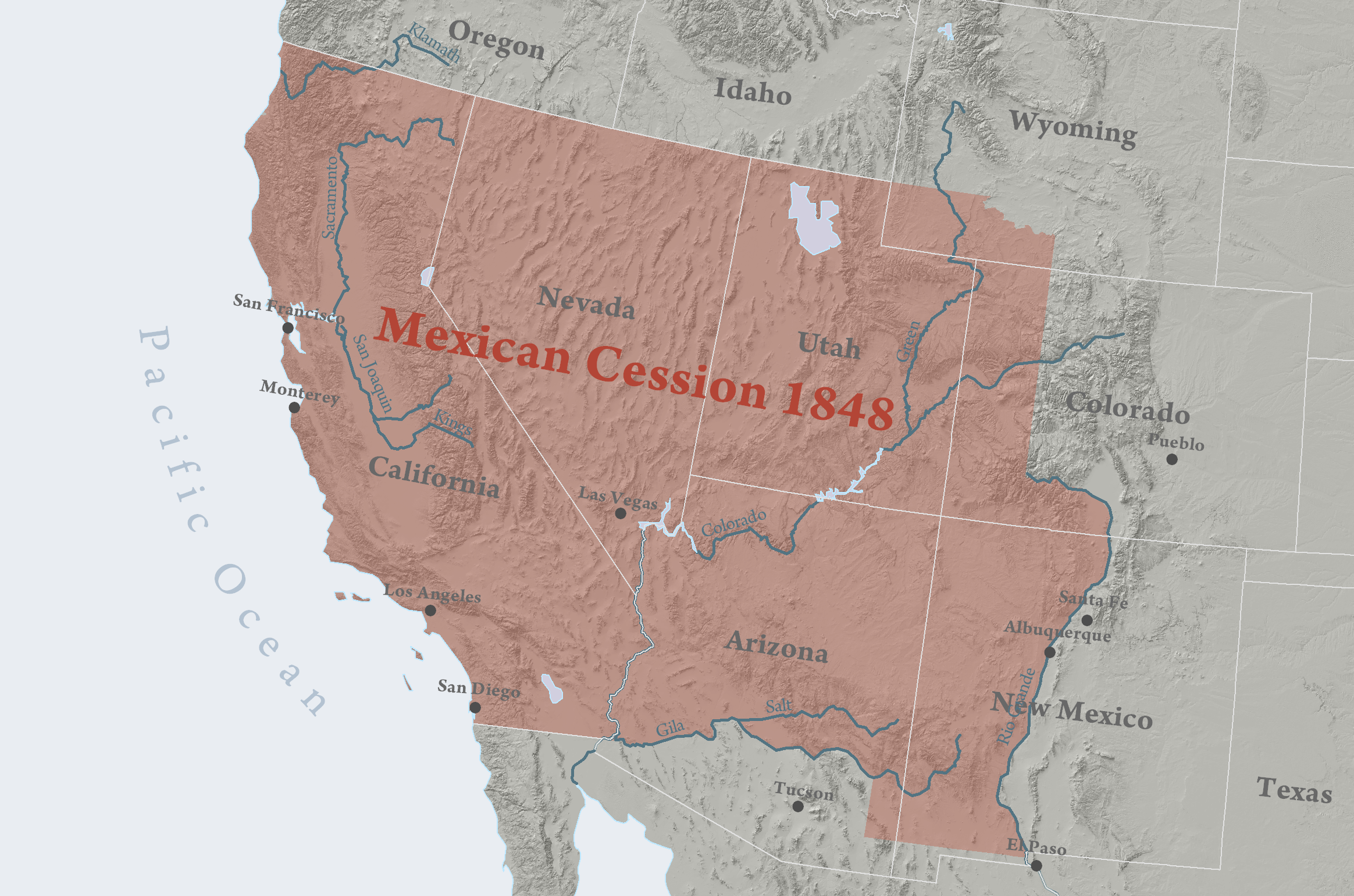
Under the terms of the treaty, Mexico ceded approximately 525,000 square miles of territory to the United States in exchange for $15 million and the assumption of Mexican debts owed to American citizens. This massive acquisition included not only California but also parts of present-day Arizona, Colorado, Nevada, New Mexico, Utah, and Wyoming. The treaty established the present-day boundary between the United States and Mexico.
For the residents of the ceded territories, the treaty offered U.S. citizenship and the protection of their property rights. However, the reality for many Californios and other Mexican citizens often fell short of these promises, as land disputes and cultural clashes persisted for decades.
The Gold Rush and Rapid Statehood
Just days before the signing of the Treaty of Guadalupe Hidalgo, gold was discovered by James W. Marshall at Sutter’s Mill near Coloma on January 24, 1848. This discovery ignited the California Gold Rush, an event of unparalleled significance that triggered an unprecedented influx of people from across the globe into California.
The population explosion and economic boom created an urgent need for stable governance. With its population skyrocketing from an estimated 15,000 non-indigenous residents in 1848 to over 100,000 by 1850, California rapidly bypassed the traditional territorial phase. Amidst fierce national debates over slavery, the Compromise of 1850 allowed California to be admitted to the Union as a free state on September 9, 1850, further cementing its place as an integral part of the United States. From a distant Spanish outpost to a Mexican province, and finally a vibrant American state, California’s acquisition story is a monumental landmark in the tapestry of American history.
LifeOutOfTheBox is a participant in the Amazon Services LLC Associates Program, an affiliate advertising program designed to provide a means for sites to earn advertising fees by advertising and linking to Amazon.com. Amazon, the Amazon logo, AmazonSupply, and the AmazonSupply logo are trademarks of Amazon.com, Inc. or its affiliates. As an Amazon Associate we earn affiliate commissions from qualifying purchases.