
The name “The Five Points” conjures images of a bygone era in New York City – a notorious 19th-century slum, a crucible of poverty, crime, and immigrant dreams immortalized in history books and popular culture. For many travelers exploring the vibrant streets of modern Manhattan, the idea of this infamous neighborhood still existing feels like a compelling historical mystery. Does it remain as a physical entity, a hidden relic of a grittier past, or is it merely a ghost story whispered through the city’s ever-evolving narrative?
As a hub for travel, tourism, and understanding the world’s most fascinating destinations, we often delve into the layered history of places. New York City, in particular, is a metropolis built upon countless forgotten stories, with its landscape constantly shifting to meet the demands of a new age. The area once known as The Five Points is a prime example of this relentless transformation. While the physical streets and ramshackle tenements that defined The Five Points no longer stand, its profound legacy continues to shape the identity, culture, and very foundations of contemporary New York City. This article will journey back in time to understand what The Five Points was, trace its disappearance, and explore how its spirit and historical significance can still be experienced by intrepid travelers and history enthusiasts today.
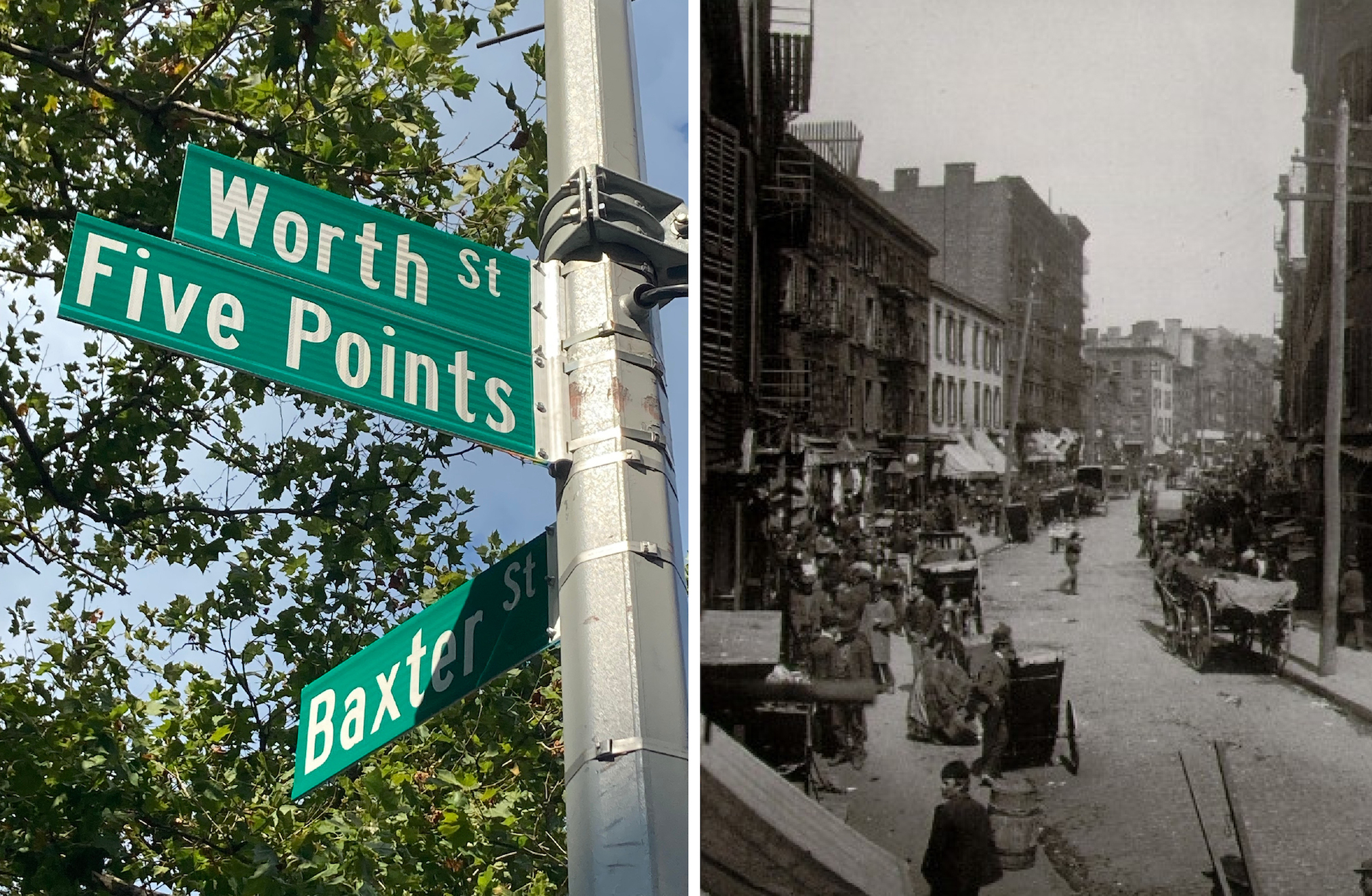
The Ghost of a Bygone Era: What Was The Five Points?
To answer whether The Five Points still exists, one must first understand what it truly was. It wasn’t just a district on a map; it was an epicenter of human struggle, resilience, and urban development, born from a unique geographical quirk and a massive influx of diverse populations.
A Crucible of Cultures and Conflict
The Five Points emerged in the early 19th century on land reclaimed from the infamous Collect Pond, a freshwater lake that had once been a pristine natural feature but became severely polluted as New York City grew. When the pond was filled in the 1810s, the hastily constructed infrastructure led to unstable ground, poor drainage, and conditions ripe for slum development. The notorious intersection that gave the area its name was formed by the convergence of Orange Street (now Baxter Street), Cross Street (now Mosco Street), and Anthony Street (now Worth Street), with a fifth point sometimes attributed to Little Water Street or Mulberry Street. This intersection was a literal hub of chaos.
From the 1820s onward, The Five Points became the primary destination for waves of impoverished immigrants, most notably the Irish fleeing the Great Famine and African Americans, many of whom were freed slaves from the American South. Later, Italian and Jewish immigrants also settled in the surrounding areas. The overcrowding was horrific, with multiple families often sharing single rooms in dilapidated tenements. Disease was rampant, crime flourished, and the area gained a reputation as one of the most dangerous and squalid slums in the Western world. Gangs like the Dead Rabbits and the Bowery Boys fought brutal street battles, a period vividly depicted in popular culture, such as Martin Scorsese’s film “Gangs of New York.”
Despite the destitution, The Five Points was also a place of vibrant cultural exchange and resilience. African American and Irish cultures blended, influencing early forms of tap dance and music. Churches, benevolent societies, and political organizations formed, providing lifelines to those struggling to survive. It was a place where new arrivals grappled with the harsh realities of urban life, worked tirelessly, and contributed to the burgeoning fabric of New York City.
From Infamy to Urban Renewal
The infamous reputation of The Five Points eventually prompted calls for reform and, ultimately, destruction. Efforts to improve living conditions were often met with resistance or proved inadequate against the sheer scale of the problems. By the late 19th and early 20th centuries, as the city began to modernize and develop new public health initiatives, the area became a target for urban renewal.
The city government initiated several phases of slum clearance, tearing down the decrepit buildings and redeveloping the land. The primary goal was to replace the unsanitary and dangerous tenements with more orderly, respectable public buildings, reflecting a progressive era’s vision for a more civilized metropolis. This transformation was not just about sanitation; it was about asserting municipal control and erasing the visual reminders of New York City’s chaotic past. By the mid-20th century, the original configuration of streets and the buildings that defined The Five Points had largely vanished.
Tracing the Footprints: Where Was It and What Stands Today?
If The Five Points no longer exists as a physical neighborhood, where exactly was it, and what can visitors expect to see in its place today? The answer lies in the monumental structures that now dominate this corner of Lower Manhattan.
Locating the Historic Core
The historical heart of The Five Points was roughly bounded by what are now Centre Street to the east, Broadway to the west, Pearl Street to the south, and Canal Street to the north. More precisely, the notorious intersection was located where Worth Street, Baxter Street, and Park Row meet today, very close to the current junction of Mott Street and Mulberry Street.
This area is now part of what is known as the Civic Center district, a dense cluster of government buildings that symbolize the very order and authority that replaced the chaos of The Five Points. When you visit the Civic Center today, you are literally walking over the buried layers of New York City’s past.
Modern-Day Manhattan Above the Past
What replaced the infamous tenements of The Five Points? Today, the landscape is dominated by imposing structures such as the New York County Supreme Court, the Thurgood Marshall United States Courthouse, and the Jacob K. Javits Federal Building. These grand, often classical, edifices stand in stark contrast to the ramshackle shanties they replaced.
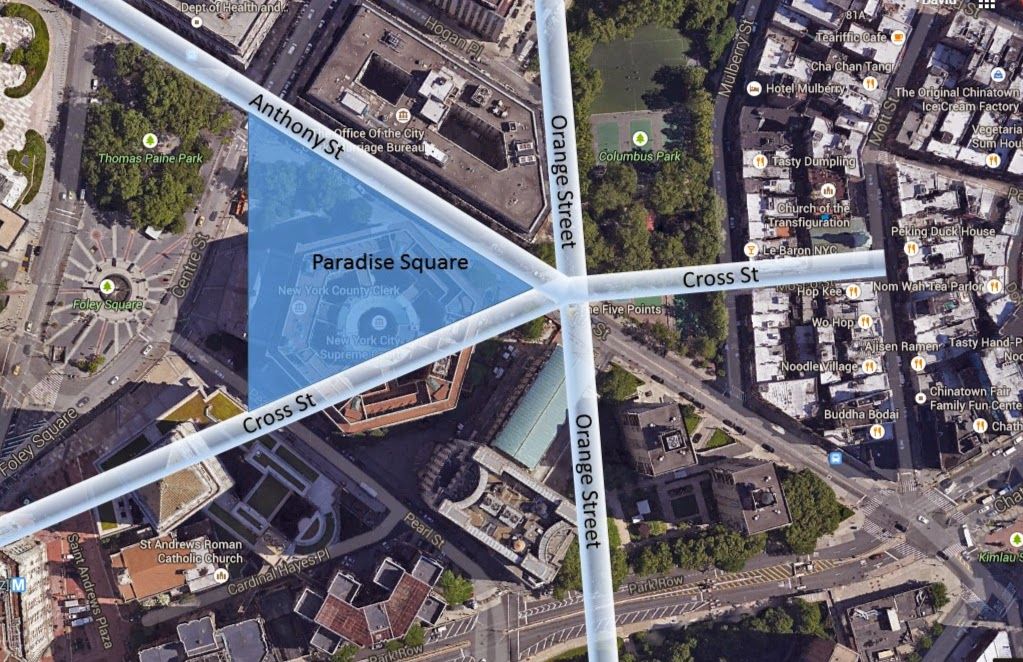
Perhaps one of the most poignant transformations is the creation of Collect Pond Park, a small green space designed to commemorate the historic pond that lay beneath. It’s a quiet oasis amidst the concrete and glass, a subtle nod to the natural feature that inadvertently spawned the city’s most infamous slum. While there are no visible remnants of the original buildings of The Five Points, archaeological excavations, particularly those related to the construction of new government buildings, have unearthed numerous artifacts, providing invaluable insights into the daily lives of its former inhabitants.
Crucially, the nearby African Burial Ground National Monument offers a tangible connection to one of the communities that thrived, and suffered, in this area. Discovered in 1991 during the construction of a federal building, this site revealed the remains of over 400 enslaved and free Africans buried in the 17th and 18th centuries, underscoring the deep and often hidden history of early New York City’s diverse population, some of whom would have certainly been part of the later Five Points community.
Experiencing The Five Points Legacy: Tourism and Culture Today
While The Five Points no longer exists in its physical form, its legacy is very much alive, offering a compelling narrative for visitors interested in urban history, immigration, and social change. Modern tourism guides often highlight this transformation, offering unique experiences.
Historical Tours and Walking Guides
For those eager to connect with the past, several specialized historical walking tours in New York City focus on the former Five Points area and its surrounding neighborhoods. These tours provide maps and historical accounts, guiding participants to the exact locations where notorious events occurred or where significant community centers once stood. Knowledgeable guides use archival images and storytelling to recreate the atmosphere of the 19th century, helping visitors visualize the bustling, chaotic streets and the lives of the people who inhabited them. These experiences are invaluable for understanding the human stories behind the statistics of poverty and crime, offering a nuanced perspective on this critical period in New York history.
Beyond the immediate vicinity of The Five Points, institutions like the Tenement Museum on the nearby Lower East Side offer an immersive look into immigrant life in similar conditions. While not directly about The Five Points, the museum’s preserved apartments and personal stories of immigrant families provide a powerful context for understanding the daily struggles and triumphs experienced by residents of New York City’s historic working-class neighborhoods. It’s a testament to the enduring spirit of communities that built the city from the ground up.
Adjacent Neighborhoods: A Continuing Story
The area immediately surrounding the former Five Points district continues to be vibrant and culturally rich, embodying the ongoing narrative of immigrant life in New York City. Just steps away, you’ll find Chinatown and what remains of Little Italy. These neighborhoods, while distinct from The Five Points, share a common thread: they were also destination points for new arrivals seeking opportunity and community, and they too faced periods of struggle and triumph.
Exploring Chinatown today offers a sensory overload of authentic restaurants, bustling markets, and unique cultural experiences. Visitors can sample diverse cuisines, browse traditional shops, and witness a community that has carved out its own enduring identity. Similarly, what’s left of Little Italy along Mulberry Street still celebrates its Italian American heritage with restaurants and annual festivals, although much of its territory has been absorbed by the expansion of Chinatown. These districts are living examples of how immigrant cultures persist and adapt, providing a continuous narrative to the stories of The Five Points. They remind us that while specific neighborhoods may disappear, the spirit of their communities often finds new homes and expressions.
Planning Your Visit: Accommodation and Lifestyle in Historic Downtown
For those drawn to the rich history of Lower Manhattan and the legacy of The Five Points, planning a trip offers a blend of historical exploration, cultural immersion, and modern luxury.
Where to Stay: Hotels Near the Historic Heart
While you won’t find hotels directly in the historical footprint of The Five Points, the surrounding areas of Lower Manhattan, the Financial District, and Tribeca offer an array of accommodation options. These neighborhoods put you within easy walking distance or a short subway ride of the Civic Center and the vibrant streets of Chinatown and Little Italy.
For those seeking luxury travel, properties like The Beekman, a Thompson Hotel in the Financial District offer opulent stays in a stunning historic building, blending Victorian-era elegance with contemporary design. Its grand atrium and proximity to major attractions make it an excellent base. Another top-tier choice is the Four Seasons Hotel New York Downtown, offering unparalleled service and sophisticated accommodations in Tribeca, a short stroll from the former Five Points area.
For boutique hotel experiences or more budget-conscious travelers, there are numerous options in Chinatown and the Lower East Side that provide an authentic local immersion. Consider stylish apartments or suites available through various booking platforms for a longer-term stay, allowing you to truly live like a local and explore the intricate layers of these historic districts at your own pace. Many hotels in Lower Manhattan also boast amenities like rooftop bars with stunning skyline views, a perfect way to reflect on the city’s incredible evolution.
Lifestyle Explorations: Beyond the History Books
Visiting the legacy of The Five Points is more than just a historical excursion; it’s an opportunity to engage with the broader lifestyle and cultural tapestry of New York City. After delving into the somber history of The Five Points and the resilience of its inhabitants, you can easily shift gears to enjoy the diverse culinary scene in Chinatown, explore the vibrant art galleries of Tribeca, or immerse yourself in the dynamic energy of the Financial District.
Understanding The Five Points allows for a deeper appreciation of the modern city – its progress, its challenges, and its ongoing capacity for reinvention. It encourages a form of responsible tourism where visitors don’t just consume attractions but engage with the stories that shaped them. Whether you’re interested in luxury travel or a more budget-friendly adventure, incorporating this historical context enriches your New York City experience, transforming a simple sightseeing trip into a profound journey through time and culture.
In conclusion, while the physical structures of The Five Points have long been replaced by the gleaming modernity of the Civic Center, the spirit of this legendary neighborhood unequivocally still exists in New York City. It lives in the archaeological remnants beneath the streets, in the ongoing narratives of immigrant communities in nearby Chinatown and Little Italy, and most importantly, in the collective memory of a city that constantly redefines itself while carrying the weight and glory of its past. For any traveler passionate about history, culture, and the evolution of urban landscapes, a journey to uncover the legacy of The Five Points is an essential and deeply rewarding experience.
LifeOutOfTheBox is a participant in the Amazon Services LLC Associates Program, an affiliate advertising program designed to provide a means for sites to earn advertising fees by advertising and linking to Amazon.com. Amazon, the Amazon logo, AmazonSupply, and the AmazonSupply logo are trademarks of Amazon.com, Inc. or its affiliates. As an Amazon Associate we earn affiliate commissions from qualifying purchases.