
The story of how the United States came to possess the Hawaiian Islands is a complex tapestry woven with threads of international politics, economic ambition, and cultural upheaval. While many envision a straightforward annexation, the reality is a much more nuanced and, for many, a painful historical narrative. This journey from an independent Polynesian kingdom to an American state is a pivotal chapter in American history and a significant event for the indigenous Hawaiian people. Understanding this acquisition requires delving into the escalating influence of American business interests, the shifting geopolitical landscape of the late 19th century, and the persistent aspirations of Native Hawaiians for self-governance.
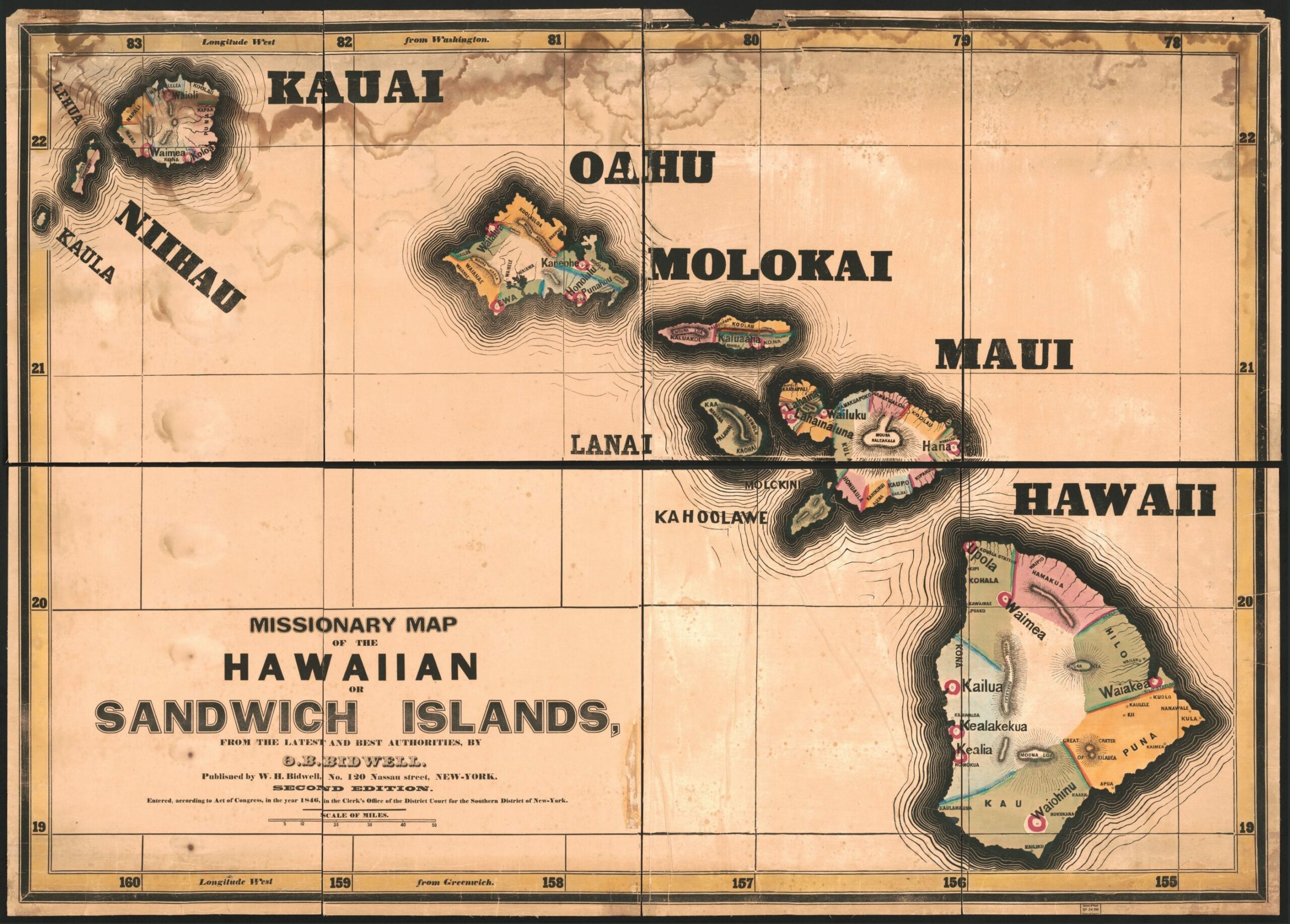
The pristine, strategically located archipelago of Hawaii had long captivated the attention of global powers. For centuries, Native Hawaiians had thrived, developing a sophisticated society with unique traditions, language, and a deep spiritual connection to their land. European contact, beginning with Captain James Cook in the late 18th century, introduced new diseases and drastically altered the course of Hawaiian history. However, it was the arrival of American missionaries and businessmen in the 19th century that laid the groundwork for the eventual annexation.
The Growing Influence of American Interests
The 19th century witnessed a dramatic surge in American economic and cultural influence in Hawaii. Missionaries, arriving in the early 1800s, played a dual role. While they brought Christianity and Western education, they also introduced a new social order and subtly eroded traditional Hawaiian customs and governance. More overtly, American businessmen, particularly those involved in the burgeoning sugar industry, began to amass significant economic power. The fertile volcanic soil of Hawaii proved ideal for sugar cultivation, and American planters established vast plantations, importing labor from across the globe.
The Sugar Industry and Economic Leverage
The economic engine driving American ambition in Hawaii was undoubtedly sugar. By the mid-19th century, Hawaiian sugar commanded a privileged position in the American market, largely due to reciprocal trade agreements. These agreements, particularly the Reciprocity Treaty of 1875, allowed Hawaiian sugar to enter the United States duty-free, a significant advantage that boosted the industry’s profitability. In return, the United States secured exclusive rights to Pearl Harbor for naval purposes, a strategic move that would have profound implications later.
This economic dependence created a powerful lobby of American sugar barons who increasingly dictated Hawaiian policy. They advocated for closer ties with the United States, seeing annexation as the ultimate way to secure their financial interests and eliminate any potential threat to their dominance. The Hawaiian monarchy, led by monarchs like King Kalākaua, found themselves in an increasingly precarious position, caught between the demands of their Native Hawaiian subjects and the formidable economic clout of American planters. King Kalākaua, in particular, sought to assert Hawaiian sovereignty and strengthen ties with other Asian and Pacific nations, a move that was viewed with suspicion by the American business community.
The Overthrow of the Monarchy
The friction between the desire for American annexation and Hawaiian sovereignty reached a breaking point in the early 1890s. The McKinley Tariff of 1890 in the United States eliminated the duty-free status of Hawaiian sugar, significantly impacting the profitability of the plantations. This economic blow further galvanized the American business elite and their allies in Hawaii to push for annexation, believing it was the only way to restore economic stability and ensure their continued prosperity.
The Committee of Safety and the Coup
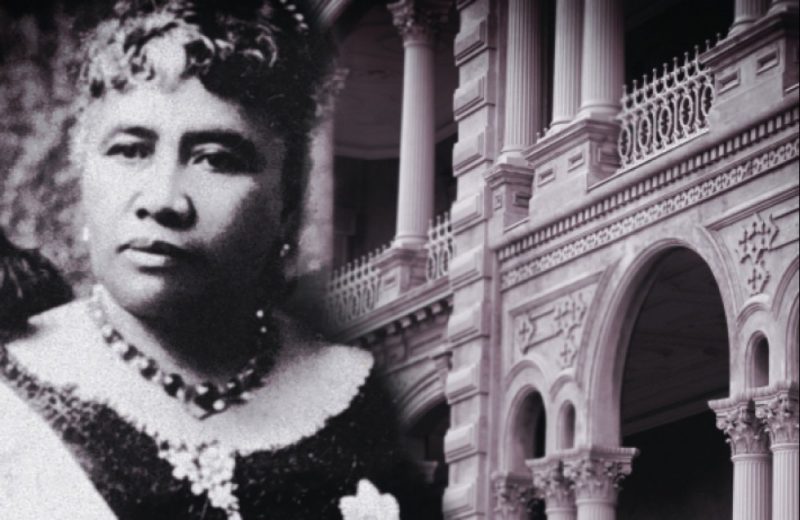
In January 1893, a group of primarily American businessmen and their supporters, calling themselves the Committee of Safety, orchestrated a coup d’état against Queen Liliuokalani, the reigning monarch. Queen Liliuokalani had ascended to the throne in 1891 and was actively working to draft a new constitution that would restore power to the monarchy and disenfranchise the foreign-born population, particularly the American planters. Her attempts to reform the political system were seen as a direct threat by those who favored annexation.
With the support of the United States Minister to Hawaii, John L. Stevens, and the landing of United States Marines from the USS Boston, the Committee of Safety was able to depose Queen Liliuokalani without significant bloodshed. Stevens’s intervention is a highly controversial aspect of the overthrow, as it clearly signaled American government support for the anti-monarchy faction. The Queen, recognizing the futility of resisting the armed U.S. forces, yielded her throne under protest, stating, “I yield to the superior force of the United States of America.” This act, however, was not an abdication but a temporary concession to prevent further violence.
A Provisional Government was immediately established, led by Sanford B. Dole, a U.S.-born lawyer and businessman. This provisional government, largely composed of American interests, declared its intention to seek annexation by the United States. The subsequent period was marked by political maneuvering and protests from Native Hawaiians, who largely opposed the annexation and continued to advocate for their sovereignty.
The Annexation and Statehood
The path to formal annexation was not immediate or without opposition. The initial annexation treaty, signed in 1893 under President Benjamin Harrison, was withdrawn by his successor, President Grover Cleveland, who viewed the overthrow of the monarchy as illegal and unjust. Cleveland launched an investigation and concluded that the United States had indeed acted improperly. He even attempted to restore Queen Liliuokalani to her throne, but the Provisional Government, backed by the powerful American business interests, refused to relinquish power.
The Joint Resolution of Annexation
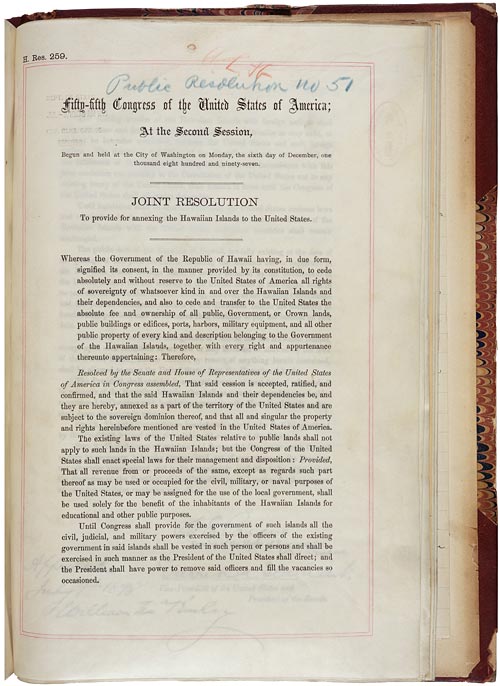
It wasn’t until the Spanish-American War in 1898, when the strategic importance of Hawaii as a coaling station and naval base became paramount, that annexation was finally pushed through. Under President William McKinley, the United States abandoned the treaty process and instead opted for a joint resolution of Congress. This bypassed the need for a two-thirds Senate majority required for a treaty and was ultimately approved in July 1898. Hawaii was officially annexed as a territory of the United States.
For decades, Hawaii remained a U.S. territory. The indigenous Hawaiian population continued to struggle for recognition and rights, facing social and economic marginalization. The powerful American business interests that had driven the annexation continued to dominate the islands’ economy and politics.
The Path to Statehood
The desire for statehood grew over the years, fueled by the hope that it would grant Native Hawaiians greater representation and equality within the United States. Following World War II, and after significant advocacy, the push for statehood intensified. Finally, on August 21, 1959, Hawaii was admitted to the Union as the 50th state.
The acquisition of Hawaii remains a complex and often contentious topic. For Native Hawaiians, it represents a profound historical injustice, a violation of their sovereignty and cultural heritage. For the United States, it marked a significant expansion of its territory and a pivotal moment in its rise as a global power. Today, Hawaii is a popular tourist destination, renowned for its stunning natural beauty, vibrant culture, and luxurious resorts. Visitors flock to experience its unique attractions, from the historic sites of Pearl Harbor to the breathtaking landscapes of Maui and the surfing mecca of Oahu. However, as travelers explore this paradise, it is crucial to remember the rich and often tragic history that shaped its present, a history that continues to influence the lives and aspirations of the Hawaiian people. The legacy of the overthrow and annexation is a vital part of understanding the soul of these islands, a reminder that beneath the sun-drenched beaches and swaying palm trees lies a story of nationhood, resistance, and the enduring spirit of the Hawaiian people.