
Texas, the Lone Star State, conjures images of vast open spaces, vibrant cities, and a distinct cultural identity forged from a dramatic past. From the bustling streets of Houston to the historic charm of San Antonio and the live music scene in Austin, modern Texas offers an incredible array of experiences for travelers. Yet, to truly understand the spirit of this remarkable state and appreciate its unique blend of Mexican, Spanish, and American influences, one must delve into the compelling story of how it came to be part of the United States. It’s a tale of ambition, revolution, independence, and political maneuvering that left an indelible mark on North America and shaped the destiny of millions.
The journey of Texas into the U.S. Union is far more intricate than a simple territorial acquisition. It involved a clash of cultures, competing geopolitical interests, and the heroic, sometimes tragic, struggles of pioneers and patriots. This historical narrative not only explains the present-day demographics and cultural tapestry of Texas but also points to numerous historical landmarks and attractions that draw visitors from around the globe. For anyone planning a trip to this magnificent state, understanding its formative years offers a richer, more meaningful travel experience, connecting them directly to the very soil that witnessed these pivotal events.
From Distant Outpost to Revolutionary Heartbeat: Early Influences on Texas
The land that would become Texas was initially a vast and sparsely populated frontier, a crossroads of indigenous cultures long before European arrival. Its strategic location, bordering both the expanding United States and the heart of Mexico, destined it for a turbulent future.
Early Spanish Explorers and Missions
The first European claims to Texas came from Spain in the 16th century. Explorers like Álvar Núñez Cabeza de Vaca traversed its landscapes, followed by missionaries and soldiers who established a chain of missions and presidios in the 17th and 18th centuries. These outposts, such as the famous Mission San Antonio de Valero (later known as the Alamo), were intended to convert indigenous populations, solidify Spanish control, and serve as buffers against encroachment from French Louisiana.
Life in these early Spanish settlements was challenging, marked by isolation, disease, and conflicts with native tribes like the Comanche and Apache. Despite these hardships, the Spanish left an enduring legacy in Texas, seen in its architecture, legal system, cattle ranching traditions, and many place names. Travelers can explore the impressive chain of San Antonio Missions National Historical Park, a UNESCO World Heritage Site, which offers a tangible link to this foundational era. Walking through these historic grounds provides a profound sense of the resilience and ambition of these early pioneers.
Mexican Independence and American Settlement
As the 19th century dawned, political changes far from Texas began to reshape its future. In 1821, Mexico won its independence from Spain, inheriting the vast, largely undeveloped territory of Texas. Simultaneously, the United States, fueled by westward expansion and the concept of Manifest Destiny, was eyeing the lands to its west. The Louisiana Purchase in 1803 had already doubled the size of the U.S. and brought its border closer to Texas, creating a sense of inevitability about future American presence.
The newly independent Mexican government, seeking to develop its northern frontier and provide a buffer against Native American raids, adopted a liberal immigration policy. This opened the door for Anglo-American settlers. The most prominent of these empresarios was Stephen F. Austin, who in 1821, with permission from the Mexican government, led the first significant wave of American colonists to Texas. These early settlers, famously known as the “Old Three Hundred,” pledged allegiance to Mexico, converted to Catholicism (at least nominally), and brought with them their own cultural traditions, including a strong desire for self-governance.
By the mid-1830s, the number of Anglo-American settlers, drawn by cheap land and the promise of a new life, vastly outnumbered the native Mexican population (Tejanos). This demographic shift, coupled with growing cultural differences and political instability in Mexico City, set the stage for conflict. The Mexican government, increasingly concerned about losing control of Texas, began to enact stricter laws, including the abolition of slavery (which many American settlers relied upon for their cotton plantations) and restrictions on further immigration. These tensions simmered, eventually boiling over into a full-scale revolution.
The Fires of Revolution: The Birth of a Republic
The simmering discontent between the American settlers in Texas and the Mexican government erupted into open rebellion in 1835. What began as protests against centralized rule and taxation quickly escalated into a fight for independence, forever altering the destiny of the region.
Seeds of Discontent and Early Clashes
The catalyst for the Texas Revolution was the rise of General Antonio López de Santa Anna to power in Mexico. Santa Anna repealed the liberal Constitution of 1824 and established a centralized, authoritarian government, which was seen as a direct threat to the autonomy enjoyed by the Texas colonists. A series of conventions held by the Texans attempted to address their grievances, seeking greater self-rule within Mexico, but these efforts ultimately failed.
The first shots of the revolution were fired in October 1835 at the Battle of Gonzales, where Texans famously flew a flag emblazoned with a cannon and the words “Come and Take It,” daring the Mexican army to retrieve a small cannon they had provided for defense against Native Americans. This initial skirmish ignited a full-blown insurgency, attracting volunteers from the United States and galvanizing the Texans’ resolve for independence.
The Alamo, Goliad, and the Spirit of Sacrifice
The revolution’s most iconic and tragic events occurred in early 1836. General Santa Anna personally led a massive Mexican army north to crush the rebellion. His first major objective was San Antonio, where a small force of Texans, including legends like William B. Travis, Davy Crockett, and Jim Bowie, fortified themselves within the Alamo mission. For 13 days, these defenders, vastly outnumbered, held off Santa Anna’s forces. The Battle of the Alamo, ending on March 6, 1836, with the deaths of all Texan combatants, became a powerful symbol of courage and sacrifice. Today, the Alamo stands as one of Texas’s most visited landmarks, a poignant memorial to those who died for freedom.
Just weeks later, another horrific event unfolded at Goliad. Colonel James Fannin and his Texan forces, after surrendering to Mexican troops, were massacred on Santa Anna’s orders. These twin tragedies, though devastating, galvanized the Texan cause. The cries of “Remember the Alamo!” and “Remember Goliad!” became rallying calls, igniting a fierce determination among the remaining Texan forces.
San Jacinto and the Birth of a Republic
Despite the early setbacks, the Texans found their leader in Sam Houston, a former Tennessee governor and protégé of Andrew Jackson. Houston strategically retreated, drawing Santa Anna’s forces deeper into Texas. On April 21, 1836, Houston’s army launched a surprise attack on Santa Anna’s encamped troops near the San Jacinto River. The ensuing Battle of San Jacinto was a decisive victory for the Texans, lasting only 18 minutes. Santa Anna was captured, and with his capture, Mexico’s efforts to reclaim Texas effectively ended.
The Republic of Texas was formally declared on March 2, 1836, at Washington-on-the-Brazos, even as the Alamo siege was underway. With independence secured at San Jacinto, Sam Houston became the republic’s first elected president, ushering in nearly a decade of independent statehood. The San Jacinto Monument and Battleship Texas State Historic Site near Houston commemorate this pivotal moment, offering breathtaking views and immersive historical insights for visitors.
The Republic Years and the Path to Annexation
For almost ten years, from 1836 to 1845, Texas existed as an independent nation, the Republic of Texas. This period was marked by ongoing challenges, a distinct national identity, and an ever-present question: would Texas remain independent or join the growing United States?
Governing a New Nation
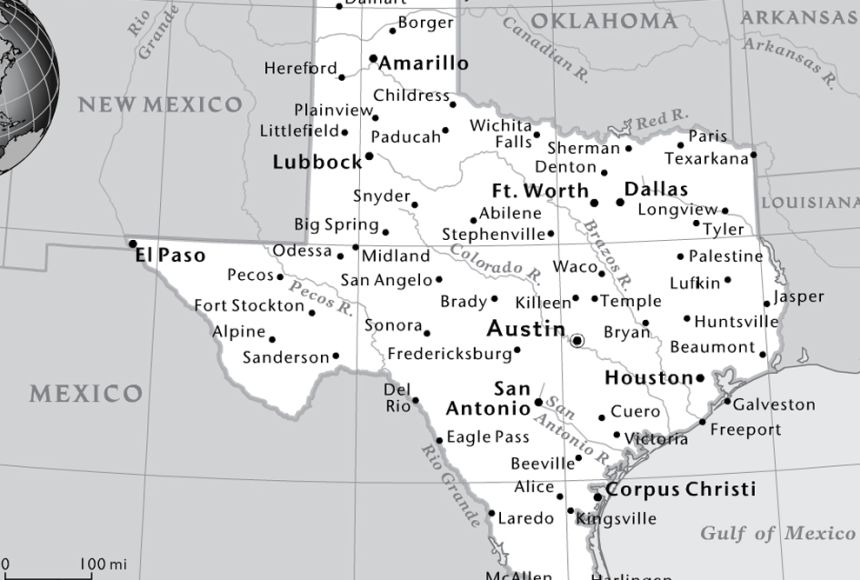
Establishing a functioning government for the young republic was no small feat. Under presidents like Sam Houston and Mirabeau B. Lamar, Texas faced a multitude of issues. Financial stability was a constant struggle, with the republic frequently on the verge of bankruptcy. Relations with Mexico remained hostile, as Mexico City refused to officially recognize Texas’s independence. Border skirmishes were common, particularly along the disputed territory south of the Nueces River, which Texas claimed, but Mexico did not.
Furthermore, conflicts with Native American tribes, especially the formidable Comanche and Cherokee, were prevalent. Lamar’s aggressive policies led to significant warfare, while Houston pursued more conciliatory approaches. Despite these challenges, the republic began to lay the foundations of a unique Texan identity, one fiercely independent and proud. The state capital eventually settled in Austin, a city that still embodies much of that independent spirit today.
The Quest for Annexation
From its inception, the idea of annexation by the United States was a dominant theme in Texan politics. Many of the American settlers had come to Texas with the expectation of becoming part of the U.S., and the republic’s presidents, particularly Sam Houston, actively pursued this goal.
However, annexation was a contentious issue within the United States itself. The primary obstacle was slavery. Texas was a slave-holding territory, and its admission as a slave state would upset the delicate balance of power between free and slave states in the U.S. Congress. Northern abolitionists vehemently opposed annexation, fearing it would expand the institution of slavery. Concerns about provoking a war with Mexico also made many wary.
For several years, the United States hesitated, despite the Texans’ repeated requests. This period of delay left Texas in a precarious position, struggling economically and vulnerable to Mexican threats. Some considered aligning with Great Britain or France for protection, adding another layer of geopolitical complexity to the situation.
Annexation and the Mexican-American War: Texas Joins the Union
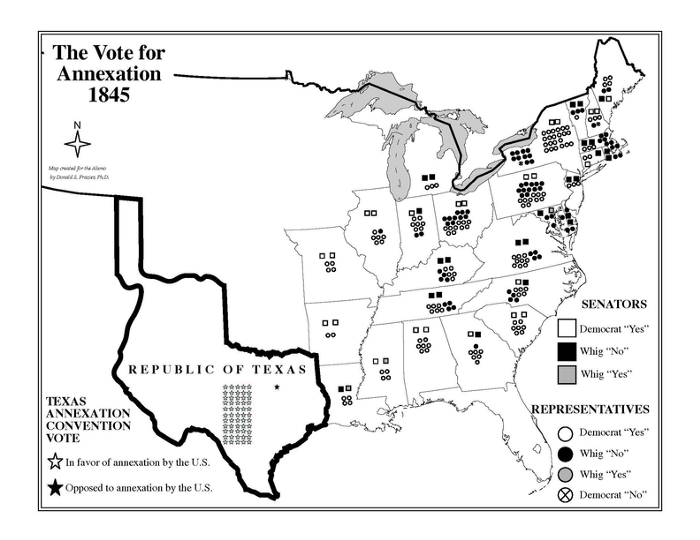
The debate over Texas annexation reached a fever pitch in the United States during the 1844 presidential election. The outcome of that election, coupled with a shifting political landscape, finally paved the way for Texas to become the 28th state.
The Road to Statehood
The election of James K. Polk, a staunch advocate for westward expansion and Manifest Destiny, signaled a clear change in U.S. policy. Polk’s victory was interpreted as a mandate for annexation. Before Polk even took office, outgoing President John Tyler, seizing the moment, pushed a joint resolution through Congress to offer Texas statehood.
On December 29, 1845, after the citizens of the Republic of Texas voted overwhelmingly in favor, Texas formally joined the United States. The last president of the Republic of Texas, Anson Jones, famously declared, “The great drama is ended.” The annexation was a triumph for American expansionists and a fulfillment of the Texans’ long-held desire. However, it came at a significant cost, as Mexico had warned that it would consider annexation an act of war.
The Mexican-American War and Border Disputes
True to its word, Mexico severed diplomatic relations with the United States shortly after annexation. The central dispute was over the southern border of Texas. Texas, and now the U.S., claimed the Rio Grande as the boundary, while Mexico insisted the border remained the Nueces River, considerably farther north.
President Polk, determined to acquire more western territory, sent troops under General Zachary Taylor into the disputed zone between the two rivers, near present-day Corpus Christi. When Mexican forces attacked American soldiers in April 1846, Polk declared that Mexico had “shed American blood upon American soil,” and the Mexican-American War officially began.
The war lasted for two years, ending with a decisive American victory. The Treaty of Guadalupe Hidalgo, signed in 1848, formally recognized the Rio Grande as the southern border of Texas and ceded vast territories, including California, Nevada, Utah, and parts of Arizona, New Mexico, Colorado, and Wyoming, to the United States. This monumental land acquisition solidified the modern boundaries of the U.S. and cemented Texas’s place within it.
Legacy and Texas Today: A Traveler’s Perspective
The tumultuous history of how the United States acquired Texas has profoundly shaped the state’s culture, landscape, and identity. For today’s traveler, this rich past offers a unique lens through which to explore and appreciate the vibrant present.
Historical Landmarks to Visit
Texas is dotted with incredible landmarks that tell the story of its journey. Beyond the Alamo in San Antonio, visitors can walk the grounds of the San Jacinto Battlefield State Historic Site, where a towering monument commemorates the decisive battle. The San Antonio Riverwalk, while a major tourism attraction today, is nestled among colonial-era missions and buildings, offering a beautiful blend of relaxation and history.
In Washington-on-the-Brazos State Historic Site, you can step back in time to the very birthplace of Texan independence, exploring reconstructed buildings and learning about the drafting of the Texas Constitution. For those interested in the post-annexation period, museums in Austin like the Bullock Texas State History Museum provide comprehensive insights into the state’s broader development. Even exploring the historic districts of cities like Galveston reveals architectural gems from the era when Texas was still finding its feet in the Union.
Cultural Mosaic and Cuisine
The cultural legacy of Texas’s formation is perhaps its most appealing aspect for travelers. The strong Mexican influence is palpable everywhere, from the architecture and language to the incredible culinary scene. Tex-Mex cuisine, a delicious fusion of Mexican and Southern American flavors, is a must-try, with bustling taquerias and upscale restaurants found in every city from Dallas to Fort Worth. The enduring traditions of cowboy culture, born from both Spanish vaqueros and American frontiersmen, are celebrated in rodeos, ranch stays, and Western museums throughout the state.
This unique blend of influences also extends to the vibrant arts and music scenes. From Conjunto music with its polka-infused Mexican rhythms to the blues and country that define much of American music, Texas offers an auditory feast. The hospitality of Texans, a blend of Southern charm and independent grit, makes for a welcoming and memorable travel experience.

Planning Your Texas Adventure
Understanding the complex history of Texas deepens any visit, transforming a simple vacation into an educational journey. When planning your trip, consider incorporating historical tours alongside visits to modern attractions like Space Center Houston or the stunning natural beauty of Big Bend National Park and Guadalupe Mountains National Park.
Whether you’re seeking luxury accommodations in a historic San Antonio hotel, a family-friendly resort on South Padre Island, or a charming bed-and-breakfast near a battlefield, Texas offers diverse options to suit every traveler. By immersing yourself in its history, you’ll not only appreciate the grandeur of its past but also gain a profound understanding of why Texas remains such a fiercely proud and distinct part of the United States today.