
California, the Golden State, a land of dreams and diverse landscapes, conjures images of sun-drenched beaches, towering redwood forests, glitzy Hollywood studios, and fertile agricultural valleys. It’s a destination that draws millions of travelers each year, seeking everything from luxury resorts to budget-friendly road trips, family adventures to sophisticated business stays. But how did this sprawling, iconic territory become the United States’ most populous state? The story of California’s acquisition is a fascinating, complex narrative woven from exploration, conquest, political maneuvering, and a pivotal moment in American history.
The very first Europeans to lay eyes on what is now California were not seeking to claim territory for a nascent nation, but rather to chart new maritime routes. In 1542, Portuguese explorer Juan Rodríguez Cabrillo, sailing under the Spanish flag, became the first European to navigate the coast of present-day California, landing near San Diego. He claimed the land for Spain, naming it Nueva España (New Spain). For centuries, however, Spain‘s presence in California remained minimal, characterized by a series of missions established by Franciscan friars along the coast, starting with Mission San Diego de Alcalá in 1769. These missions, while spreading Spanish influence and culture, were not indicative of a deeply rooted colonial establishment across the vast interior.
From Spanish Rule to Mexican Independence
For over two centuries, California remained a remote outpost of the Spanish Empire. The Mexican War of Independence, which concluded in 1821, brought about a significant shift. Mexico gained its independence from Spain, and California, along with its mission system, became part of the newly formed Mexican Republic. Under Mexican rule, California, known as Alta California, saw a gradual increase in non-Indigenous settlers, primarily Mexicans and a growing number of foreign traders, particularly from the United States and Great Britain.
The Californios, as the descendants of Spanish settlers and Mexicans were known, developed a distinct ranchero culture, centered around vast cattle ranches. The secularization of the missions led to the distribution of their lands, further solidifying this agrarian society. However, Mexican governance in Alta California was often characterized by instability and a lack of strong central authority. This political fragmentation, coupled with the increasing presence of foreign settlers, laid the groundwork for future disputes over sovereignty.
The Bear Flag Revolt and the Mexican-American War
The 1840s proved to be a tumultuous decade for California. Tensions between Mexico and the United States were escalating, fueled by expansionist ambitions in the U.S., particularly the doctrine of “Manifest Destiny.” Many American settlers, who had begun arriving in significant numbers in Alta California, felt disenfranchised by Mexican rule and were increasingly drawn to the idea of joining the United States.
In 1846, a small group of American settlers, with the perceived encouragement of U.S. Army Captain John C. Frémont, launched the Bear Flag Revolt in Sonoma. They declared California an independent republic, hoisting a crudely made flag featuring a bear, a star, and a red stripe. While this revolt was short-lived, it served as a symbolic precursor to American control.
Crucially, the Bear Flag Revolt coincided with the outbreak of the Mexican-American War in 1846. The United States, under President James K. Polk, saw the conflict as an opportunity to acquire vast territories from Mexico, including California. U.S. naval forces quickly seized control of key coastal ports like Monterey and San Francisco, while land forces, including those led by General Stephen Kearny, advanced into the territory.
Despite some resistance from Californio militias, the superior military might and organization of the United States army proved decisive. By 1847, American forces had effectively secured control of Alta California. The war officially ended with the Treaty of Guadalupe Hidalgo in 1848.
The Treaty of Guadalupe Hidalgo and its Aftermath
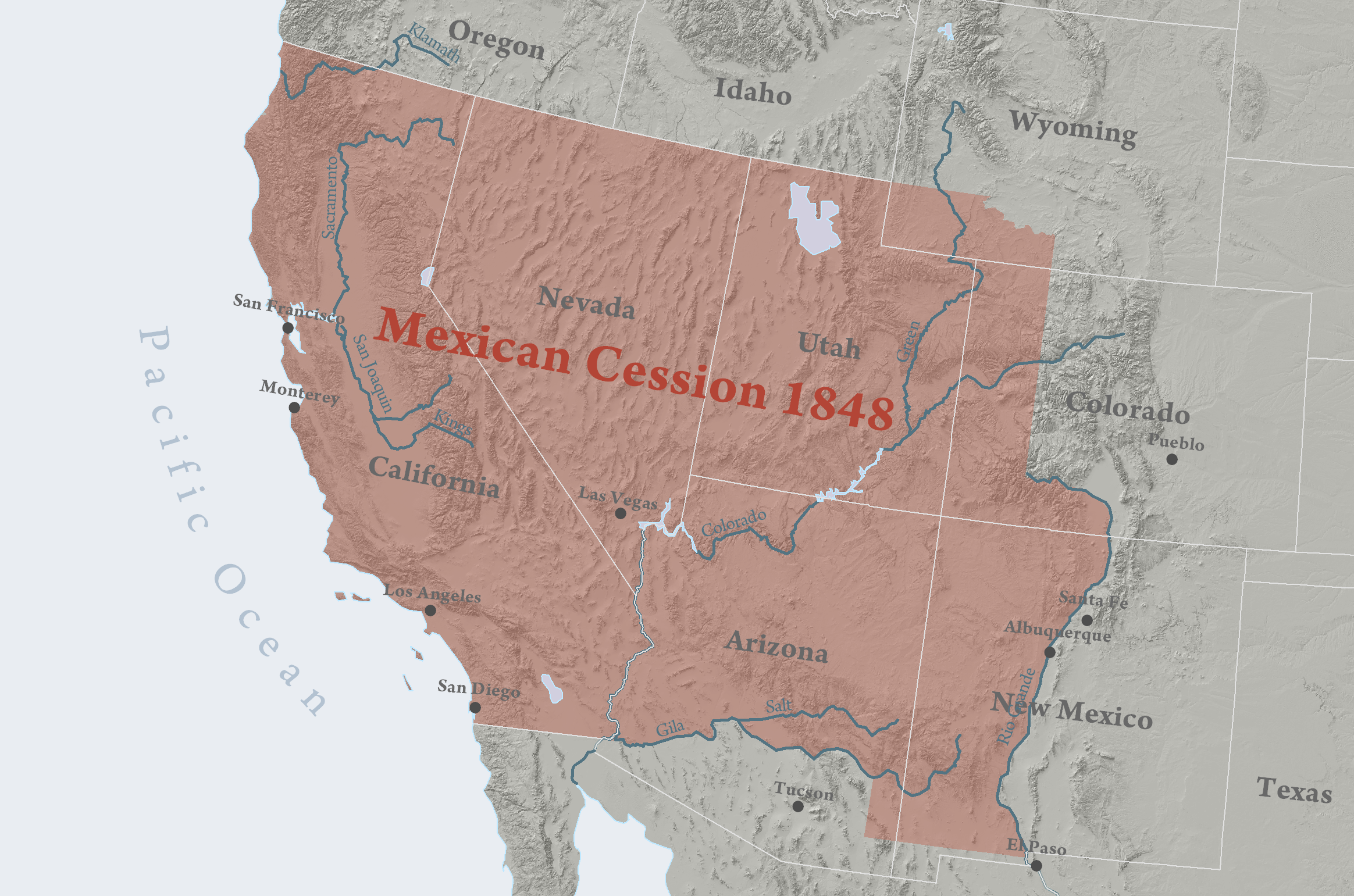
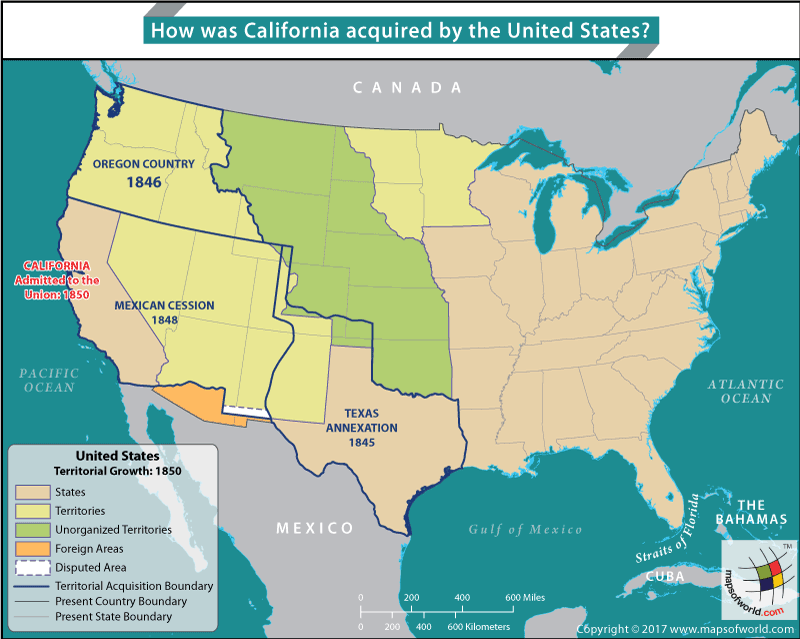
The Treaty of Guadalupe Hidalgo was a monumental agreement that reshaped the map of North America. Mexico ceded a vast swathe of territory to the United States, including present-day California, Nevada, Utah, most of Arizona and New Mexico, and parts of Colorado and Wyoming. In exchange, the United States paid Mexico $15 million and assumed $3.25 million in debts owed by the Mexican government to U.S. citizens.
The treaty guaranteed the property rights of Mexican citizens residing in the ceded territories, but in practice, many Californios lost their ancestral lands due to legal challenges and economic pressures. The U.S. military government maintained control of California until 1849, when a constitutional convention was held in Monterey.
The Gold Rush and Statehood
Just as the ink was drying on the Treaty of Guadalupe Hidalgo, an event occurred that would irrevocably transform California and accelerate its path to statehood: the discovery of gold. In January 1848, James W. Marshall discovered gold at Sutter’s Mill near Coloma. News of the discovery spread like wildfire, triggering the California Gold Rush.
From 1848 onwards, hundreds of thousands of prospectors, often referred to as “forty-niners,” flocked to California from all corners of the globe, seeking their fortunes. This massive influx of people dramatically altered the demographic and economic landscape of the territory. Boomtowns sprang up overnight, fortunes were made and lost, and the foundations of California’s eventual economic prosperity were laid.
The rapid population growth and the burgeoning economy created an urgent need for stable governance. The United States Congress, however, was divided over the issue of slavery, and the admission of California as a free state threatened to upset the delicate balance of power between free and slave states. This contentious debate was eventually resolved with the Compromise of 1850.
As part of the Compromise of 1850, California was admitted to the Union as the 31st state. This was a remarkable achievement, given that just two years prior, it had been a remote territory of Mexico. The Compromise of 1850 also included provisions that admitted New Mexico and Utah as territories, abolished the slave trade in Washington D.C., and enacted a stricter Fugitive Slave Act. California’s admission as a free state was a significant victory for the anti-slavery movement and a pivotal moment in the lead-up to the American Civil War.
California Today: A Legacy of Diversity and Opportunity
From its humble beginnings as a sparsely populated outpost under Spanish and Mexican rule, to its explosive growth fueled by gold and westward expansion, California’s journey to becoming a U.S. state is a captivating saga. The state’s rich history is evident in its diverse landscapes, from the rugged coastline to the fertile valleys, and in its vibrant multicultural population.
Today, California is a global leader in technology, entertainment, agriculture, and innovation. Its iconic landmarks, such as the Golden Gate Bridge, Disneyland Resort, and Yosemite National Park, attract millions of tourists, while its bustling cities like Los Angeles, San Francisco, and San Diego offer a wealth of experiences for every kind of traveler. Whether you’re seeking luxury accommodations in a Napa Valley villa, exploring the historic architecture of San Francisco, or enjoying a family trip to the theme parks of Southern California, California continues to embody the spirit of opportunity and reinvention that has defined it since its acquisition by the United States. The legacy of its diverse past is a cornerstone of its present, making it a truly unique and enduring destination.