
Dreaming of sun-kissed beaches, lush volcanic landscapes, and the gentle rhythm of island life? A trip to the Hawaiian Islands is a cherished aspiration for many, a tropical escape that promises unforgettable memories. However, before you can feel the warm sand between your toes and experience the aloha spirit, you’ll need to embark on a journey across the vast Pacific Ocean. The crucial question on every traveler’s mind is: “How long does a flight to Hawaii take?” This is a question with a nuanced answer, as the duration of your flight is not a one-size-fits-all figure. It depends on a multitude of factors, from your departure city and the specific Hawaiian island you’re aiming for, to the airline you choose and whether you opt for a direct route or a layover.
Understanding these variables is key to planning your Hawaiian adventure effectively. A well-planned journey minimizes travel stress and maximizes your precious vacation time. This comprehensive guide will delve into the typical flight durations, the influencing factors, and tips for making your long-haul flight as comfortable and enjoyable as possible, ensuring your transition from mainland bustle to island tranquility is seamless. Whether you’re contemplating a luxurious getaway, a budget-friendly escape, or a family vacation, knowing your flight time is the first step in orchestrating your perfect trip to paradise.
Understanding Flight Duration to Hawaii
The allure of Hawaii, with its distinct islands each offering a unique flavor of paradise, draws millions of visitors annually. From the vibrant energy of Oahu to the dramatic beauty of Maui, the natural wonders of the Big Island (Hawaii Island), and the serene beaches of Kauai, there’s an island for every traveler’s desire. However, the significant geographical distance between the continental United States and this archipelago means that flights are a considerable part of the travel equation.
Direct Flights: The Fastest Route to Paradise
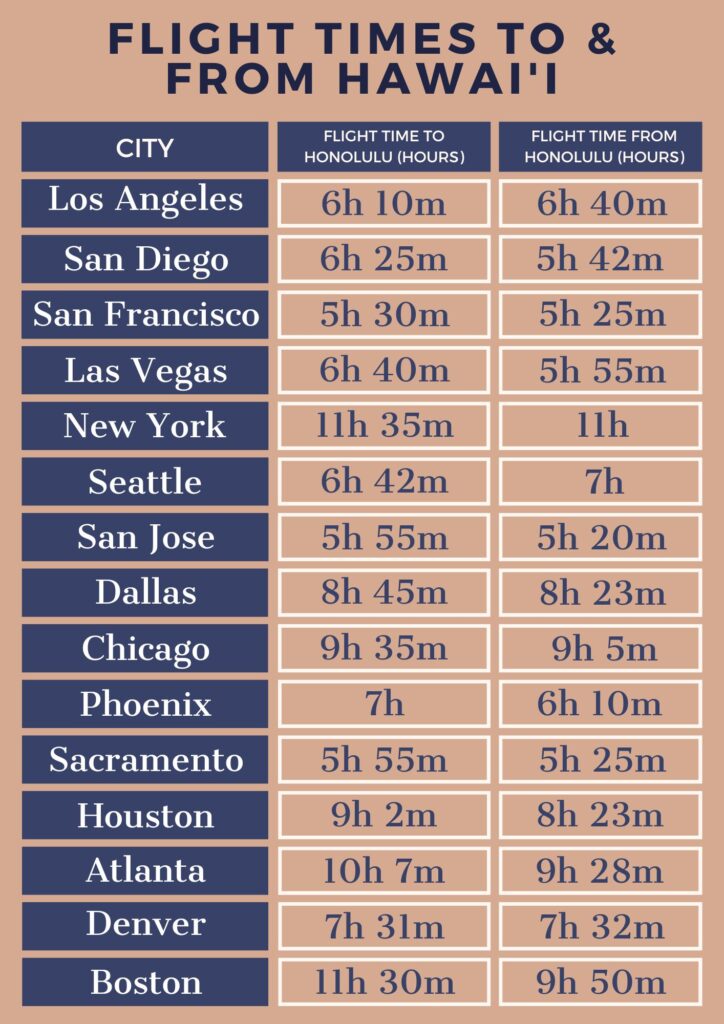
For those residing on the West Coast of the United States, direct flights to Hawaii are the most convenient and time-efficient option. Cities like Los Angeles, San Francisco, Seattle, and San Diego offer frequent direct services to major Hawaiian airports, primarily Honolulu International Airport (HNL) on Oahu, and increasingly to Kahului Airport (OGG) on Maui.
A direct flight from the West Coast to Honolulu typically ranges from 5 to 6 hours. This is the ideal scenario for maximizing your time on the islands, allowing you to settle into your accommodation and begin exploring much sooner. For example, a flight from Los Angeles International Airport (LAX) to Honolulu is usually around 5 hours and 30 minutes. Similarly, a flight from San Francisco International Airport (SFO) to Oahu will hover around the 5-hour mark. Flights to Maui from the West Coast are generally a little longer, often in the 5.5 to 6.5-hour range, due to its slightly more easterly position relative to Oahu.
As you move further north along the West Coast, such as from Seattle-Tacoma International Airport (SEA), flight times can extend slightly, often landing in the 6 to 7-hour bracket. This is still a remarkably efficient journey for the distance covered.
Flights from the Central and Eastern United States: Extended Journeys
When your departure point shifts towards the central and eastern regions of the United States, the flight duration to Hawaii naturally increases. Direct flights from these areas are far less common, with most travelers opting for a connecting flight.
From cities like Chicago, Denver, or Dallas, a direct flight, if available, would typically be in the 8 to 10-hour range. However, it’s more probable that you will encounter at least one layover. These layovers are most commonly found on the West Coast, in hubs like Los Angeles, San Francisco, or Seattle.
For example, a flight from Chicago O’Hare International Airport (ORD) to Honolulu with a single layover on the West Coast could add an additional 2 to 4 hours to your total travel time, bringing the overall journey to anywhere from 10 to 14 hours, including the layover period. This means a significant portion of your travel day will be dedicated to getting to Hawaii.
Travelers on the East Coast, from cities like New York City or Miami, face the longest flight times. Direct flights from the East Coast are extremely rare, almost non-existent for commercial passenger routes. Therefore, you can expect at least one, and often two, layovers. These layovers are typically in major mainland hubs like Chicago, Dallas, Atlanta, or on the West Coast.
A typical flight from New York City to Honolulu with one layover on the West Coast can easily take 10 to 12 hours of flight time, plus the layover. This often results in a total door-to-door travel time of 13 to 18 hours. Some journeys, especially those with longer layovers or multiple connections, can even stretch to 20 hours or more. This emphasizes the importance of packing accordingly and planning for significant time spent in transit.
Factors Influencing Flight Duration
Several factors contribute to the overall duration of your flight to Hawaii, extending beyond just the distance between your departure and arrival points.
1. Departure City
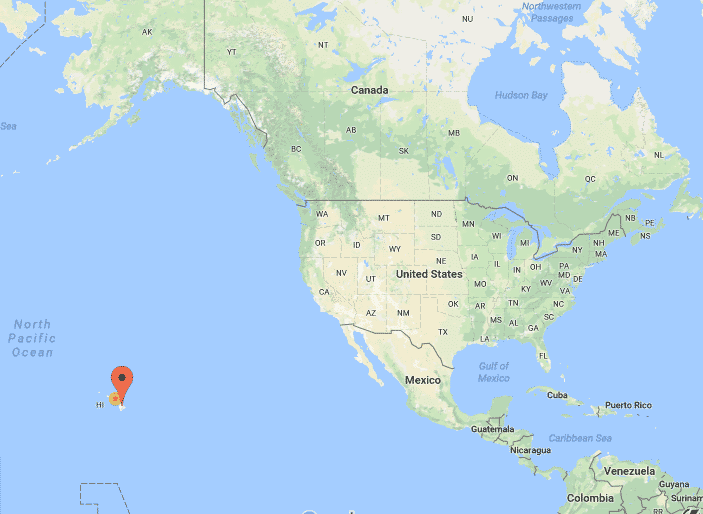
As detailed above, your departure city is the primary determinant of flight time. Proximity to the Pacific coast significantly shortens travel. Cities further inland or on the eastern seaboard will inherently require longer flights and likely more connections.
2. Direct Flights vs. Flights with Layovers
The decision between a direct flight and one with layovers dramatically impacts travel time. Direct flights are invariably shorter and less stressful. However, they may be more expensive or have fewer scheduling options. Flights with layovers, while often more affordable and offering more departure flexibility, add substantial time to your journey. The length of the layover itself is a critical factor; a short 1-hour layover is vastly different from a 4-hour wait. It’s also worth considering the location of the layover – a layover in Los Angeles for a flight to Maui might be more efficient than one in Denver for the same destination.
3. Hawaiian Island Destination
While this guide focuses on Hawaii generally, the specific island you are flying into can also have a minor impact. Honolulu International Airport (HNL) on Oahu is the primary gateway and receives the most international and mainland traffic. Flights to other islands like Maui (OGG), Kauai (LIH), or the Big Island (Kona International Airport – KOA, or Hilo International Airport – ITO) may involve an additional inter-island flight or a longer direct flight from the mainland. However, the difference in direct flight times between Oahu and Maui from the West Coast is usually less than an hour.
4. Airline and Aircraft Type
While less impactful than the above factors, the specific airline and the type of aircraft used can subtly influence flight times. Factors such as wind speeds encountered during flight, the flight path chosen by air traffic control, and the cruising speed of the aircraft can lead to minor variations. However, these are generally within a predictable range and not a primary consideration when estimating your travel time.
5. Time Zones and Jet Lag
It’s crucial to remember that Hawaii operates on Hawaii Standard Time (HST), which is 5 hours behind Pacific Standard Time (PST), 6 hours behind Mountain Standard Time (MST), and 10 hours behind Eastern Standard Time (EST). This time difference, while not affecting flight duration, contributes to the feeling of a long journey and can cause jet lag upon arrival. Planning for this disorientation is part of preparing for your trip.
Making the Most of Your Flight to Hawaii
Long flights can be daunting, but with a little preparation, you can transform the journey into a relaxing prelude to your Hawaiian holiday.
1. Entertainment and Comfort
- Pre-download Entertainment: Load your devices with movies, TV shows, podcasts, and music. Many airlines offer in-flight entertainment systems, but having your own curated selection ensures you won’t run out of options.
- Comfortable Clothing: Opt for loose, breathable clothing. Layers are essential, as cabin temperatures can fluctuate. Bring a comfortable neck pillow, a blanket, and an eye mask to aid sleep.
- Stay Hydrated: Airplane air is notoriously dry. Drink plenty of water throughout the flight and limit alcohol and caffeine, which can dehydrate you. Carry an empty reusable water bottle to refill after security.
- Movement: Get up and walk the aisles periodically to prevent stiffness and improve circulation, especially on longer flights. Simple in-seat stretches can also be beneficial.
2. Planning Your Travel Day
- Choose Wisely: If layovers are unavoidable, try to book flights with layovers in cities you might be interested in exploring briefly, or ensure you have enough time to comfortably transfer between gates. Some travelers even build short sightseeing excursions into longer layovers.
- Pack Smart: Keep essentials like medications, a change of clothes, toiletries, and your entertainment devices in your carry-on bag. This is crucial if your checked luggage experiences delays.
- Arrival Time: Consider the time of day you will arrive in Hawaii. Arriving in the evening might be beneficial for adjusting to the local time zone, allowing you to get a good night’s sleep in your hotel or resort. Many travelers find booking a hotel for the night of arrival, even if they plan to check into their main accommodation the next day, can ease the transition. Consider exploring options on Booking.com or researching local resorts that cater to early arrivals.
By understanding the intricacies of flight durations and employing smart travel strategies, your journey to the enchanting Hawaiian Islands can be as enjoyable as the destination itself. Whether you’re seeking the adventure of exploring Volcanoes National Park, the tranquility of a Waikiki beach resort, or the cultural richness of Lahaina, the first step is a smooth and well-prepared flight.
LifeOutOfTheBox is a participant in the Amazon Services LLC Associates Program, an affiliate advertising program designed to provide a means for sites to earn advertising fees by advertising and linking to Amazon.com. Amazon, the Amazon logo, AmazonSupply, and the AmazonSupply logo are trademarks of Amazon.com, Inc. or its affiliates. As an Amazon Associate we earn affiliate commissions from qualifying purchases.