
Navigating the legal landscape of divorce can feel as complex and time-consuming as planning an extended international journey. While the ultimate destination – a finalized divorce – is clear, the path to get there in California can be as varied as the routes one might take to explore Italy or discover the hidden gems of Kyoto. Understanding the typical timelines involved is crucial for managing expectations and preparing for the significant life changes that divorce brings. This guide aims to demystify the process, offering insights into the factors that influence how long a divorce might take in the Golden State.

The legal framework in California is designed to facilitate a fair and orderly dissolution of marriage. However, the duration of this process is not a one-size-fits-all scenario. It’s influenced by a confluence of legal requirements, the specific circumstances of the marital breakdown, and the cooperation between the parties. Much like how the best time to visit Paris depends on whether you seek blooming gardens or festive holiday markets, the speed of a California divorce hinges on numerous variables.
Understanding the Minimum Waiting Period and Common Delays
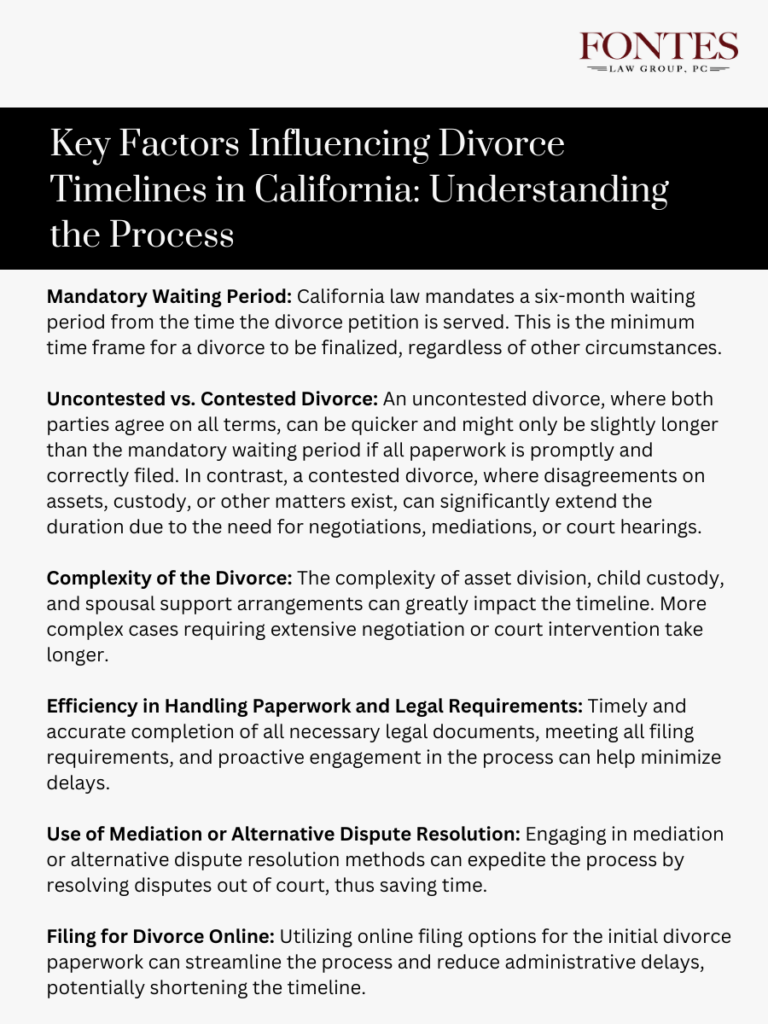
California has a mandatory waiting period before a divorce can be finalized, a crucial point that applies to all cases regardless of complexity. This period is designed to provide parties with a cooling-off period, allowing for reflection and the potential for reconciliation, though in most cases, it simply serves as a legal checkpoint.
The Mandatory Six-Month Waiting Period
The cornerstone of California divorce timelines is the statutory six-month waiting period. This period begins the moment the respondent (the spouse who is served with divorce papers) is officially notified of the divorce proceedings. It’s important to note that this is not six months from the date the petition is filed; it is six months from the date of service.
Here’s how it breaks down:
- Filing the Petition: One spouse files a petition for dissolution of marriage with the court.
- Serving the Papers: The other spouse (the respondent) is formally served with the divorce papers. This can be done by a sheriff, a registered process server, or any adult who is not a party to the case.
- The Six-Month Clock Starts: The six-month countdown begins on the date the respondent is served.
- Finalization: Even if all issues are resolved amicably and promptly, the divorce cannot be legally finalized until this six-month period has elapsed.
This waiting period is a minimum. Many divorces take significantly longer than six months to conclude. The six-month mark is merely the earliest point at which the divorce can be granted. It does not guarantee that the divorce will be finalized on that exact day.
Factors That Extend the Divorce Process
While the six-month waiting period is a legal minimum, several factors can cause the divorce proceedings to drag on for many months, or even years, much like planning a lengthy expedition across Africa.
-
Uncontested vs. Contested Divorce: The most significant determinant of divorce duration is whether the divorce is contested or uncontested.
- Uncontested Divorce: In an uncontested divorce, both spouses agree on all major issues, including child custody and visitation, child support, spousal support, and the division of community property (assets and debts acquired during the marriage). When parties are in complete agreement, they can often submit a written agreement to the court, and the divorce can proceed relatively quickly once the six-month waiting period is over. This is akin to a meticulously planned itinerary where every detail is agreed upon, ensuring a smooth journey.
- Contested Divorce: In a contested divorce, the spouses disagree on one or more significant issues. This disagreement necessitates court intervention. Negotiations, mediation, and potentially lengthy court hearings or trials will be required to resolve these disputes. Each point of contention adds time to the process, as legal procedures must be followed to reach a resolution. This can be likened to navigating a journey with unexpected detours and challenges, such as unpredictable weather impacting a trek through the Himalayas.
-
Complex Financial Matters: Divorces involving significant assets, businesses, or complicated investment portfolios can take longer to resolve. The accurate valuation and equitable division of these assets require expert appraisals, extensive documentation, and careful negotiation. This complexity is similar to deciphering the intricate architecture of ancient ruins or understanding the nuances of local trade practices in a bustling Marrakech souk.
-
Child Custody Disputes: Disagreements over child custody and visitation are often the most emotionally charged and time-consuming aspects of a divorce. California courts prioritize the best interests of the child, and resolving these issues can involve custody evaluations, mediation sessions, and potentially court hearings to determine custody arrangements. This is analogous to the careful planning required for a family adventure to Disneyland, ensuring all children’s needs and preferences are considered.
-
Spousal Support Negotiations: Determining spousal support (alimony) can also prolong a divorce. Factors like the length of the marriage, the income of each spouse, and their earning capacities are considered. Reaching an agreement or having a judge decide can involve extensive financial disclosures and analysis.
-
Lengthy Court Calendars: Even when parties are ready to move forward, court dockets can be overwhelmed. Scheduling hearings, status conferences, and trials can be subject to delays based on the court’s availability, especially in busy urban areas like Los Angeles or San Francisco. This is akin to trying to book a popular hotel in a prime tourist season in Rome, where availability can be scarce.
-
Lack of Cooperation: When one or both spouses are uncooperative, refuse to provide necessary information, or intentionally delay proceedings, the divorce can be significantly extended. This lack of collaboration can feel like being stranded with a travel companion who is unwilling to make decisions or compromise.
Stages of a California Divorce and Their Timelines
A divorce in California progresses through distinct stages, each with its own potential timeline. Understanding these stages can provide a clearer picture of the overall process.
Stage 1: Filing and Service
- Filing the Petition: This initial step involves preparing and filing the “Petition for Dissolution of Marriage” with the court. This can be done relatively quickly, often within a few days to a couple of weeks, depending on the efficiency of the legal counsel or the self-represented party.
- Serving the Respondent: Once filed, the respondent must be served. This process can take anywhere from a week to a month, depending on the respondent’s availability and cooperation in accepting service. If the respondent is difficult to locate, service can take longer.
Timeline for Stage 1: Typically 1-2 months.
Stage 2: Response and Financial Disclosures
- Respondent’s Response: The respondent generally has 30 days from the date of service to file a response. If they fail to respond, the petitioner can request a “default” judgment, which can expedite the process but may not always result in a fair outcome for the non-responsive party.
- Preliminary Declaration of Disclosure: Both parties are required to exchange detailed financial information within 60 days of filing the petition. This includes information about income, expenses, assets, and debts. This stage can be straightforward if both parties are transparent, but it can become protracted if there is a lack of cooperation or hidden assets. This is akin to preparing a detailed budget for a dream vacation to the Maldives, ensuring all expenses are accounted for.
Timeline for Stage 2: Typically 2-4 months.
Stage 3: Negotiation, Mediation, or Litigation
This is the most variable stage and where the majority of the time is often spent.
- Uncontested: If parties agree on all issues, they can draft a Marital Settlement Agreement (MSA). This agreement is then submitted to the court for approval. The court can review and approve the MSA relatively quickly once the mandatory six-month waiting period has passed.
- Contested: If there are disagreements, parties may engage in:
- Negotiations: Attorneys for each party may negotiate directly.
- Mediation: A neutral third party helps facilitate discussions and guide the parties toward an agreement. California encourages mediation, especially in child custody disputes.
- Court Hearings/Trials: If negotiation and mediation fail, the case will proceed to court. This involves discovery (gathering evidence), pre-trial motions, and ultimately, a trial where a judge will make decisions on the disputed issues. Court dates can be weeks or months apart. This can be as complex as mapping out a multi-city tour of Southeast Asia, requiring intricate logistical planning and flexibility.
Timeline for Stage 3: Highly variable.
- Uncontested: 2-6 months after Stage 2.
- Contested: 6 months to several years, depending on the complexity and number of issues.
Stage 4: Judgment and Finalization
Once all issues are resolved (either by agreement or court order) and the six-month waiting period has elapsed, the parties can submit final judgment documents to the court.
- Final Judgment: This document officially dissolves the marriage.
- Court Approval: The judge reviews and signs the judgment.
Timeline for Stage 4: Typically 1-2 months after all issues are resolved and the waiting period has passed.
Estimating Your Divorce Timeline: Key Considerations
Given the variables, providing an exact timeline for a California divorce is challenging. However, by considering the following, you can establish a more realistic expectation.
The Spectrum of Divorce Durations
-
Fastest Possible Divorce: The absolute quickest a California divorce can be finalized is approximately six months and one day from the date of service. This is only achievable in a truly uncontested divorce where both parties are highly cooperative, all paperwork is filed perfectly, and the court’s schedule allows for prompt processing. This is akin to a direct, no-stop flight to your destination.
-
Average Divorce: For many couples, especially those with some level of cooperation but minor issues to resolve, divorces can take anywhere from 8 to 18 months. This allows for negotiation, mediation, and the court process without significant protracted battles. This is comparable to a well-planned vacation with a few optional excursions.
-
Complex or High-Conflict Divorces: Divorces involving significant assets, extensive child custody disputes, uncooperative spouses, or multiple court battles can easily extend to 18 months, 2 years, or even longer. These cases require substantial legal maneuvering and often involve multiple court appearances. This is akin to undertaking an extensive research trip or a multi-year cultural immersion.

Tips for Expediting Your Divorce (Where Possible)
While you cannot circumvent the mandatory waiting period or the need to resolve core issues, some strategies can help streamline the process:
- Seek Legal Counsel Early: An experienced California divorce attorney can guide you through the process, ensure paperwork is filed correctly, and help you understand your rights and obligations.
- Be Prepared to Compromise: If your goal is a faster divorce, be willing to negotiate and compromise on certain issues. Focus on what is most important to you and be flexible on less critical points.
- Gather Financial Information Promptly: Proactively collecting all necessary financial documents will expedite the disclosure process.
- Consider Mediation: Mediation is often faster and less expensive than litigation, especially for couples who can communicate reasonably well.
- Maintain Communication (When Possible): Open and respectful communication with your spouse, or through your attorneys, can prevent misunderstandings and delays.
- Be Organized: Keep meticulous records of all communications, documents, and court filings.
Ultimately, how long a divorce takes in California is a deeply personal journey. While the law provides a framework, the path is shaped by the unique circumstances of each couple. By understanding the legal requirements, the potential delays, and by approaching the process with a degree of cooperation and preparedness, you can navigate this challenging transition with greater clarity and efficiency, much like charting a course for an unforgettable travel experience.