
The vast expanse of our planet often sparks curiosity about the proximity of seemingly distant lands. Among the most intriguing geographical questions is the distance separating Alaska, a U.S. state renowned for its rugged wilderness, and Russia, the largest country in the world. While separated by a significant body of water, the Bering Strait, the actual miles between these two colossal landmasses are surprisingly short, a testament to the dynamic geological history that shaped our world. This exploration will not only answer the fundamental question of distance but also delve into the fascinating geography, historical significance, and potential travel implications of this unique transcontinental relationship.

The Narrowest Divide: Understanding the Bering Strait
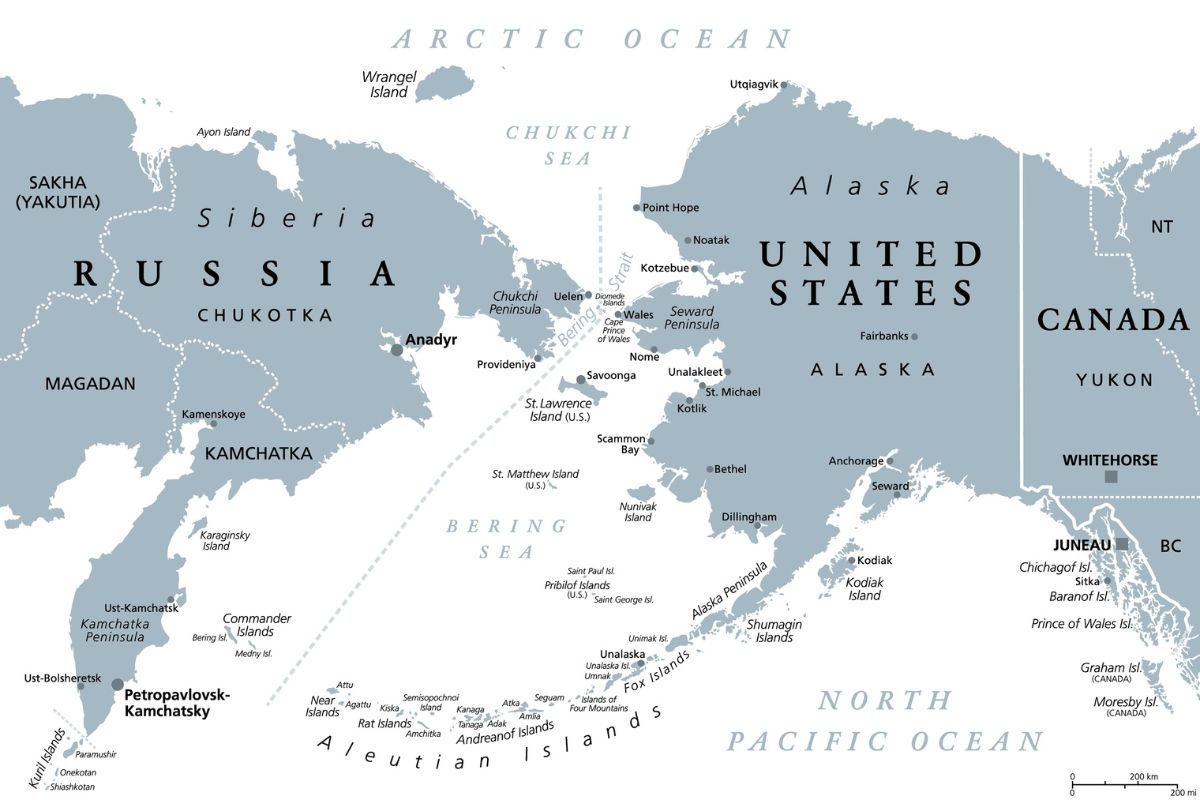
The primary answer to “How Many Miles Between Alaska And Russia?” lies in the Bering Strait. This crucial waterway serves as the international boundary between the two nations, dividing North America from Asia. At its narrowest point, the strait is a mere 53 miles (85 kilometers) wide. This striking proximity is a result of continental drift and the ebb and flow of ice ages. During glacial periods, sea levels dropped significantly, exposing a land bridge known as Beringia that once connected what is now Siberia and Alaska. This ancient land bridge is believed to have been a vital pathway for the migration of humans and animals between the continents.
Geography and Key Islands
Within the Bering Strait, a geographical feature further accentuates the closeness between Alaska and Russia: the Diomede Islands. These two islands, Big Diomede (part of Russia) and Little Diomede (part of the United States), sit just a few miles apart. Big Diomede is approximately 2.5 miles (4 kilometers) from Little Diomede.
- Big Diomede Island (Ostrov Ratmanova): This Russian island is uninhabited, though it has military installations. It lies to the west of the International Date Line.
- Little Diomede Island (Alaska): This U.S. island is inhabited by a small community of Inupiat people. It lies to the east of the International Date Line.
The existence of these islands means that at one specific point, the distance between the two countries is reduced to a mere few miles. This creates a unique situation where one can technically stand on one continent and see the other across a short stretch of water. The International Date Line also runs between the two islands, meaning that despite their close proximity, there is a 21-hour time difference between them. When it’s noon on Little Diomede, it’s already 9 AM the next day on Big Diomede. This temporal anomaly adds another layer of intrigue to this already fascinating geographical nexus.
The waters of the Bering Strait themselves are a vital ecological corridor, supporting a rich diversity of marine life, including whales, seals, and migratory birds. The strait is also a crucial shipping lane, connecting the Pacific Ocean to the Arctic Ocean via the Chukchi Sea. Understanding the geography of the Bering Strait is key to appreciating the limited distance between Alaska and Russia.
Historical and Cultural Connections
The proximity of Alaska and Russia is not just a geographical curiosity; it’s a story etched in centuries of history, human migration, and cultural exchange. Long before either Russia or the United States laid claim to these lands, indigenous peoples traversed the Bering Strait on foot via the ancient land bridge of Beringia. These ancestral migrations laid the groundwork for the diverse cultures that thrive in the region today.
Indigenous Peoples and Migration

The Inupiat people of Alaska and the Chukchi and Yupik peoples of Siberia share deep historical and cultural ties, stemming from their common ancestry and millennia of interaction. For thousands of years, these communities navigated the waters and ice of the Bering Strait, maintaining relationships, trading goods, and sharing traditions. This enduring connection highlights that despite political borders, the human element has always found ways to bridge the geographical divide. The ancestral lands of these indigenous groups often spanned both sides of the strait, reflecting a time before defined national boundaries.
Russian Exploration and the Sale of Alaska
The modern historical narrative of Russian presence in Alaska is primarily linked to exploration and eventual sale. Russian explorers, notably Vitus Bering, embarked on expeditions in the 18th century, charting the coastlines and establishing a presence in Alaska. For a period, Russia actively colonized parts of Alaska, establishing settlements and engaging in the fur trade, which was highly lucrative at the time. Cities like Sitka were once the capital of Russian America.
However, maintaining such a vast and remote territory proved challenging and costly for the Russian Empire. The Crimean War further strained Russian resources and increased concerns about the vulnerability of Alaska to British attack. In 1867, Russia sold Alaska to the United States for $7.2 million, a transaction famously known as the Alaska Purchase. This pivotal event transferred sovereignty over the territory and redefined the geopolitical landscape of the region. Despite the sale, the historical legacy of Russian influence remains visible in place names, architecture, and cultural remnants in Alaska. The sale, driven by economic and strategic considerations, underscores the complex relationship between geography, politics, and national interests.
Travel and Exploration Between Alaska and Russia
While the Bering Strait is a formidable natural barrier, the proximity of Alaska and Russia has long fueled dreams of travel and exploration. Direct, regular commercial travel between the two landmasses is practically non-existent due to political and logistical challenges. However, this doesn’t mean the journey is entirely impossible.
Limited Direct Travel Options
Currently, there are no scheduled ferry services or direct flights connecting Alaska and Russia. The vastness of the Bering Sea, the harsh climate, and the remote nature of many settlements on both sides present significant obstacles to establishing routine transport links. Most travel between the two regions, if undertaken, is highly specialized and often involves private charters, scientific expeditions, or highly organized adventure tours.
For those interested in experiencing the remoteness and unique geography, specialized cruises sometimes circumnavigate the Arctic and may include passages through the Bering Strait. These voyages offer glimpses of the dramatic landscapes, wildlife, and the stark beauty of this frontier region.
Adventure Travel and Future Possibilities
The allure of the Bering Strait and its adjacent territories continues to attract adventurers and intrepid travelers. Expeditions across the ice in winter, while extremely dangerous and requiring expert guides and extensive preparation, have been undertaken. Similarly, sea kayaking expeditions can navigate the waters, though they are subject to severe weather conditions.
The potential for future tourism development exists, particularly for niche markets focusing on adventure, wildlife, and cultural immersion. However, such development would require significant investment in infrastructure, robust international cooperation, and careful consideration of environmental impacts. The economic viability of such ventures would also be a major factor. For now, the journey remains more of an aspiration for the adventurous traveler than a conventional travel route. The stark beauty and historical resonance of the region, however, ensure its place on the map for those seeking the extraordinary. Whether by sea or air, the journey across the Bering Strait promises an unforgettable encounter with one of the planet’s most remote and historically significant frontiers.
LifeOutOfTheBox is a participant in the Amazon Services LLC Associates Program, an affiliate advertising program designed to provide a means for sites to earn advertising fees by advertising and linking to Amazon.com. Amazon, the Amazon logo, AmazonSupply, and the AmazonSupply logo are trademarks of Amazon.com, Inc. or its affiliates. As an Amazon Associate we earn affiliate commissions from qualifying purchases.