
The allure of teaching in New York is undeniable. Beyond the vibrant energy of New York City and the scenic beauty of Upstate New York, the state offers a rich tapestry of cultural experiences, historical landmarks, and diverse lifestyles that appeal to many. For those considering a career in education within this bustling state, a primary question often arises: “How much does a teacher make in New York?” While the profession is driven by passion and a commitment to shaping young minds, understanding the financial realities is crucial for planning and long-term stability.

This exploration delves into the average teacher salaries across New York State, considering various factors that influence income, from experience and education level to location and school district. We will also touch upon the cost of living in New York and how it intersects with teacher compensation, offering a comprehensive view for aspiring educators and those looking to advance their careers within the Empire State.
Understanding Teacher Salaries in New York
Teacher salaries in New York are not a monolithic figure; they are a dynamic reflection of a complex interplay of elements. Unlike some professions with standardized pay scales, the compensation for educators is influenced by a multitude of variables, making a single answer to “how much does a teacher make?” an oversimplification.
Factors Influencing Teacher Pay
Several key factors contribute to the range of salaries observed among teachers in New York:
Experience Level
As with most professions, a teacher’s tenure plays a significant role in their earning potential. Entry-level teachers, often referred to as novice educators, will generally earn less than their more seasoned counterparts. This is typically reflected in a structured salary schedule, often referred to as a “step” or “lane” system. A teacher starting their career might be on the lowest step of the salary schedule, while a teacher with 10, 15, or even 20 years of experience will be on a higher step, commanding a correspondingly higher salary. This incremental increase acknowledges the growing expertise, classroom management skills, and pedagogical knowledge gained over time.
Education and Certifications
The level of education a teacher possesses also directly impacts their salary. Most New York State teaching positions require at least a Bachelor’s degree and a valid teaching certificate. However, teachers who pursue further education, such as a Master’s degree or a Doctorate, are often compensated at a higher rate. Many New York school districts offer salary differentials for advanced degrees, recognizing the additional training and specialized knowledge acquired. Furthermore, obtaining additional certifications in high-demand subject areas or specialized fields (e.g., special education, English as a Second Language, STEM fields) can also lead to salary enhancements or increased job opportunities.
School District and Location
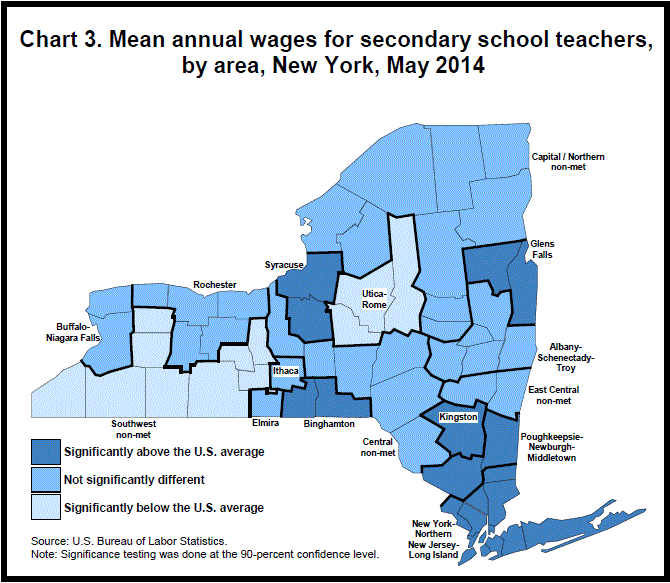
The geographical location of a school district within New York State is a critical determinant of teacher salaries. New York City and its surrounding suburban areas, such as those in Westchester County or Long Island, generally offer higher salaries compared to rural districts in more remote parts of the state. This disparity is largely attributed to the higher cost of living in these metropolitan and suburban regions. Housing, transportation, and general daily expenses are significantly more expensive in areas like Manhattan or Brooklyn than in towns like Plattsburgh or Jamestown. Consequently, school districts in these high-cost-of-living areas must offer more competitive salaries to attract and retain qualified educators.
Union Contracts and Collective Bargaining
In New York, the majority of public school teachers are represented by unions, most notably the New York State United Teachers (NYSUT). These unions engage in collective bargaining with school districts on behalf of their members. The resulting union contracts often dictate salary schedules, benefits, working conditions, and professional development opportunities. These contracts are typically negotiated for a set period and can lead to significant variations in pay scales between different school districts, even those in similar geographic areas. Teachers in districts with strong union representation may benefit from more robust salary increases and benefits packages.
Subject Area and Demand
While not always a primary driver of base salary, the subject area a teacher specializes in can sometimes influence their overall compensation, especially when considering stipends or bonuses for teaching in high-demand fields. For instance, teachers in subjects like STEM (Science, Technology, Engineering, and Mathematics), special education, or bilingual education may find more opportunities for additional compensation or be more sought after by districts facing shortages in these areas.
Average Teacher Salaries Across New York State
While precise figures can fluctuate annually and vary significantly by district, we can examine general salary trends for teachers in New York. It’s important to remember these are averages, and individual salaries can fall above or below these ranges.
Entry-Level and Experienced Teacher Salaries
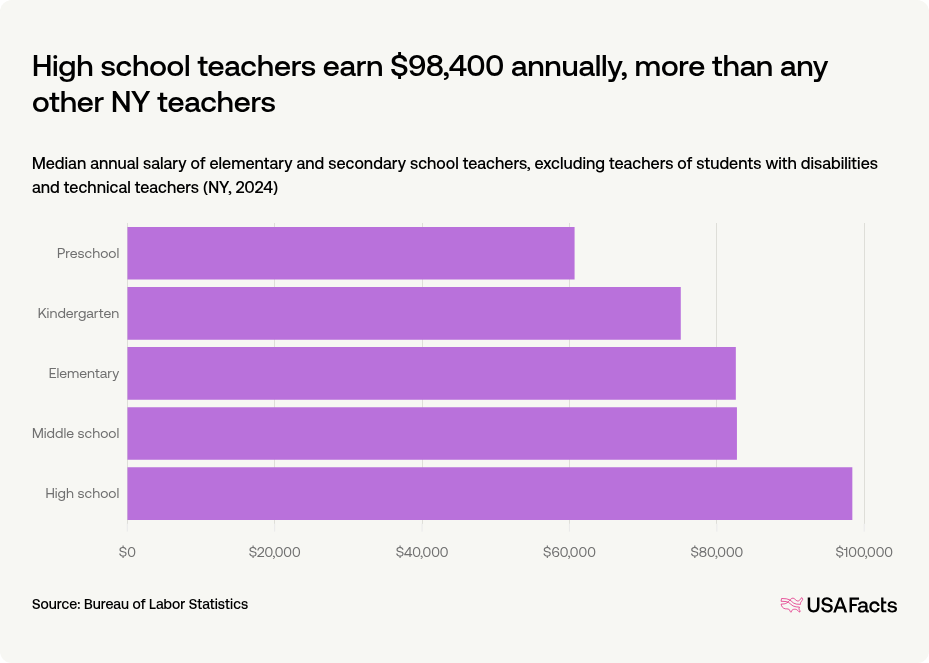
At the entry level, a new teacher in New York might expect to earn an annual salary in the range of $50,000 to $65,000. This figure can be lower in some of the more rural or less affluent districts and higher in areas with a greater cost of living and stronger union contracts.
As teachers gain experience and move up the salary scale, their earnings increase substantially. Teachers with 5-10 years of experience can typically see their salaries rise to the range of $65,000 to $85,000. Experienced educators with 15-20 years in the profession, often holding advanced degrees, can earn well into the six figures, with salaries ranging from $85,000 to over $100,000 annually, particularly in well-funded districts or New York City.
District-Specific Salary Comparisons
To illustrate the variations, consider the following:
-
New York City Department of Education: As the largest school district in New York, the NYC system has a well-defined salary schedule that generally places it among the higher-paying districts in the state. New teachers start at a competitive salary, and with experience and further education, can reach the top of the pay scale, which can exceed $100,000 for highly experienced teachers. The district’s agreement with the United Federation of Teachers (UFT) outlines these scales.
-
Suburban Districts (e.g., Westchester, Long Island): School districts in affluent suburban areas surrounding New York City often mirror or even surpass NYC salaries due to high property taxes and a strong demand for quality education. Teachers in these areas can expect starting salaries in the $60,000s and reach over $100,000 with significant experience.
-
Upstate New York Districts: In contrast, districts in more rural or economically challenged regions of Upstate New York tend to offer lower salary ranges. Starting salaries might be closer to the lower end of the statewide spectrum, and the top of the pay scale may not reach the same levels as in the metropolitan areas. However, the cost of living in these areas is also significantly lower, which can offset the difference in nominal income. For example, a teacher in a district near the Adirondack Mountains might earn less in absolute terms than a teacher in Scarsdale, but their purchasing power could be comparable due to lower housing and living costs.
The Impact of Advanced Degrees and Longevity
It is not uncommon for teachers with a Master’s degree and 20+ years of experience in a well-compensated district to earn upwards of $90,000 to $110,000 annually. Some districts may even offer additional stipends for roles such as department heads, coaches, or advisors for extracurricular activities, further boosting a teacher’s total compensation. The longevity factor, combined with educational attainment, is a powerful driver of salary progression.
The Cost of Living in New York and its Influence
New York is renowned for its vibrant culture, iconic landmarks like the Statue of Liberty and Times Square, and diverse attractions, but it is also known for its high cost of living. This is a critical consideration when evaluating teacher salaries.
Housing Costs
Housing is often the single largest expense for residents in New York. In New York City, particularly in boroughs like Manhattan and Brooklyn, rental prices and homeownership costs are among the highest in the nation. A modest apartment can easily consume a significant portion of a teacher’s salary. Even in suburban areas, housing prices can be substantial. This is a primary reason why salaries are generally higher in these areas – to make it feasible for educators to live within a reasonable commuting distance of their workplaces. Conversely, in many Upstate New York towns, housing is much more affordable, making a lower nominal salary stretch further.
Other Essential Expenses
Beyond housing, other essential expenses such as transportation, groceries, healthcare, and childcare can also be considerably higher in New York compared to many other states. While public transportation in New York City is extensive and relatively affordable, owning a car and associated costs (gas, insurance, parking) can add up in suburban and rural areas.
Balancing Salary and Lifestyle
When considering a teaching position in New York, it’s imperative to look beyond the gross salary figure and analyze the net income after taxes and the cost of living in the specific location. A teacher earning $70,000 in a rural New York county might enjoy a higher quality of life and greater disposable income than a teacher earning $85,000 in Westchester County or Nassau County. This is where understanding the nuances of different regions and their respective living expenses becomes paramount. For those interested in enjoying New York’s offerings, from exploring the Adirondack Park to experiencing the arts in Saratoga Springs, the financial planning is key.
Benefits and Beyond Salary
While salary is a primary concern, teachers in New York also benefit from a comprehensive package of benefits, which can significantly enhance their overall compensation and job security.
Health Insurance and Retirement Plans
Most New York school districts offer robust health insurance plans for teachers and their families. These plans typically cover medical, dental, and vision care, often with modest employee contributions. Furthermore, New York teachers are typically part of a state-sponsored retirement system, the New York State Teachers’ Retirement System (NYSTRS). This system provides a defined-benefit pension plan, offering a secure retirement income based on a teacher’s years of service and final average salary. This pension is a significant financial asset that contributes to a teacher’s long-term financial well-being.
Paid Time Off and Professional Development
Teachers in New York typically receive generous paid time off, including summer breaks, winter breaks, and numerous holidays. This extended time off is a significant perk of the profession, allowing for personal pursuits, family time, or professional development. Many districts also offer paid professional development opportunities, workshops, and tuition reimbursement programs, encouraging teachers to enhance their skills and knowledge without incurring personal expense.
Other Potential Perks
Depending on the district and union contract, teachers may also have access to other perks such as:
- Life Insurance: Employer-provided life insurance policies.
- Disability Insurance: Short-term and long-term disability coverage.
- Union Support: Access to legal assistance and advocacy through their union.
- Job Security: Tenure protections, which provide significant job security after a probationary period.
When evaluating a teaching offer in New York, it is essential to consider the total compensation package, including salary, benefits, and the value of the pension plan, in conjunction with the cost of living in the chosen location. This holistic approach provides a more accurate picture of the financial viability and overall desirability of a teaching career in the Empire State. Whether one dreams of exploring the bustling streets of New York City, the serene landscapes of the Hudson Valley, or the charming towns of Western New York, a teaching career in New York offers a path with both professional fulfillment and a reasonable standard of living, provided one thoroughly researches and understands the financial landscape.
LifeOutOfTheBox is a participant in the Amazon Services LLC Associates Program, an affiliate advertising program designed to provide a means for sites to earn advertising fees by advertising and linking to Amazon.com. Amazon, the Amazon logo, AmazonSupply, and the AmazonSupply logo are trademarks of Amazon.com, Inc. or its affiliates. As an Amazon Associate we earn affiliate commissions from qualifying purchases.