
Embarking on the journey to earn a GED in Texas is a significant step towards personal and professional growth. It’s an endeavor that opens doors to higher education, better employment opportunities, and a renewed sense of accomplishment. This guide will navigate you through the essential steps and considerations for obtaining your GED credential in the Lone Star State.
Understanding the GED Test
The GED (General Educational Development) test is a series of exams designed to assess your knowledge in four core subject areas: Reasoning Through Language Arts, Mathematical Reasoning, Science, and Social Studies. Successfully passing these exams grants you a high school equivalency credential, recognized by most colleges, universities, and employers. In Texas, the GED test is administered by approved testing centers, ensuring a standardized and reputable assessment process.

The Four GED Subject Areas
Each subject area tests a specific set of skills and knowledge:
- Reasoning Through Language Arts (RLA): This section evaluates your ability to read and understand complex texts, analyze arguments, and express your ideas clearly in writing. It includes both multiple-choice questions and a constructed response (essay) component. You’ll be tested on your comprehension of literature, informational texts, and your ability to write persuasively and analytically.
- Mathematical Reasoning: This part of the test focuses on your ability to solve problems using mathematical concepts and skills. It covers a range of topics, including algebra, geometry, data analysis, and probability. The GED Math test utilizes a mix of multiple-choice questions and constructed response problems, often requiring you to show your work or explain your reasoning. A calculator is permitted for certain parts of this exam.
- Science: The science section assesses your understanding of life science, physical science, and earth and space science. Questions are typically scenario-based, requiring you to interpret data, draw conclusions, and apply scientific principles. You’ll encounter multiple-choice questions that gauge your ability to analyze scientific information and understand scientific concepts.
- Social Studies: This subject area tests your knowledge of U.S. history, civics and government, geography, and economics. Similar to the science section, you’ll be presented with passages, charts, graphs, and maps from which you’ll need to extract information, analyze data, and apply your social studies knowledge. Multiple-choice questions are the primary format for this exam.
Eligibility Requirements for GED in Texas
To be eligible to take the GED test in Texas, you must meet certain criteria set forth by the Texas Department of Education. These requirements are in place to ensure that the GED is a valuable credential for those who have not completed traditional high school.
Age Requirements
In Texas, you must be at least 16 years old to take the GED test. However, there are specific conditions for individuals under 18:
- 16 and 17 Year Olds: If you are 16 or 17 years old, you must obtain a signed GED application from your local school district superintendent or a designated representative. This document typically confirms that you are no longer enrolled in a public or private high school and that you are not in compulsory attendance. This requirement ensures that the GED is not used as a means to drop out of school before completing your mandatory education.
- 18 Years and Older: If you are 18 years old or older, you do not need to obtain permission from a school district. You can proceed directly with the registration and testing process, provided you meet the other eligibility criteria.
Residency and Identity Verification
While there are no strict residency duration requirements to take the GED in Texas, you will need to provide valid identification to verify your identity. Accepted forms of identification typically include:
- A current, valid driver’s license.
- A state-issued identification card.
- A U.S. passport.
- A U.S. military ID.
- A foreign passport with a valid visa or I-94.
The specific acceptable forms of identification may vary slightly by testing center, so it is always advisable to check with your chosen testing location beforehand. You may also be asked to provide proof of residency, especially if you are under 18 and seeking the school district superintendent’s signature.
Prior High School Completion
A crucial eligibility requirement is that you must not have already graduated from high school or completed a high school equivalency program in another state or country. The GED is designed for individuals who have not earned a traditional high school diploma. If you have previously earned a diploma, you are not eligible to take the GED test.
Preparing for the GED Test in Texas
Effective preparation is key to successfully passing the GED test. Texas offers a variety of resources and strategies to help you study and feel confident on test day.
Study Options and Resources
There are several pathways to prepare for the GED exam in Texas, catering to different learning styles and needs:
- Adult Education and Literacy (AEL) Programs: These programs, often offered by community colleges and non-profit organizations across Texas, provide free or low-cost GED preparation classes. These classes are taught by certified instructors and cover all subject areas of the GED test. They often include practice tests, one-on-one tutoring, and study materials. Many AEL programs are located in major cities like Houston, Dallas, and San Antonio.
- Online GED Prep Courses: Numerous online platforms offer comprehensive GED preparation courses. These courses can be self-paced and are convenient for individuals with busy schedules. They often include video lessons, practice quizzes, diagnostic tests, and simulated GED exams. Some popular online providers include Kaplan and TestPrepReview.
- GED Practice Tests: Taking official GED practice tests is an invaluable tool for assessing your readiness. These practice tests are designed to mimic the actual GED exam format and question types. They help you identify areas where you need further study and familiarize yourself with the testing environment. You can find official practice tests through the GED Testing Service website.
- Self-Study with Books and Workbooks: For motivated learners, self-study using GED preparation books and workbooks can be an effective method. These materials offer in-depth explanations of concepts, practice exercises, and review questions. Look for materials specifically aligned with the current GED test version. Major bookstores and online retailers offer a wide selection.
Scheduling Your GED Test
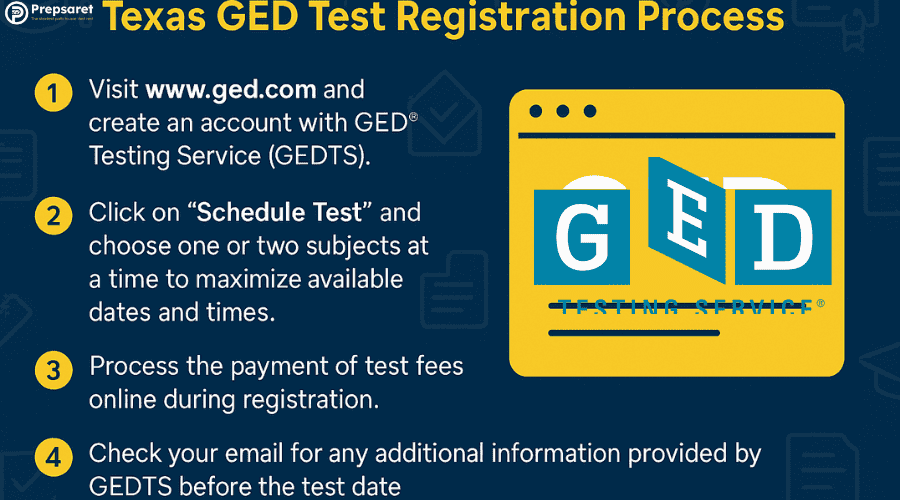
Once you feel adequately prepared, the next step is to schedule your GED test. All GED testing in Texas is administered at official GED testing centers.
- Finding a Testing Center: You can locate approved GED testing centers in Texas by visiting the official GED Testing Service website (ged.com). The website provides a search tool where you can enter your location to find nearby testing facilities. Popular cities like Austin, Fort Worth, and El Paso have multiple testing center options.
- Creating a GED.com Account: To register and schedule your tests, you will need to create an account on the GED.com website. This account will serve as your central hub for managing your tests, viewing scores, and accessing study resources.
- Registering and Paying for Tests: You can register and pay for each subject test individually through your GED.com account. The fee for each subject test can vary, so it’s advisable to check the current pricing on the GED.com website. Some AEL programs may offer vouchers or assistance with testing fees.
- Test Day Procedures: On the day of your test, arrive at the testing center early. You will need to bring a valid, government-issued photo ID. Be prepared for security measures, which may include ID checks and a brief scanning process. Familiarize yourself with the testing center’s policies regarding personal belongings, such as cell phones and bags.
The GED Test Experience and Beyond
Passing the GED test is a significant achievement, but it’s also the beginning of new possibilities. Understanding what to expect on test day and how to leverage your new credential is crucial.
What to Expect on Test Day
The GED test is administered on computer at official testing centers. Here’s a breakdown of what you can anticipate:
- Computer-Based Testing: All GED subject tests are taken on a computer. You will be provided with a computer and a headset. The testing software is user-friendly and includes features like a calculator, a highlighter, and a way to flag questions for review.
- Test Duration: Each GED subject test has a specific time limit. The RLA test is approximately 2 hours and 10 minutes, Mathematical Reasoning is about 2 hours, Science is about 1 hour and 30 minutes, and Social Studies is about 1 hour and 10 minutes. Breaks are permitted between sections, but the clock continues to run.
- Passing Scores: To pass the GED test, you need to achieve a minimum score of 145 on each of the four subject tests. The total score across all four tests is not used for passing. You will receive your scores shortly after completing each test.
- Retaking Tests: If you do not pass a particular subject test, you can retake it. Texas offers a grace period for retakes with reduced fees after the initial attempt. It is important to review the specific policies regarding retakes on the GED.com website or by contacting the Texas GED Program.

Leveraging Your GED Credential
Earning your GED in Texas opens up a world of opportunities. It signifies that you possess the academic skills equivalent to a high school graduate.
- Higher Education: Your GED credential is widely accepted by colleges and universities in Texas and across the nation. This includes institutions like the University of Texas at Austin, Texas A&M University, and the University of Houston. You can pursue associate’s degrees, bachelor’s degrees, and vocational training programs.
- Employment: Many employers in Texas, from retail and customer service to skilled trades and administrative roles, recognize the GED as a requirement for employment. It demonstrates a commitment to education and a baseline level of competency. Consider industries in Houston‘s energy sector or Dallas‘s financial services for potential career paths.
- Career Advancement: For individuals already in the workforce, a GED can be a stepping stone to promotions, new career paths, or entry into specialized training programs that lead to better-paying jobs. It can be particularly beneficial in fields like healthcare, manufacturing, and technology.
- Personal Fulfillment: Beyond practical benefits, earning your GED can bring immense personal satisfaction. It is a testament to your perseverance, dedication, and ability to set and achieve challenging goals. This sense of accomplishment can have a profound positive impact on your self-esteem and overall outlook on life.
By following the outlined steps and utilizing the available resources, you can successfully navigate the process of obtaining your GED in Texas and embark on a brighter future. The journey may require effort and dedication, but the rewards of achieving this significant educational milestone are immeasurable.