
Embarking on a career as a commercial driver in Texas offers a unique blend of freedom, responsibility, and the opportunity to explore vast stretches of the United States. From the bustling metropolises of Houston and Dallas to the scenic routes connecting El Paso to Corpus Christi, a Commercial Driver’s License (CDL) opens doors to a dynamic lifestyle. This isn’t just a job; for many, it’s a way of life that intertwines with travel, diverse experiences, and often, a surprising amount of interaction with the local tourism and accommodation industries. If you’ve ever considered driving the open road, transporting vital goods, or ferrying passengers across this great state and beyond, understanding the precise steps to obtain your CDL in Texas is your first crucial destination.

This comprehensive guide will navigate you through the intricate process, from initial eligibility to passing your final skills test. We’ll demystify the requirements, outline the training pathways, and provide insights into the exciting career possibilities that await. Prepare to hit the road – your journey to a Texas CDL starts here.
Understanding the Foundation: Eligibility and CDL Classes
Before you can even think about getting behind the wheel of a commercial vehicle, you must meet a specific set of eligibility criteria established by both federal and state regulations. These requirements are in place to ensure that all commercial drivers possess the necessary maturity, physical health, and responsible driving history to operate large vehicles safely.
Initial Eligibility Requirements
To qualify for a CDL in Texas, you must typically meet the following fundamental criteria:
- Age: You must be at least 18 years old to drive a commercial motor vehicle (CMV) within Texas state lines. To drive a CMV across state lines (interstate commerce), you must be at least 21 years old. This 21-year-old requirement also applies if you plan to transport hazardous materials or operate passenger vehicles.
- Residency: You must be a legal resident of Texas. This usually means providing proof of residency, such as a utility bill, voter registration card, or lease agreement, along with your valid Texas driver’s license.
- Driving Record: Your driving history will be scrutinized. You must have a clean driving record, generally free of serious violations such as DUIs, reckless driving, or leaving the scene of an accident. Certain serious offenses can disqualify you from obtaining a CDL for a specified period or even permanently.
- English Proficiency: You must be able to read and speak English sufficiently to understand traffic signs and signals, respond to official inquiries, and communicate with the public. This is a crucial safety requirement.
- Medical Certification: All CDL holders must pass a Department of Transportation (DOT) physical examination, conducted by a certified medical examiner. This ensures you are physically capable of operating a CMV safely. The medical examiner will assess your vision, hearing, blood pressure, and overall physical and mental health. Upon passing, you will receive a Medical Examiner’s Certificate (Med Card), which must be kept current and on file with the Texas Department of Public Safety (DPS).
Deciphering CDL Classes and Endorsements
The type of CDL you pursue will depend entirely on the type of commercial vehicle you intend to operate. There are three primary classes of CDLs, each with specific weight and passenger capacities. Furthermore, endorsements are specialized additions to your CDL that permit you to operate certain types of vehicles or carry specific cargo.
- Class A CDL: This is the highest class of CDL and allows you to operate any combination of vehicles with a Gross Combination Weight Rating (GCWR) of 26,001 pounds or more, provided the Gross Vehicle Weight Rating (GVWR) of the vehicle(s) being towed is in excess of 10,000 pounds. This is typically for tractor-trailers, truck and trailer combinations, and flatbeds. A Class A CDL offers the broadest range of job opportunities, often involving long-haul travel across state lines, allowing drivers to experience a wide array of cities and landscapes.
- Class B CDL: This license permits you to operate a single vehicle with a GVWR of 26,001 pounds or more, or a vehicle towing a trailer not exceeding 10,000 pounds GVWR. Common vehicles requiring a Class B CDL include straight trucks, box trucks, large buses, and dump trucks. Many local delivery jobs in Dallas or San Antonio, construction roles, or public transit positions fall under this category.
- Class C CDL: This is for vehicles not covered by Class A or B, but are designed to transport 16 or more passengers (including the driver), or transport hazardous materials that require placarding under federal regulations. Small hazardous materials trucks or passenger vans often fall into this class.
Endorsements: Beyond the basic classes, endorsements are specialized qualifications indicated on your CDL. To obtain an endorsement, you usually need to pass additional knowledge tests and sometimes a skills test. Common endorsements include:
- H (Hazardous Materials): For transporting hazardous materials. Requires a background check and TSA threat assessment.
- N (Tank Vehicle): For operating tank vehicles designed to transport liquid or gaseous materials.
- P (Passenger): For operating vehicles designed to transport passengers (e.g., buses). Requires a skills test in a passenger vehicle.
- S (School Bus): Required for operating a school bus. Involves specific knowledge and skills tests, plus a background check.
- T (Double/Triple Trailers): For pulling double or triple trailers (not permitted in all states, but knowledge is tested).
- X (Tanker and Hazardous Materials): A combination of H and N endorsements.
Choosing the right class and necessary endorsements is a critical first step, as it will dictate your study materials and the type of vehicle you train with.
The Road to Licensure: From Permit to Professional Driver
Once you’ve confirmed your eligibility and decided on the appropriate CDL class and endorsements, the actual process of obtaining your license begins. This journey typically involves several key stages: obtaining a Commercial Learner’s Permit (CLP), completing mandatory Entry-Level Driver Training (ELDT), and finally, passing the rigorous CDL skills test.
Step 1: Obtain Your Commercial Learner’s Permit (CLP)
The Commercial Learner’s Permit (CLP) is your first official document on the path to a CDL. Think of it as a learner’s permit for a car, but for commercial vehicles. To get a CLP in Texas, you must:
- Submit Your Application: Visit a Texas Department of Public Safety (DPS) office. You’ll need to bring your valid Texas driver’s license, proof of U.S. citizenship or lawful permanent residency, and proof of Texas residency.
- Pass the DOT Physical: Present your valid Medical Examiner’s Certificate (Med Card). Your medical information will be recorded on your driving record.
- Pass Knowledge Tests: You must pass general knowledge tests for the specific CDL class you are seeking, as well as any endorsements you wish to obtain (e.g., air brakes, combination vehicles, hazardous materials). These tests cover topics like safe driving practices, vehicle inspection, air brakes, and transportation regulations. Studying the Texas CDL Manual is essential for this stage.
- Pay Fees: There are application and permit fees associated with obtaining your CLP.
Once you have your CLP, you are authorized to practice driving a commercial vehicle on public roads, but only with a qualified CDL holder present in the passenger seat. Your CLP is valid for 180 days and can be renewed once for another 180 days. You must hold your CLP for a minimum of 14 days before you can take the CDL skills test.
Step 2: Complete Entry-Level Driver Training (ELDT)
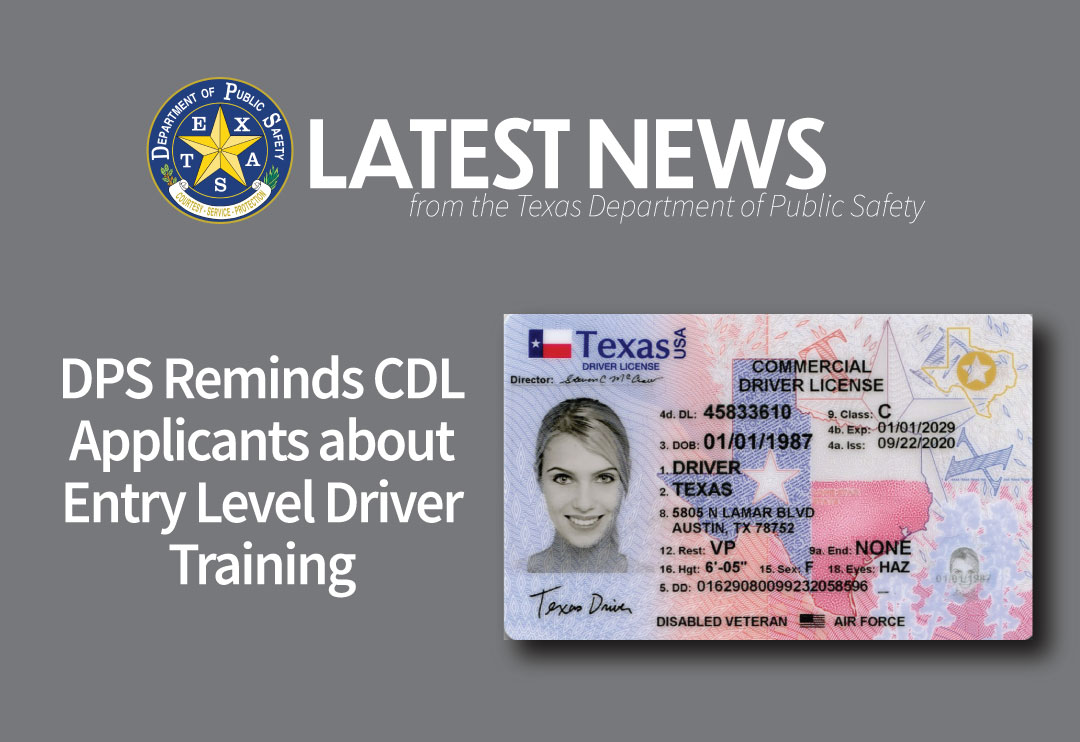
As of February 7, 2022, the Federal Motor Carrier Safety Administration (FMCSA) mandates that all individuals seeking a Class A or Class B CDL, or an S, P, or H endorsement for the first time, must complete specific Entry-Level Driver Training (ELDT). This training must be provided by a school or entity listed on the FMCSA’s Training Provider Registry (TPR).
ELDT consists of two main components:
- Theory Instruction: This covers a comprehensive curriculum including basic operation, safe operating procedures, advanced operating practices, vehicle systems, and non-driving activities (e.g., cargo handling, hours of service). This can be completed online or in a classroom setting.
- Behind-the-Wheel (BTW) Training: This is hands-on instruction in a commercial vehicle on a driving range and public roads. It focuses on practical skills such as vehicle inspection, basic controls, shifting, backing maneuvers, coupling and uncoupling (for Class A), and safe driving in various traffic conditions.
Choosing the right ELDT provider is crucial. Many CDL schools in major Texas cities like Austin, Houston, and Fort Worth offer comprehensive programs. When researching schools, consider factors such as:
- Accreditation and TPR Listing: Ensure they are legitimately listed on the FMCSA TPR.
- Program Length and Structure: Some offer intensive multi-week programs, while others might be more flexible.
- Vehicle Availability: Do they have modern, well-maintained vehicles representative of what you’ll drive?
- Instructor Experience: Look for experienced and patient instructors.
- Job Placement Assistance: Many schools offer help connecting graduates with trucking companies, which can be invaluable for new drivers.
- Accommodation options: If you’re traveling for training, proximity to suitable accommodation (be it budget hotels, extended-stay suites, or even local apartment rentals) might be a consideration.
Upon successful completion of both theory and BTW training, your training provider will electronically submit your certification to the FMCSA. This certification is required before you can schedule your CDL skills test.
Step 3: Pass the CDL Skills Test
This is the final hurdle to obtaining your CDL. The skills test is a comprehensive, three-part examination designed to assess your practical driving abilities and knowledge. You must pass all three components in the same testing session.
- Vehicle Inspection Test: You will be required to perform a pre-trip inspection of the commercial vehicle, identifying various components and explaining whether they are in good working order. This includes checking under the hood, around the exterior, and inside the cab. Knowledge of air brakes and fluid levels is critical.
- Basic Controls Test: This segment assesses your ability to control the vehicle in a controlled environment. It typically involves a series of maneuvering exercises, such as straight-line backing, offset backing, and parallel parking (both driver side and conventional). Precision and smooth execution are key.
- Road Test: This is the practical driving portion on public roads, supervised by a Texas Department of Public Safety (DPS) examiner. You will be evaluated on your ability to safely operate the commercial vehicle in various traffic situations, including starting, stopping, turning, lane changes, merging, highway driving, and railroad crossings. The examiner will be looking for safe driving habits, adherence to traffic laws, and proper use of vehicle controls.
Once you successfully pass all three parts of the CDL skills test, you will return to a Texas DPS office to pay the final fees and have your photograph taken. You will then be issued your official Texas CDL!
The Commercial Driving Lifestyle in Texas
Beyond the paperwork and practical tests, earning your CDL in Texas ushers in a new lifestyle, brimming with opportunities and unique challenges. It’s a career path that resonates strongly with the “Travel” and “Lifestyle” themes of lifeoutofthebox.com, offering an unparalleled perspective on the country.
The Open Road and Travel Opportunities
As a commercial driver, your office becomes the open road. From the vast deserts of West Texas near Big Bend National Park to the piney woods of East Texas, you’ll witness diverse landscapes and encounter countless cities. Long-haul drivers often cross multiple states, making deliveries from Houston to destinations as far-flung as Yellowstone National Park’s gateway communities or even across borders into Mexico or Canada. This constant movement offers a different kind of “travel” experience, far removed from the typical tourist’s itinerary. You’ll become intimately familiar with interstate highways, learn the best truck stops for amenities, and discover hidden gems along your routes. For those with a wanderlust spirit, even if it’s from the cab of a big rig, a CDL can be an ideal fit.
Accommodation and Downtime
The commercial driving lifestyle also brings unique considerations for accommodation. While many drivers spend nights in their sleeper cabs, others opt for more comfortable stays. The demand for truck-friendly hotels and motels near major trucking routes is significant. Companies like Pilot Flying J and Love’s Travel Stops often partner with budget hotels or offer their own driver-specific suites and amenities. During home time or longer breaks, drivers might choose to indulge in different types of accommodation, perhaps a resort for relaxation or a cozy apartment rental for a longer family visit.
Downtime also presents opportunities for local tourism. A long layover in San Antonio could mean a visit to the historic Alamo or a stroll along the Riverwalk. A stop near Houston might allow for a quick trip to Space Center Houston. Even a short break can be an occasion to explore a local diner, visit a regional landmark, or simply enjoy the unique culture of a new town. The career encourages a pragmatic approach to travel, where comfort, convenience, and value are often prioritized, aligning with both budget travel and practical lifestyle considerations.
Professional Growth and Earnings
A CDL is not just a license; it’s a valuable credential that can lead to a stable and lucrative career. With experience, drivers can specialize in various sectors, from hazmat transport to oversized loads, often commanding higher pay. The demand for skilled commercial drivers remains consistently high, offering job security. For many, the ability to earn a good living while experiencing the country’s diverse landscapes is a powerful motivator, providing a tangible connection between their profession and a fulfilling life of continuous learning and exploration.
Conclusion
Obtaining your Commercial Driver’s License in Texas is a demanding yet incredibly rewarding endeavor. It requires dedication to study, commitment to training, and a strong sense of responsibility. From understanding the initial eligibility and choosing the correct CDL class to navigating the complexities of ELDT and conquering the skills test, each step brings you closer to a fulfilling career.
The journey to earning your CDL is more than just acquiring a permit; it’s about embracing a new profession that blends essential service with a unique travel-centric lifestyle. Whether you dream of long-haul adventures across the continent, or prefer the consistent routes within your home state, a Texas CDL is your key to unlocking these opportunities. Prepare well, stay focused, and soon you’ll be joining the ranks of professional drivers, contributing to the backbone of the economy while charting your own course on the open roads of Texas and beyond.