
Texas Hold’em, the undisputed king of poker, has captivated players worldwide with its blend of strategy, psychology, and a touch of luck. While the game appears deceptively simple at first glance – five community cards, two hole cards, and the goal of making the best five-card hand – mastering its intricacies can be a lifelong pursuit. This guide will break down the fundamentals of Texas Hold’em, from the initial deal to the triumphant river card, ensuring you’re well-equipped to join a game, whether it’s a friendly home game in Las Vegas or a high-stakes tournament in Monaco.

The allure of Texas Hold’em extends beyond the felt of a casino. It’s a social lubricant, a mental workout, and for some, a path to significant winnings. Understanding the rules is the first, crucial step. From there, developing a sound strategy, learning to read your opponents, and managing your bankroll become paramount. This article aims to provide a comprehensive overview, empowering you to not just play, but to play with confidence and a degree of skill.
The game is played with a standard 52-card deck. The objective is to form the best possible five-card poker hand by combining your two private “hole” cards with the five “community” cards dealt face-up on the table. Hands are ranked according to established poker hand rankings, with a Royal Flush being the highest and a High Card being the lowest.
The Anatomy of a Texas Hold’em Hand
Before diving into the betting rounds and strategic nuances, it’s essential to understand the progression of a Texas Hold’em hand. Each hand unfolds in distinct stages, offering opportunities for players to bet, raise, call, or fold.
The Pre-Flop: Your Initial Hand
The game begins with each player receiving two cards face down. These are your hole cards, and they are private. The identity of these cards is known only to you. The strength of your starting hand is a significant factor in your decision-making throughout the hand. Some starting hands are inherently stronger than others, while some have greater potential to improve as more community cards are revealed.
Following the deal of hole cards, the first round of betting commences. This is known as the pre-flop betting round. The player to the immediate left of the big blind acts first. They have the option to fold, call the amount of the big blind, or raise. The betting continues clockwise around the table until all active players have placed an equal amount of chips into the pot or have folded.
The Flop: Three Community Cards
Once the pre-flop betting is complete, the dealer reveals the first three community cards, placing them face-up in the center of the table. This is called “the flop.” These three cards are shared by all players and can be used in conjunction with their hole cards to form a poker hand.
A second round of betting follows the flop. The player to the left of the dealer button (or the first active player to the left of the button) initiates the action. Again, players can check (if no bet has been made), bet, call, raise, or fold. The decision-making here becomes more complex as players can now potentially form stronger hands with the three community cards.
The Turn: The Fourth Community Card
After the betting on the flop concludes, the dealer reveals the fourth community card, known as “the turn,” placing it face-up next to the flop. This card adds another layer of possibility to hand formation.
A third round of betting ensues, mirroring the structure of the previous betting rounds. By the turn, players often have a clearer picture of the potential winning hands at the table. This is where bluffing and strategic betting can become particularly pronounced.
The River: The Final Community Card
The fifth and final community card is dealt face-up, and this is called “the river.” This is the last card to be revealed, and with it, all the community cards are now visible.
The final betting round takes place after the river card is dealt. Once this round of betting is complete, if there is more than one player remaining, it’s time for the showdown.
The Showdown: Revealing the Best Hand
If two or more players remain in the hand after the final betting round, the showdown occurs. The player who made the last aggressive action (bet or raise) typically reveals their hand first. If there was no bet on the river, the player to the left of the dealer button shows their hand first.
Players then reveal their hole cards, and the player who can form the best five-card poker hand using any combination of their two hole cards and the five community cards wins the pot. The pot is the accumulation of all bets made by players during the hand.
Poker Hand Rankings: The Foundation of Winning
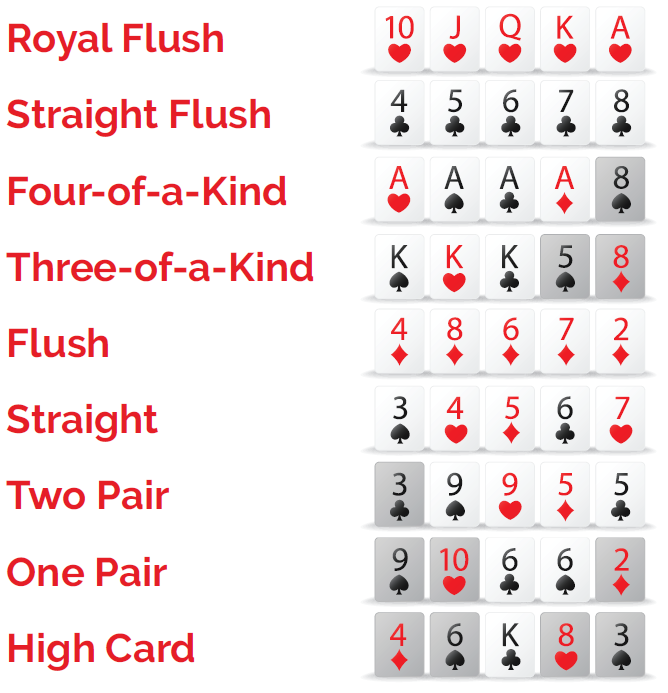
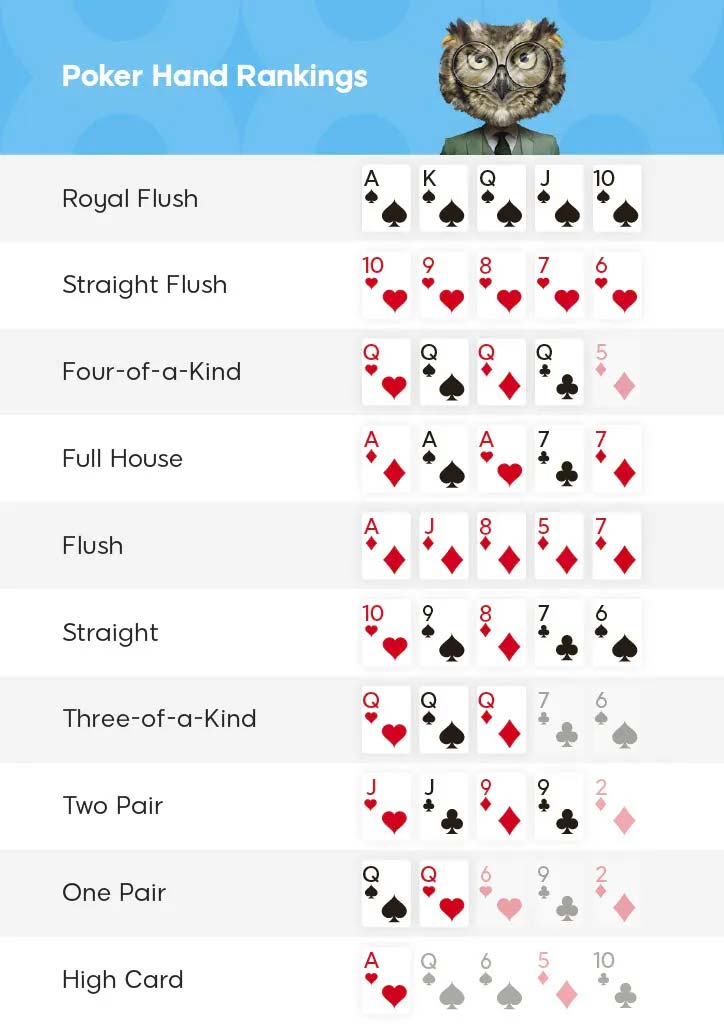
Understanding the hierarchy of poker hands is non-negotiable for playing Texas Hold’em. Knowing which hand beats another allows you to assess your own hand’s strength and your opponents’ potential holdings.
- Royal Flush: Ace, King, Queen, Jack, Ten of the same suit. (e.g., A♥ K♥ Q♥ J♥ 10♥)
- Straight Flush: Five cards in sequence, all of the same suit. (e.g., 9♠ 8♠ 7♠ 6♠ 5♠)
- Four of a Kind: Four cards of the same rank. (e.g., 7♥ 7♦ 7♣ 7♠ K♦)
- Full House: Three cards of one rank and two cards of another rank. (e.g., J♣ J♥ J♠ 4♦ 4♣)
- Flush: Five cards of the same suit, not in sequence. (e.g., K♦ 9♦ 7♦ 4♦ 2♦)
- Straight: Five cards in sequence, but not all of the same suit. (e.g., 10♣ 9♥ 8♠ 7♦ 6♣)
- Three of a Kind: Three cards of the same rank. (e.g., 5♥ 5♦ 5♠ Q♣ 8♦)
- Two Pair: Two cards of one rank and two cards of another rank. (e.g., A♠ A♦ 9♥ 9♣ 3♦)
- One Pair: Two cards of the same rank. (e.g., K♥ Q♦ J♠ J♣ 7♠)
- High Card: If no player has any of the above hands, the player with the highest-ranking card wins. (e.g., A♣ K♠ 7♦ 4♥ 2♣)
In cases where players have the same hand category, the ranking is determined by the highest card(s) within that hand. For example, if two players have a pair of Kings, the player with the higher kicker card (the highest unpaired card) wins. If the kickers are also the same, the pot is split.
Navigating the Betting Rounds: Strategy and Tactics
The betting structure in Texas Hold’em is what truly separates the novices from the seasoned players. Each betting round presents an opportunity to gather information, build the pot, or force opponents out.
Blinds and Button Position
Before any cards are dealt, two players are obligated to post “blinds.” The player immediately to the left of the dealer button posts the “small blind,” and the player to their left posts the “big blind,” which is typically double the small blind. These blinds ensure there is always money in the pot to play for, even before the first card is dealt. The dealer button rotates clockwise after each hand, meaning everyone eventually gets a chance to be in every position, including the blinds and the button.
The position of a player relative to the dealer button is a crucial strategic element. Players acting later in a betting round (closer to the button) have the advantage of seeing how their opponents act before they have to make a decision. This “late position” is often considered the most profitable place to play hands. Conversely, playing in early positions requires a tighter, more selective approach to starting hands.
Betting Actions Explained
- Check: If no bet has been made before you in a betting round, you can “check.” This means you do not wish to bet, but you are not folding either. Your turn to act passes to the next player. Checking is only possible if there is no active bet to call.
- Bet: To initiate a betting round when no bet has been made. You place chips into the pot.
- Call: To match the amount of the current bet or raise.
- Raise: To increase the current bet. When a player raises, subsequent players must call the new, higher amount, re-raise, or fold.
- Fold: To discard your hand and forfeit any chance of winning the current pot. You lose any chips you have already contributed to the pot in that hand.
The Importance of Pot Odds and Implied Odds
Beyond the mechanics of betting, understanding poker mathematics is vital. Pot odds are the ratio of the current size of the pot to the cost of a contemplated call. If the pot is large and the bet you need to call is small, you have good pot odds. This means you might be justified in calling if you believe you have a reasonable chance of making a winning hand.
Implied odds consider the potential future winnings if you make your hand. This is particularly relevant when you have a drawing hand (a hand that needs certain cards to improve, like a flush draw or a straight draw). Even if the current pot odds aren’t favorable, if you believe you can win a significant amount of money from your opponents on later streets if you complete your draw, it might be worth calling.
Bluffing and Reading Opponents
Texas Hold’em is not just about the cards you’re dealt; it’s also a game of deception and observation. Bluffing, the act of betting or raising with a hand that is unlikely to be the best, is a critical component. A successful bluff can win you pots you wouldn’t otherwise win. However, it’s a risky play and requires careful consideration of your opponents’ tendencies and the board texture.
Learning to read your opponents is an ongoing skill. Observe their betting patterns, their physical tells (if playing live), and their general demeanor. Do they bet aggressively when they have a strong hand? Do they seem hesitant? Do they appear nervous? These observations can provide invaluable clues about the strength of their holdings.
Bankroll Management
For anyone serious about playing Texas Hold’em, especially for stakes beyond casual home games, bankroll management is paramount. Your bankroll is the total amount of money you have set aside specifically for playing poker. Sound bankroll management ensures you can withstand the natural variance (swings of luck) inherent in the game without going broke. A common guideline is to have at least 20-30 buy-ins for the stakes you are playing. For example, if you play in a $1/$2 No-Limit Hold’em game where the buy-in is typically $200, you should ideally have $4,000-$6,000 in your bankroll.
Texas Hold’em is a journey of continuous learning. As you gain experience, you’ll develop your own playing style, refine your strategies, and become more adept at reading the game. Whether you’re playing for leisure at a cozy bed and breakfast in the countryside or aiming for the bright lights of a World Series of Poker event, the fundamental rules and principles remain the same. Embrace the learning process, enjoy the challenge, and may your cards be ever favorable.