
Planning a trip to the Sunshine State often involves dreaming of pristine beaches, thrilling theme parks, and vibrant city life. However, one crucial detail that can sometimes catch travelers off guard is Florida‘s unique time zone situation. While much of the state proudly operates within the Eastern Time Zone, a significant portion of its western Florida Panhandle observes the Central Time Zone. Understanding this geographical split is not just a matter of trivial knowledge; it’s essential for seamless travel planning, managing expectations, and making the most of every precious moment in this diverse and enchanting destination.
This comprehensive guide will delve into the intricacies of Florida’s time zones, explore how they impact your travel experience, from booking flights and accommodations to scheduling attractions, and offer insights into the distinct charm of each region. Whether you’re chasing the sunrise over the Atlantic Ocean or witnessing a spectacular sunset over the Gulf of Mexico, being time-aware will ensure your Florida adventure unfolds without a hitch.
Decoding Florida’s Time Zones: More Than Meets the Eye
When most people think of Florida, they automatically associate it with the Eastern Time Zone (ET). Indeed, the vast majority of the state, including its most populous cities and renowned tourist hubs, adheres to this standard. However, to truly answer the question, “Is Florida Eastern Time Zone?”, we must acknowledge the notable exception that carves out a distinct temporal boundary within the state.
The Eastern Time Zone Majority
The bulk of Florida operates on Eastern Standard Time (EST) during the winter months and Eastern Daylight Time (EDT) during Daylight Saving Time. This encompasses the entire peninsula, stretching from the bustling streets of Miami in the south, through the theme park mecca of Orlando, up to the historic charm of St. Augustine and the vibrant city of Jacksonville in the north. This also includes the popular Florida Keys, with gems like Key West, and the lively Gulf Coast cities of Tampa, St. Petersburg, and Naples.
For travelers arriving in these regions, coordinating flights, hotel check-ins, and attraction schedules is straightforward, as the entire area observes a uniform time. This consistency simplifies planning, whether you’re exploring the magical realms of Walt Disney World Resort and Universal Orlando Resort, relaxing on South Beach, or discovering the aerospace wonders at the Kennedy Space Center Visitor Complex.

The Panhandle Exception: Central Time’s Influence
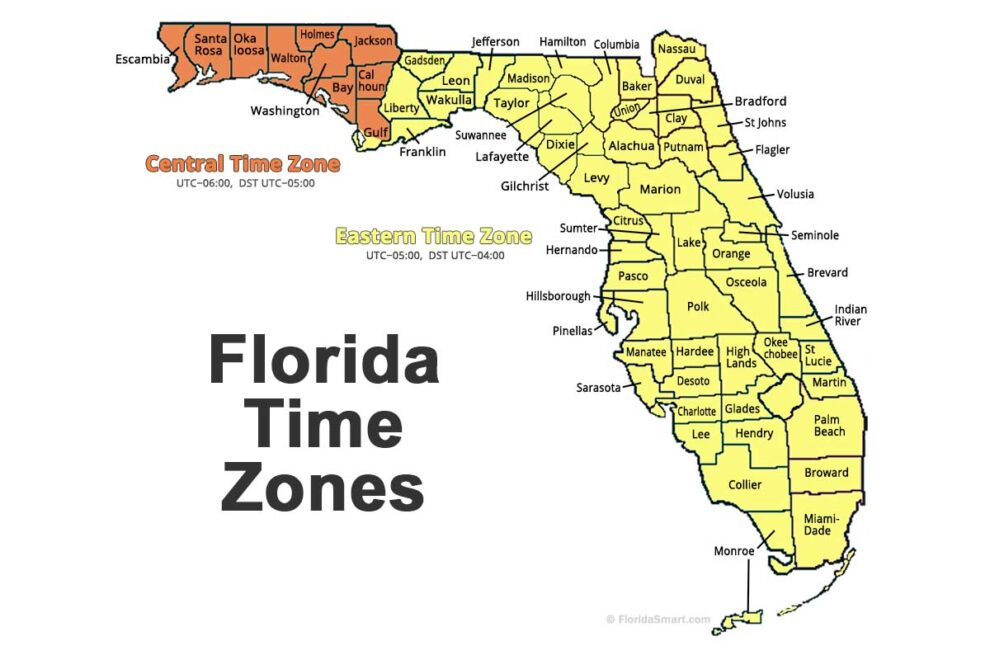
The key to understanding Florida’s time zone complexity lies in its panhandle. The western part of the Florida Panhandle observes Central Standard Time (CST) and Central Daylight Time (CDT). The dividing line is roughly along the Apalachicola River. This means cities west of the river, such as Tallahassee (the state capital), Pensacola, Panama City Beach, and Destin, are one hour behind the rest of the state.
This distinction is largely due to historical and geographical ties. The Florida Panhandle shares a border with Alabama and Georgia, both of which largely observe the Central Time Zone. Specifically, eight counties are entirely within the Central Time Zone: Bay, Calhoun, Escambia, Holmes, Jackson, Okaloosa, Santa Rosa, Walton, and Washington. A ninth county, Gulf County, is split by the Apalachicola River, with its western portion adhering to Central Time and its eastern portion to Eastern Time.

For travelers, this means a significant time change when driving across the state, particularly if your journey takes you between the main peninsula and the western panhandle. Missing a flight, an appointment, or a reservation due to a one-hour time difference can be a significant hassle, emphasizing the importance of double-checking time zones for all segments of your trip.
Daylight Saving Time in the Sunshine State
Like most of the United States, Florida observes Daylight Saving Time (DST). This means that clocks “spring forward” one hour in the early spring and “fall back” one hour in the autumn. Both the Eastern and Central Time portions of Florida follow this practice, maintaining their respective one-hour difference throughout the year.
While there have been discussions and even legislative efforts to keep Florida on permanent Daylight Saving Time (effectively making it two hours ahead of Central Standard Time year-round), as of now, the state continues to observe the twice-yearly clock changes. This further reinforces the need for travelers to verify local times, especially if their visit coincides with the start or end of DST.
Navigating Time Zones for a Seamless Florida Experience
Understanding Florida’s dual time zones is more than just an interesting fact; it’s a critical component of effective travel planning. From the moment you begin envisioning your trip to the minute you depart, being mindful of the temporal divisions will ensure a smooth, stress-free journey.
Planning Your Itinerary: Crucial Considerations
When crafting your Florida itinerary, especially if it involves travel between the peninsula and the panhandle, time zone awareness should be a top priority.
- Flights and Transportation: If you’re flying into a Panama City Beach airport but have an early morning meeting in [Tallahassee](https://lifeoutofthebox.com/tallahassee] (both in CT) after spending a few days in Orlando (ET), remember that you will “lose” an hour when heading west or “gain” an hour when heading east. Always confirm the local time for arrivals and departures. Bus and train schedules will also reflect local times at each stop.
- Attraction Timings: Theme parks, museums, and natural landmarks like Everglades National Park or Dry Tortugas National Park operate on strict schedules. A 9 AM opening time in Orlando (ET) is different from a 9 AM opening time in Pensacola (CT). Double-check the time zone of the attraction’s location when planning your visit, especially for timed entry tickets or show schedules.
- Dining Reservations and Events: From a sunset cruise in Sarasota to a dinner reservation in Fort Lauderdale, timing is everything. If you’re coordinating with friends or family arriving from different parts of Florida or even the United States, explicitly stating the time zone for meet-ups is crucial to avoid confusion.
Booking Accommodation and Travel Across Time Lines
When booking hotels, resorts, apartments, or villas, confirm their location relative to the time zone. Most online booking platforms will display the local check-in/check-out times, but it’s always wise to verify, especially if your arrival or departure day involves crossing the time zone boundary. For example, a traveler driving from Miami (ET) to a beachfront resort in Destin (CT) needs to factor in both the driving time and the one-hour time shift.
Consider the implications for different types of accommodation:
- Luxury Resorts: High-end resorts like The Breakers Palm Beach or [Fontainebleau Miami Beach](https://lifeoutofthebox.com/fontainebleau-miami-beach] are typically well-versed in handling diverse guest arrivals. However, understanding their local time ensures you arrive punctually for concierge services, spa appointments, or fine dining experiences.
- Family-Friendly Stays: For family trips, especially with young children, disruptions to routine can be challenging. Knowing the local time helps adjust feeding schedules, nap times, and bedtimes. If staying at a resort like Four Seasons Resort Orlando at Walt Disney World Resort, aligning with Orlando’s Eastern Time is paramount for maximizing theme park hours.
- Long-Term Stays: If you’re planning a longer visit or a business trip, living on the correct local time from the outset is vital for establishing a comfortable routine and avoiding any confusion with local services or appointments.
Business and Communication: Staying on Schedule
For business travelers or those needing to stay connected with work or family during their Florida vacation, time zone awareness is paramount. A 9 AM conference call scheduled from New York means a 9 AM call in Miami (both ET) but an 8 AM call in Pensacola (CT). Conversely, a client in Chicago (CT) scheduling a 2 PM meeting will expect you in Tallahassee (CT) to join at 2 PM, but you would need to adjust your Orlando (ET) clock to 3 PM. Always confirm the time zone of your counterpart to prevent missed connections and ensure smooth communication.
Exploring Florida’s Diverse Regions and Their Timeless Allure
Florida’s appeal lies in its incredible diversity, offering everything from bustling urban centers to serene natural escapes. Each region, influenced by its time zone, presents a unique character and a wealth of experiences.
East Coast Gems: From Miami’s Buzz to Orlando’s Magic
Operating entirely within the Eastern Time Zone, Florida’s East Coast is a vibrant tapestry of culture, entertainment, and natural beauty.
- Miami & Fort Lauderdale: These southern coastal cities are renowned for their energetic nightlife, stunning beaches like South Beach, and distinct Art Deco Historic District. Miami also serves as a major cruise port, connecting travelers to the Caribbean.
- Orlando: The undisputed theme park capital of the world, home to Walt Disney World Resort and Universal Orlando Resort, offers endless entertainment for families. Its Eastern Time operation ensures consistent scheduling for park hopping and dining.
- Space Coast & Daytona Beach: Further north, the Space Coast is where you can witness rocket launches from the Kennedy Space Center Visitor Complex. Daytona Beach is famous for its motorsports and expansive sandy shores.
- Palm Beach & Jacksonville: Offering luxury resorts, high-end shopping, and a sophisticated ambiance, Palm Beach contrasts with Jacksonville, a sprawling city known for its vibrant arts scene and beautiful beaches.
- Florida Keys: Stretching southwest into the Gulf of Mexico, the Florida Keys (including Key West) are a paradise for diving, fishing, and laid-back island vibes, all firmly on Eastern Time.
West Coast Wonders: Beaches and Beyond
The peninsula’s Gulf Coast, while still in the Eastern Time Zone, offers a different pace and ambiance compared to its eastern counterpart.
- Tampa & St. Petersburg: Tampa combines a historic charm with modern attractions like Busch Gardens Tampa Bay. St. Petersburg boasts award-winning beaches and a thriving arts scene, including the Dalí Museum.
- Sarasota & Naples: Known for its cultural institutions, beautiful beaches, and upscale living, Sarasota offers a refined Florida experience. Naples provides a luxurious escape with stunning Gulf Coast sunsets and championship golf courses.
- Nature Escapes: This side of the state also provides access to natural wonders such as Everglades National Park and Biscayne National Park, offering opportunities for airboat rides, wildlife viewing, and kayaking.
The Panhandle’s Unique Charm: A Central Time Retreat
Crossing the invisible time zone line into the Florida Panhandle brings you to a region with a distinct Southern character, often referred to as “Old Florida.” These areas operate on Central Time, offering a slightly different rhythm.
- Tallahassee: The state capital, Tallahassee, blends history and politics with beautiful natural surroundings. It’s home to historic sites and vibrant university life.
- Pensacola & Pensacola Beach: With its stunning sugar-white sands and emerald waters, Pensacola Beach offers a relaxing Gulf Coast getaway. Pensacola itself boasts a rich naval history and a charming downtown.
- Panama City Beach & Destin: These cities are famed for their family-friendly attractions, vibrant nightlife, and some of the most beautiful beaches in the United States. Their Central Time status means sunsets arrive an hour later than on the Eastern Time Gulf Coast, extending beach leisure into the evening.
Lifestyle and Leisure: Making the Most of Florida Time
Beyond logistics, understanding Florida’s time zones can profoundly impact your overall vacation experience, influencing everything from managing jet lag to enjoying local culinary scenes.
Adapting to the Pace: Jet Lag and Relaxation
For those traveling from significantly different time zones, especially international visitors or those from the Pacific or Mountain Time Zones in the United States, adapting to Florida’s time can take a day or two. Even the one-hour shift when crossing from Eastern to Central Time within the state can subtly affect your internal clock.
- Strategic Arrival: If possible, plan your arrival to coincide with late afternoon or early evening local time. This allows you to have dinner and go to bed at a reasonable local hour, helping to reset your circadian rhythm.
- Hydration and Light Exposure: Stay hydrated and expose yourself to natural light in the mornings to help adjust.
- Flexibility: Build some flexibility into your initial itinerary, especially if moving between the Eastern and Central Time zones. Don’t schedule anything critical immediately after a time zone crossing. Allow yourself to ease into the local rhythm.
Culinary Delights and Evening Entertainment
Florida’s culinary scene is as diverse as its landscapes, offering everything from fresh seafood to international gourmet experiences. The time zone can influence when you dine and experience local nightlife.
- Early Dinners on the East Coast: In Miami or Orlando, an early dinner reservation might mean sunset dining during certain times of the year, particularly if you’re close to the Atlantic Ocean.
- Later Sunsets in the Panhandle: The Central Time Zone means that sunsets in Destin or Panama City Beach occur an hour later than on the comparable latitude of the Eastern Time side. This can extend your beach time or provide a more leisurely approach to evening activities and dining. Many restaurants and bars adjust their happy hour and entertainment schedules to align with the later sunsets, creating a relaxed, extended evening vibe.
- Nightlife: From Miami’s pulsating clubs to Key West’s lively Duval Street, Florida’s nightlife operates on local time. Be sure to check operating hours according to the specific time zone you are in.
Maximizing Your Vacation: Tips for Time Management
To truly master the art of time management during your Florida vacation, consider these practical tips:
- Use a Multi-Time Zone Clock: Many smartphones and smartwatches offer features to display multiple time zones simultaneously. This is invaluable if you’re regularly communicating with people in different zones or traveling across the state.
- Confirm All Bookings: When making any reservation – be it for a hotel, a tour, a rental car pickup, or a flight – always explicitly confirm the local time zone of that particular service. Don’t assume.
- Inform Your Travel Companions: If you’re traveling with a group, ensure everyone is aware of the time zone changes, especially when crossing the Apalachicola River boundary.
- Embrace the Pace: Ultimately, travel is about embracing new experiences. While time zones require attention, allow yourself to adapt to the local rhythm and enjoy the unique flavor each part of Florida has to offer.
In conclusion, while the answer to “Is Florida Eastern Time Zone?” is predominantly yes, the nuance of the Central Time Zone in the panhandle is a vital piece of information for any discerning traveler. By understanding and planning for these distinctions, you can ensure your journey through the diverse landscapes and vibrant cultures of Florida is as smooth and enjoyable as the endless sunshine itself. So set your watches, pack your bags, and prepare for an unforgettable adventure in the Sunshine State, perfectly timed for your enjoyment.