
The resonant opening chords of the Eagles‘ “Hotel California” immediately transport listeners into a world steeped in mystery, allure, and a pervasive sense of unease. Released in 1976 as the title track from their groundbreaking album, the song swiftly transcended its musical origins to become a cultural phenomenon, a lyrical puzzle that has captivated generations. More than just a catchy tune, “Hotel California” stands as a complex narrative, a sprawling allegory that invites countless interpretations, each peeling back layers of a darkly seductive vision. For travelers, lovers of luxury hotels, and those fascinated by the intricate tapestry of lifestyle and destination narratives, the song offers a profound, if unsettling, journey into the heart of the American Dream and its potential shadows.

From the sun-drenched highways of Southern California to the opulent, yet strangely menacing, halls of the titular establishment, the song paints a vivid picture that resonates deeply with themes of ambition, indulgence, disillusionment, and entrapment. Its enduring popularity isn’t solely due to its masterful composition and the iconic guitar solos by Don Felder and Joe Walsh, but primarily to its rich, evocative lyrics penned by Don Henley and Glenn Frey alongside Felder. They crafted a masterpiece of ambiguity, allowing the listener to project their own fears and desires onto its haunting narrative, cementing its place not just in music history but as a cultural landmark reflecting deeper societal anxieties.
The Allure and Mystery of the Eagles’ Iconic Song
“Hotel California” opens with the imagery of a weary traveler driving through a desert highway, seeking respite. This immediate setup aligns perfectly with the romanticized notion of a road trip, a quintessential American travel experience. The “dark desert highway” and the “cool wind in my hair” evoke a sense of freedom and adventure, but also a hint of desolation. The appearance of the Hotel California itself is presented as a mirage, a welcoming beacon that soon reveals its deceptive nature. This duality—the promise of luxury and comfort juxtaposed with an underlying dread—is the core tension that defines the song and sparks its myriad interpretations.
A Narrative of Paradox and Pursuit
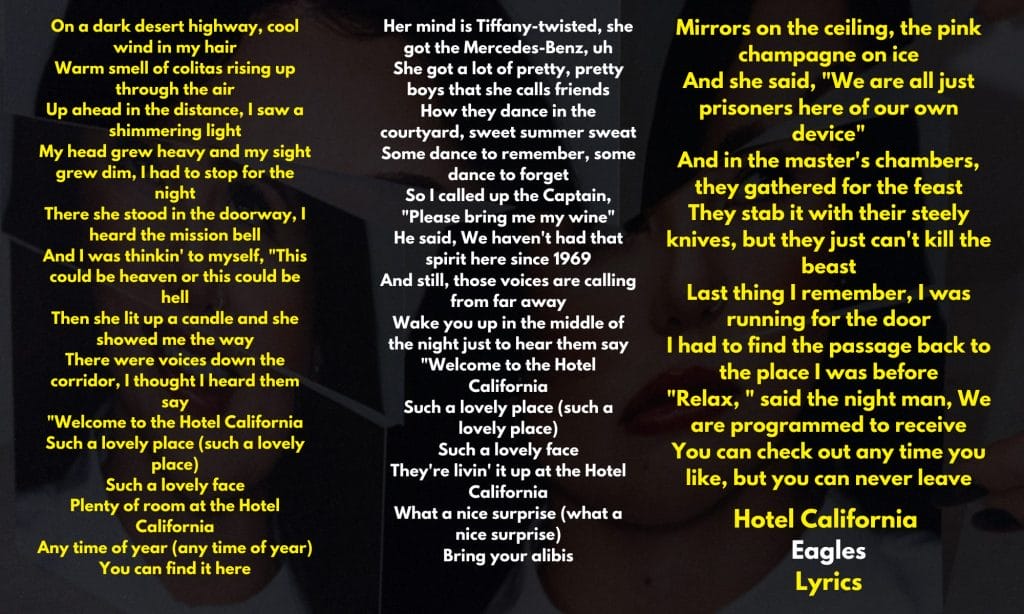
The lyrics are replete with paradoxes, creating a dreamlike, almost hallucinatory atmosphere. The “lovely place” with “plenty of room at the Hotel California” soon turns into a place “you can never leave.” The “warm smell of colitas” and the “pink champagne on ice” initially suggest hedonistic pleasure and opulent lifestyle, akin to the lavish offerings of a five-star resort. Yet, this indulgence is tinged with a unsettling quality, an artificiality that foreshadows the darker truths beneath the surface. The characters encountered within the hotel, from the enigmatic “mystery man” to the “spirited” but ultimately trapped inhabitants, further blur the lines between reality and illusion.
The song’s narrative structure, with its clear beginning, middle, and a seemingly inescapable end, mirrors a traveler’s journey that takes an unexpected, sinister turn. It’s a cautionary tale wrapped in a catchy melody, exploring the pursuit of an idyllic destination that transforms into a gilded cage. This narrative resonates with anyone who has ever pursued a dream, only to find its reality far more complex or even unsettling than anticipated. It taps into the universal human experience of seeking paradise, whether it be a vacation destination, a career goal, or a particular way of life, and confronting the often-unseen costs.
The Enduring Power of Ambiguity
Perhaps the most significant reason for the song’s lasting impact is its deliberate ambiguity. Don Henley himself has stated that the song is an allegory for the hedonism and self-destruction of the late 1970s, particularly in Los Angeles and the wider California scene. However, he also emphasized that its meaning is open to individual interpretation. This open-endedness has allowed “Hotel California” to adapt and remain relevant across different eras and cultural contexts. It’s not a didactic song with a single message but a canvas onto which listeners can project their own understanding of excess, spiritual emptiness, or the darker side of paradise.
The allure of the unknown, the tantalizing hint of a deeper meaning, transforms the song from mere entertainment into an intellectual and emotional experience. Like a cryptic ancient map, it promises a hidden treasure, but leaves the deciphering to the adventurer. This makes it a timeless piece of art, much like certain iconic landmarks or enigmatic historical sites that continue to draw visitors seeking to unravel their secrets.
Unpacking the Lyrical Landscape: Interpretations and Allegories
While the Eagles have offered some insights into the song’s origins, its power lies in its multiple layers of meaning. These interpretations often draw from the socio-cultural landscape of California in the 1970s, a hub of dreams, excess, and a burgeoning spiritual counter-culture.
The American Dream Gone Awry: Excess and Materialism
One of the most prevalent interpretations views the Hotel California as a metaphor for the dark underbelly of the American Dream, particularly as it manifested in places like Los Angeles and Hollywood. The golden promise of California as a land of opportunity, sunshine, and celebrity often came with the hidden costs of materialism, superficiality, and moral decay. The “pink champagne on ice,” the “customized Mercedes,” and the lavish amenities symbolize the superficial allure of wealth and fame.
However, beneath this glittering facade lies a sense of spiritual emptiness. The “mirrors on the ceiling” and the “pink champagne on ice” represent a decadent lifestyle that ultimately leaves one trapped and unfulfilled. The line “We haven’t had that spirit here since nineteen sixty nine” is often seen as a lament for a lost innocence, a bygone era of idealism that gave way to cynicism and hedonism. This interpretation particularly resonates with the themes of tourism and travel gone wrong—the dream destination that doesn’t live up to its promise, or worse, consumes those who seek its delights. It speaks to the idea that some places, despite their outward appeal, can be inherently damaging to one’s well-being.
A Metaphor for Addiction and Self-Destruction
Another powerful interpretation sees the Hotel California as an allegory for addiction—whether to drugs, alcohol, or even a destructive lifestyle. The phrase “you can check out any time you like, but you can never leave” perfectly encapsulates the insidious nature of addiction. The initial thrill and pleasure associated with indulgence (“warm smell of colitas,” “pink champagne”) gradually give way to a desperate struggle for freedom.
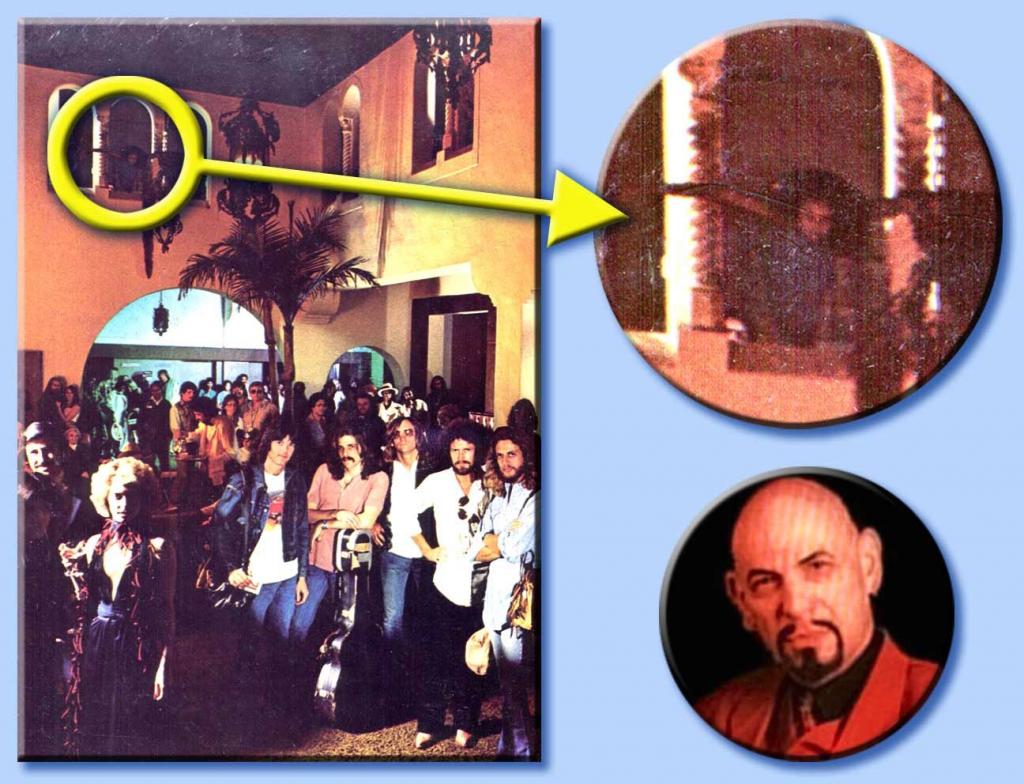
The “beast” in the master’s chamber, which the residents are “programmed to receive,” could be interpreted as the cravings or the destructive habits that ultimately control them. The endless loop of self-destruction, the inability to escape the grip of a vice, is a chilling parallel to the song’s narrative. This perspective adds a layer of psychological depth, turning the hotel into a symbolic representation of the traps we build for ourselves through harmful choices, a concept that transcends geographical boundaries and resonates universally. It’s a cautionary tale about the perils of unchecked indulgence, a theme relevant to many discussions around personal well-being and responsible travel choices.
The Traps of the Music Industry and Fame
Given the Eagles’ own experiences, many interpret the song as a commentary on the cutthroat nature of the music industry and the price of fame. The hotel itself could symbolize the record industry or the celebrity machine—a place that promises glamour and success but ultimately consumes its inhabitants. Artists are drawn in by the allure of stardom (“such a lovely place, such a lovely face”) but find themselves trapped by contracts, expectations, and the relentless demands of public life.
The lines “We are all just prisoners here, of our own device” can be seen as reflecting the lack of control artists often feel once they achieve mega-stardom. The industry, like the hotel, offers incredible amenities and a lavish lifestyle, but at the cost of personal freedom and sometimes, sanity. The “master’s chamber” might represent the powerful executives or the overwhelming forces that dictate an artist’s career. This interpretation sheds light on the darker side of glamorous professions and reminds us that behind every shiny façade, there can be immense pressure and hidden struggles, a stark contrast to the carefree image often projected by luxury travel and celebrity culture.
A Journey Through the Spiritual Underworld
A more esoteric interpretation posits the Hotel California as a metaphor for a spiritual trap, an allegory for purgatory, hell, or a cult. The “mission bell” that calls from afar, traditionally a symbol of salvation or spiritual guidance, here leads to a place of no escape. The “priestess” or “mistress” figure, the mysterious woman who guides the traveler, could be a siren luring souls to damnation.
The “cannibalism” mentioned (though disputed, some lyrics versions say “captains call,” Henley clarified “colitas”) and the idea of being “programmed to receive” contribute to a sinister, almost cult-like atmosphere. The idea of souls being trapped, forever reenacting a cycle of indulgence and despair, resonates with classical notions of the underworld. This interpretation is particularly potent when considering the spiritual movements and cults that emerged in California during the late 60s and 70s, specifically around areas like the San Francisco Bay Area. The song, from this perspective, warns against false prophets and the seductive promises of ideologies that ultimately lead to spiritual bondage. It touches upon the deeper human quest for meaning and the dangers of losing oneself in the pursuit of an artificial paradise.
The Hotel California as a Cultural Landmark
Beyond its lyrical depth, “Hotel California” has become an undeniable fixture in popular culture, its title evoking specific imagery and emotions even for those unfamiliar with its deeper meanings. It is a song that has transcended its medium to become a cultural reference point.
Real-World Inspiration and Myth-Making
While there is no single physical Hotel California that directly inspired the song, the Eagles have spoken about the general atmosphere of luxury hotels and the decadent lifestyle they witnessed in Los Angeles, particularly in areas like Beverly Hills and along Sunset Boulevard. The album artwork itself features the historic Beverly Hills Hotel, further fueling the mystique and associating the song with a specific aesthetic of opulent, yet potentially superficial, Southern California luxury.
This blending of real-world inspiration with allegorical narrative contributes to the song’s myth-making quality. It’s a fictional place that feels entirely real, drawing upon collective anxieties and desires. Much like iconic physical landmarks become infused with stories and legends, the conceptual Hotel California has become a psychological landmark, a universal symbol for a place that is beautiful on the surface but holds a sinister secret. This resonates strongly with the themes of tourism and destination marketing, where the outward appearance often masks a more complex reality.
Its Place in Travel, Tourism, and Lifestyle Narratives
“Hotel California” deeply permeates narratives surrounding travel, tourism, and lifestyle. It serves as a subtle, often subconscious, warning about the potential pitfalls of seeking ultimate paradise or indulging too freely. When travelers visit glamorous destinations, particularly those synonymous with excess like Miami or Los Angeles, the spectral presence of the Hotel California can linger in the imagination. It encourages a deeper look beyond the brochures and perfect Instagram photos, questioning what lies beneath the polished surfaces of luxury accommodation and aspirational living.
The song subtly champions the idea of authenticity and mindfulness in one’s experiences. It suggests that true freedom and contentment are not found in lavish external environments if one is internally trapped. For those interested in budget travel versus luxury travel, the song poses a critical question: what is the true cost of opulence? Is it worth a potential loss of self? This makes “Hotel California” an inadvertent philosophical guide for navigating the promises and perils of modern lifestyle and tourism, urging a deeper consideration of choices and their consequences.
The Enduring Legacy of an Enigmatic Masterpiece
The legacy of “Hotel California” is multifaceted, extending far beyond its initial release. It secured the Eagles’ place in rock history, earning them a Grammy Award for Record of the Year and becoming a perennial classic rock radio staple. It is routinely listed among the greatest songs of all time by publications like Rolling Stone and consistently ranks high in various polls and countdowns. Its iconic guitar solo is often cited as one of the best in rock history, a testament to its musical craftsmanship.
However, its deepest legacy lies in its capacity to provoke thought and stimulate discussion. For nearly five decades, listeners have debated its meaning, sharing personal interpretations and connecting its narrative to their own lives and observations of society. The song has become a cultural touchstone, a shorthand for places that are deceptively alluring, situations that are hard to escape, or the seductive but destructive pursuit of pleasure. It’s a testament to the power of art to reflect, critique, and ultimately shape our understanding of the world.
In conclusion, “What Is The Meaning Of Hotel California?” is not a question with a single, definitive answer. It is, by design, a song of many meanings—a critique of the American Dream and the excess of California in the 70s, a metaphor for addiction, a cautionary tale about the music industry, and potentially a spiritual allegory. Its genius lies in its ability to be all these things at once, allowing each listener to find their own truth within its haunting lyrics and intricate melodies. Like a truly great destination, it invites exploration, reveals layers, and leaves an indelible mark, ensuring its place as one of the most intriguing and timeless pieces of music ever created. The Hotel California may be a place you can never truly leave, but its meaning is a journey we can embark upon endlessly.
LifeOutOfTheBox is a participant in the Amazon Services LLC Associates Program, an affiliate advertising program designed to provide a means for sites to earn advertising fees by advertising and linking to Amazon.com. Amazon, the Amazon logo, AmazonSupply, and the AmazonSupply logo are trademarks of Amazon.com, Inc. or its affiliates. As an Amazon Associate we earn affiliate commissions from qualifying purchases.